Signs of spring update: bees and butterflies
Post categories: The Curious Owl
 |14:22 UK time, Thursday, 10 March 2011
Spring moves quickly. It only seems like yesterday that the snowdrops were peeping up. The daffs have long since arrived. Now it's time for the bumblebees and the butterflies.
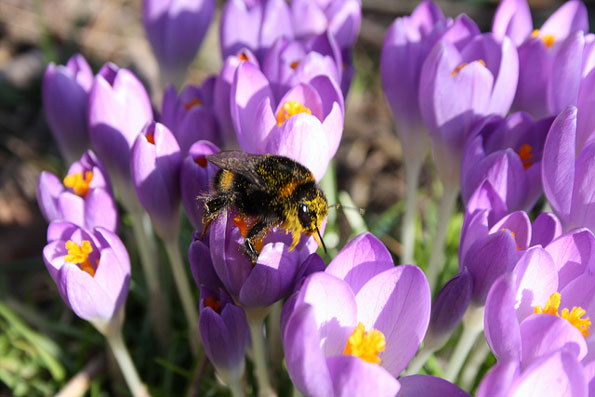
For me, the first sight of a bumblebee or butterfly is a spring rite of passage. There are few more poignant giveaways that the season has changed than seeing these fragile, flower-loving creatures out and about. From the amount of sightings we've had from you, it seems most of you feel the same way.
Bees
As samy1e rightly points out, the bumblebees around at the moment are likely to be Bombus terrestris. The buff-tailed bumblebee queen, the largest UK species, is usually the first bee to emerge, often at the end of February. Though one eagle-eyed member of our photo group spotted one on 12 February and Springwatch producer Richard Taylor-Jones caught one a whole month earlier in Deal, Kent.
The geographical split and date of our other sightings - from the Avon Wildlife Trust, Gwent, east and west London, Buckinghamshire, Stockport and Humbie in Scotland (pictured rather beautifully above) all from the last week - suggest Bombus terrestri is well on the way to finishing its hibernation. The other queen bee possibly out and about at the moment is Bombus lucorum, the white-tailed bumblebee. If you're interested, Bumblebee.org have a lovely guide on how to tell the two species apart.
Butterflies
Onto the butterflies. Autumnwatch contributor Ed Drewitt spotted a red admiral right here in Bristol on Sunday. Over on the Springwatch photo group Ian Boyd took this photo of his first tortoiseshell of the year on the Isle of Wight last week. Jim Bennett also saw the same species at a similar time, but much further north. Also in the north-west, Dan Mitten was lucky enough to have a brace of tortoiseshells in his garden.
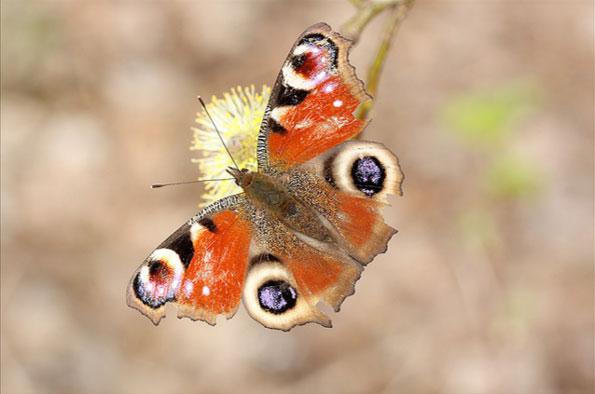
Martin Goodey spotted his first painted lady on 5 March. "Not pristine but not tatty either," he says. "These late winter/early spring migrants are thought to be a race from North Africa rather than the near continent. They've been reported in Cornwall since the 20th February."
Child of Herne saw a painted lady at Selsey Bill in early February a few years ago. "I told the butterfly group and was informed that occasionally you get early migrants from North Africa," he says.
Other species - small tortoiseshells, commas, peacock, brimstone and some red admirals as adults - don't migrate. Instead the adults hibernate here over the winter. Sussex Wildlife Trust has some excellent advice on how you can help them shelter over the cold months.
Thinking about overwintering butterflies inevitably raises the issue of climate change. Butterfly Conservation reports that the January mild spell brought all five overwintering species out of hibernation. While this isn't proof of anything in itself, there is evidence that warmer winters are starting to affect butterflies. Butterfly Conservation has found that "red admirals in particular are now surviving our winters in increasing numbers in the far south."
Oil beetles
A less iconic insect but in its own way as fascinating as the butterfly or the bee is the oil beetle. It begins its life in an egg laid close to a bee nest. After hatching, the larva climbs up a flower and then hitches a lift on a bee's back to the bee nest. Here it will spend the rest of its life feasting on pollen and bee eggs. Nice.
But it needs help. It's thought - though not known for sure - that five out of nine oil beetle species have been lost in this country. So if you want to help gather more info, from 25 March Buglife is running an oil beetle survey. Register on its website and get an ID guide. This time last week it had three records which is possible evidence of an early spring, according to Buglife's Andrew Whitehouse.
Adders
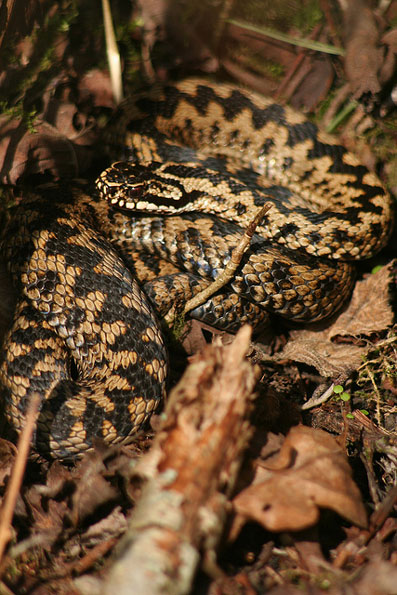
The adder is another critter in big trouble in the UK. So it's always good to hear of sightings. Stephen Duffy saw his first of the year at Chobham Common in Surrey at the end of February, then another a week later around the corner. Mike McCarthy took an intimate photo (below) of one on 3 March in Aberkenfig in Wales.
Birds
No update about spring would be complete without news of the birds. Hot off the press from Paul Stancliffe at the BTO is that the light southerly winds during the early part of this week brought with them some summer migrants. So far there's been 16 wheatears (mostly on the south coast although one was in Glamorgan), 24 sand martins (all in the southern part of the country) and swallows in Cornwall and Somerset.
Also, the first hoopoe of the spring was seen on Cornwall on Monday and yesterday a little ringed plover arrived at Beddington Sewage Farm, London.
Paul's guess is the strong westerlies we have right now will stop any more migrants arriving at least for the next couple of days. The winds are due to turn southerly on Saturday and become lighter on Sunday morning. So if you're on the lookout for more avian tourists, Sunday morning might well be the time.
Blue and great tits should be starting to nest right now. That is exactly what's happening in at least four nest boxes in George Cunningham's Liverpool garden. Though poor Pippa Roberts in south Lincolnshire hasn't seen any blue tits in her garden for months.
If you've seen any nesting (or indeed any other spring signs) then please let Nature's Calendar know: so far this year it's had only 14 reports compared to 75 this time last year.
Keep us posted
How has spring been for you so far? Is it different this year - are you seeing more or less of any usual signs? Is it coming later or earlier for you?
Post a comment right here and let us know. Or if you're on Twitter like us, tweet with the hashtag #ukspring and also see what other people are experiencing. There's a great discussion over on our Springwatch photo group on this very subject. If you have photos, please post them there.

Comment number 1.
At 21:02 10th Mar 2011, pollyphillips wrote:What a topsy turvey year for us so far. Usually our garden in NW London has bumblebees by now, esp buff-tail queens banging into the windows, and others feeding on winter-flowering Lonicera, but NOTHING so far, but curiously more honey bees in a recent mild spell than we have seen for years. And lots of frog spawn since the end of February, much earlier than usual, again during the recent mild spell. Daffs late this year, our first appearing this week.
Complain about this comment (Comment number 1)
Comment number 2.
At 14:18 12th Mar 2011, Tina wrote:I saw my first butterfly of the year today, it was a brimstone yellow.
Complain about this comment (Comment number 2)
Comment number 3.
At 14:47 12th Mar 2011, rubydoo wrote:I was up North in Fort Augustus last weekend visiting my relatives and got woken on Sunday morning by a Cuckoo I couldn't believe it!! I haven,t heard one since I left my Home on the Isle Of Mull 30 odd years ago, It was lovely.
Complain about this comment (Comment number 3)
Comment number 4.
At 14:51 12th Mar 2011, rubydoo wrote:Oh! and I forgot to mention that my brother in law has a small Rare Breeds Farm in Fort Augustus and one of there sheep had just given birth to three beautiful Lambs on the Friday.
Complain about this comment (Comment number 4)
Comment number 5.
At 21:29 12th Mar 2011, rimo wrote:Just as a quick note, the bumble is Bombus terrestris, not B. terrestri!
Complain about this comment (Comment number 5)
Comment number 6.
At 13:06 14th Mar 2011, jeztorrance wrote:@rimo - good spot. I'll change that right now.
Complain about this comment (Comment number 6)
Comment number 7.
At 09:19 15th Mar 2011, Angie Silver wrote:Saw my first bumble bee yesterday, ambling along in the garden.
Then dove into a hole in the ground, which I assume is his nest - and then looked up only to be serenaded next to my ear by two other bumble bees. So pleased as well that new bird feeders are finally being used, this morning an abundance of visitors, green finches, blue tits, great tits, chaffinches - awesome.
Complain about this comment (Comment number 7)
Comment number 8.
At 15:48 18th Mar 2011, Paulipocket wrote:A lone heron was spotted today in Bigham Pond, Great Western Road, Glasgow. Is it usual for a heron to be near a busy dual carriage way, in Scotland and on its own?
Complain about this comment (Comment number 8)
Comment number 9.
At 21:46 19th Mar 2011, Cannneil wrote:Hundreds of ladybirds spotted in hedges in cannington nr bridgwater, also lots of buttercups and a couple of painted lady butterflies
Complain about this comment (Comment number 9)
Comment number 10.
At 15:39 21st Mar 2011, buster_boy wrote:I saw a wheatear on the heath near Beaulieu in the New Forest last Sunday (13th March). I assume it was a new arrival heading further north to the upland moors where they tend to breed.
A number of Curlew were calling on the same spot this weekend (20th) as well.
No swallows or cuckoos yet, but I think it's only a matter of days...
Complain about this comment (Comment number 10)
Comment number 11.
At 18:38 21st Mar 2011, Sayer11 wrote:Is there another bird that sings like a nightingale? We have just been treated to wonderful birdsong in our garden in north Derbyshire by a mid to light brown, mid-sized bird sitting atop a pine tree. It seems too early and too far north to be a nightingale.
Complain about this comment (Comment number 11)
Comment number 12.
At 11:02 23rd Mar 2011, philbirdab31 wrote:I have two Peacock butterflies in the garden here in the Aberdeen area.
I the past week have already seen a worker bee and of course the larger bumble bee
Complain about this comment (Comment number 12)
Comment number 13.
At 20:16 24th Mar 2011, Neil Muiresk wrote:I saw my first Bumblebee and first Ladybird of the year today in North East Scotland
Complain about this comment (Comment number 13)
Comment number 14.
At 13:29 26th Mar 2011, Benjy-Kite10flyer wrote:Brimstone butterfly seen on 05/3/2011!! in my garden
Complain about this comment (Comment number 14)
Comment number 15.
At 13:29 26th Mar 2011, Benjy-Kite10flyer wrote:(Norfolk)
Complain about this comment (Comment number 15)
Comment number 16.
At 18:57 26th Mar 2011, onlymeandyd wrote:Swallows sighted :-)
I was at Chew Valley Lake (Bath & North East Somerset) on Herriotts Bridge today (26/03/2011) and saw 4 Swallows :-)
Complain about this comment (Comment number 16)