Birds in buildings
Post categories: The Curious Owl
 |12:27 UK time, Monday, 14 March 2011
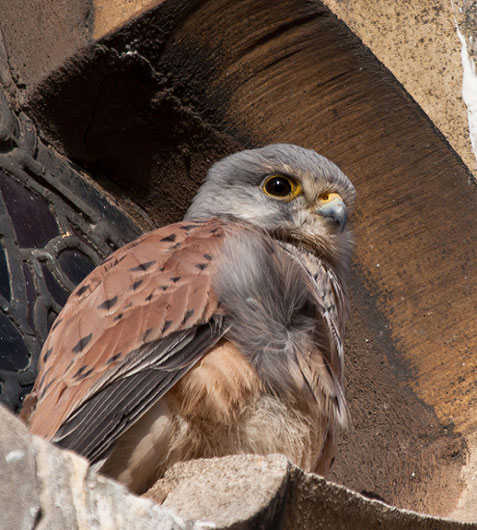
It’s nesting season but not all of our birds are busy building. The only bird of prey still in decline in the UK, the kestrel doesn’t build its own nest. Instead it will take over old nests from other birds or use suitable sites in trees, on cliff edges or even in man-made structures.
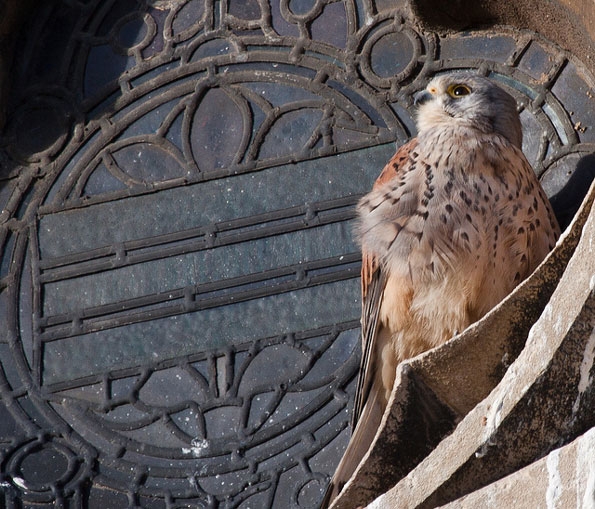
Last summer the demolition of a Hampshire power station was halted to protect the kestrels nesting there. In 2008 St Fergus gas terminal in Scotland suffered delays in their £350 million revamp as a pair made their nest in a 150ft chimney stack.
Aston University in Birmingham have been delighted by the return of a male and female who have used their nest site as a roost through the winter. Check them out on their kestrel cam.
We’ve even heard a rumour of a mating pair of kestrels in Dover Castle.
And they’re not the only birds that have adapted so well to man-made environments. There’s another bird of prey notorious for nesting in buildings. Much like kestrels, peregrine falcons don’t go in for construction. They prefer to nest on cliff edges or building roofs.
Just last month a pair of peregrines were discovered in Hadlow Tower, a Grade 1 listed building due to undergo a £4 million restoration which may now be delayed.
Norwich Cathedral is host to a mating pair. The authorities there hope the pair will be performing for their webcams again this breeding season. Together with the Hawk and Owl Trust, they installed a nest platform for the birds after they showed interest in the historic building.
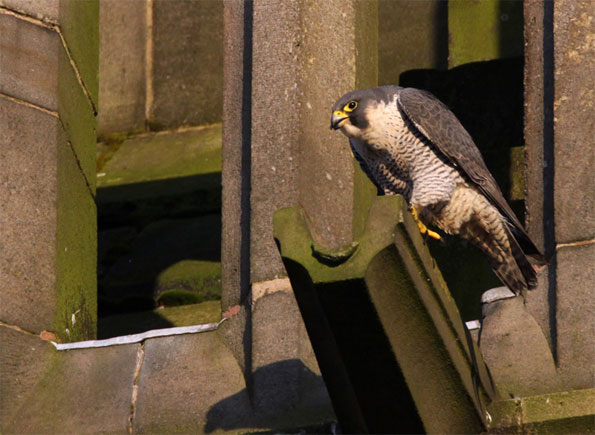
Another pair can be found at St Andrews Spire in Worcester, where there’s five webcams to keep an eye on the nesting boxes. The church has also recently had a visit from a kestrel. Follow all their latest activity on their Facebook page.
And it’s not just birds of prey that use our buildings.
The 62% decline in house sparrows over the last 25 years is thought to be in part due to the lack of suitable nest sites. In particular the lack of old-style eaves in modern housing and the reduction of hedgerows are effectively destroying the areas that these gregarious communal nesters prefer to live in. (There are ways you can help house sparrows though.)
With birds being so great at adapting to urban environments it’s easy to forget the problems that arise when they do. It’s clear that where buildings are protected, there’s a delicate balance that must be found between protecting the birds and protecting historical structures.
But it’s not just restoration that threatens the animals. Birds nesting in buildings are vulnerable to disturbance from maintenance works. There’s always the risk that a spooked parent may not return to a nest. High-rise fledglings must also negotiate the hard surfaces of the concrete jungle as they learn to use their wings and tails for directional flight.
If you’re concerned about birds in your building please check out the RSPB’s “What’s in the roof?!” advice and be aware that all birds and their nests and eggs are protected by the Wildlife & Countryside Act 1981.
Have you got birds nesting in your office block or how about under the eaves of your roof? We’d love to hear about it. Let us know by commenting below or post a photo on the Springwatch photo group.

Comment number 1.
At 11:03 15th Mar 2011, Rose Molyneux wrote:We have several sparrow families nesting under the eaves of our roof above the windows , they seem to roost there all year round aswell. At the moment they are flying back and forth with nest material!
Complain about this comment (Comment number 1)
Comment number 2.
At 14:55 17th Mar 2011, Angie Silver wrote:I haven't sadly had any sparrows in the garden for months - which is a real shame - and speaking to neighbours and other people in our area neither do they
Complain about this comment (Comment number 2)
Comment number 3.
At 13:18 18th Mar 2011, Sue wrote:Last year we had starlings trying to nest in an airbrick in the back bedroom wall, they squeezed in through a tiny gap in the brickwork by the window. Not sure if they were successful as I think a magpie got the eggs as I found a broken shell below the window & the birds seemed to leave. Today I have just spent the morning trying to get a bird out of the cavity wall in the kitchen. I thought it was a starling again from the noise as it pottered about & tapped from inside the wall. I removed an airgrill from the wall, opened the back door & shone a torch into the cavity to attract it's attention, I don't know who was more surprised - me or the tiny little bluetit who popped out! It flew out of the door none the worse for it's experience but I hope it doesn't come back to have another go at nesting there!
Complain about this comment (Comment number 3)
Comment number 4.
At 16:07 18th Mar 2011, Child of Herne wrote:Many Cathedrals now have nesting Peregrines and some set up cameras to show them to visitors. A good example is Chichester Cathedral where they have bred for several years and the RSPB set up a camera linked to a screen in the vestry so that visitors can watch them without disturbance. The male often perches on various pinnacles of the building giving good scope views from the grounds. Another regular site is the Tate Modern, on top of the chimney, although last year this pair seemed to have moved to another site, posssibly the houses of Parliament.
Complain about this comment (Comment number 4)
Comment number 5.
At 13:27 26th Mar 2011, Benjy-Kite10flyer wrote:We now have a pair of Peregrines on Norwich Cathedral!!! Platform put up by Hawk & Owl Trust. I'm recording them currently and we are hoping for some breeding soon.
Videos are up on Youtube of their activities!
Complain about this comment (Comment number 5)
Comment number 6.
At 11:54 29th Mar 2011, Lewiskimo wrote:The last few years at work we have had Kestrels nesting in an open pipe at the end of one of our buildings. Last year they produced five youngsters and I am pleased to say they are back again this year.
We also had a female Peregrine hanging around the same building and I even saw the female kestrel attack the Peregrine, which was perched on the top of a tall building, one evening just as she had left her young. Watching them spiralling down the side of the building was an amazing sight.
Well this year the Peregrine is back and has brought a mate with her. The local gull population is not too happy about it but I am keeping my fingers crossed for them setting up a scrape.
Complain about this comment (Comment number 6)
Comment number 7.
At 10:40 31st Mar 2011, Sam Unsprung Researcher wrote:Wow what wondeful stories everyone.
We've got a long tailed tit nesting in a bush right outside an office window here at BBC Bristol. We're all very jealous of the chap with the best view!
Sam :)
Complain about this comment (Comment number 7)