The Curious Owl: A sideways look at British wildlife
Post categories: The Curious Owl
 |21:15 UK time, Thursday, 9 December 2010
We're trying out a new idea on this blog. It's a sideways look at British wildlife. I'll be looking out for quirky and unusual stories, gossip, photos, myths and anything else that wouldn't get reported by the mainstream press.
Being based in the BBC's Natural History Unit gives me a headstart. In amongst the epic, the hard science and the conservation stories there's always the odd bit of throwaway trivia that won't make it onto a programme (well, maybe Unsprung). That's exactly the kind of thing I'm looking for here.
There's also our long list of very helpful, very expert friends (the BTO, the Wildlife Trusts, the RSPB, the National Trust etc) who are always keen to pass on any news.
But the best source will, I hope, be you. Judging from all the stories on Martin Hughes-Games' Autumnwatch Unsprung blog post, on Twitter and on the messageboard and all the stunning seasonal wildlife photos on the Autumnwatch and the recently started Winterwatch (2,000 photos and counting) Flickr groups, it's clear you've got plenty to share.
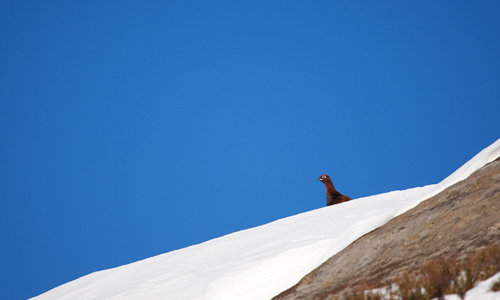
The photo from Mike Batty above is a case in point. Nothing too rare about a grouse but have you ever seen one from this viewpoint?
So when you're out on a walk, reading the newspaper, chatting to your friends in the pub, on Twitter or Facebook, or taking some wildlife photos look and listen out for anything out of the ordinary, downright crazy or that makes your blood boil and let me know. Post a comment here, tweet me or add a picture to the photo group. Look out for a few devilishly hard challenges coming soon too.

Comment number 1.
At 21:56 13th Dec 2010, Norman wrote:We have a bungalow on the Isle of Arran and our garden goes down to the beach. The other day I was sitting in the lounge reading and looking out the window, when I noticed a movement at the bottom of the back garden. It was an otter, strollng up our garden from the beach. I shouted for my wife to come, and we both saw the otter come right up to the full length windows, put it's snout up against the glass and peer in. It was about four foot from me! It then disappeared towards the front of the house as I believe the holt is about 400 metres away. No camera ready! Two hours later it returned and my wife managed to get a rear view as it disappeared back down to the shore.
Is it unusual for otters to do this?
Complain about this comment (Comment number 1)
Comment number 2.
At 12:07 14th Dec 2010, jeztorrance wrote:Hi Normanhilton, what a lovely story and how lucky you are!
Generally, we're seeing more and more otters during the day in the UK. It's something we looked at during Springwatch and Chris Packham wrote a post on the blog about his personal experiences.
But, despite this, to have an otter come this close is really rather rare.
Complain about this comment (Comment number 2)
Comment number 3.
At 22:23 14th Dec 2010, Lise wrote:I could post loads of things on this blog but will refrain from doing so. Instead I am going comment on something I know little about; the Common Earwig. I thought I’d post something about Earwigs as they never seem to make it into mainstream discussions and seem to have a stigma around them. Once when I was traveling and in need of some reading material, I picked up a second hand book that had been written by an Englishman who had been in the forces during the first part of the 20th century. The book gives accounts of his experiences around the world and there are a couple of chapters that talk about the creatures he saw and befriended in the various camps. In one chapter he talked rather affectionately about ‘the much despised and, for some unknown reason, feared earwig’, a subject matter that the ‘late King Boris of Bulgaria’ was also passionate about. He goes on to elaborate about the maternal skills of the female Earwig and states that once the brood has hatched she will often march them in two rows, in the manner of soldiers, signaling them with her antennae, left, right and forward. This image always stayed with me and is somewhat kinder than most of the things I saw on the web when I googled them tonight. “How do you kill Earwigs? Is it true Earwigs crawl into your ears when you are sleeping and eat your brain? I have noticed that there are no toads in my garden and I believe this is as a result of having lots of Earwigs in the garden - an imbalance. Earwigs are eating all my plants in the garden.” I personally can’t remember the last time I saw a live Earwig (I think it was actually over 20 years ago!) and apart from the author mentioned above, I have never heard anyone say anything positive about them. I think it would be good to start a positive thinking campaign about the misunderstood creatures that many people seem despise.
Complain about this comment (Comment number 3)
Comment number 4.
At 12:07 15th Dec 2010, jeztorrance wrote:@Lise, what a great idea. Exactly the kind of thing we're looking for.
Complain about this comment (Comment number 4)
Comment number 5.
At 21:18 18th Dec 2010, Cath wrote:I've always wondered about the old wives tales about the weather and nature - like cows lying down and swallows flying low when it's going to rain. How reliable are they?
Complain about this comment (Comment number 5)
Comment number 6.
At 14:15 20th Jan 2011, jeztorrance wrote:@Cath, another cracker. We wrote an article about summer folklore but it would be interesting to expand this.
Complain about this comment (Comment number 6)
Comment number 7.
At 19:13 24th Jan 2011, peter wrote:Collared doves.
Last year a pair of Collared Doves nested on the front of my house on my
satellite dish. they produced 8 broods totalling 10 chicks through to
October. They have been around in my garden all year. Rebuilding the nest
just after christmas and have been sitting in it since the beginning of this year. Yesterday Sunday 23th January, both doves were in my garden. Being the nest is just outside my bedroom window I looked and found at least one healty chick in the nest about week old.
Seems early in the year for a new life is it?
Is this unusual?
Wonder how many chicks I will get this year!
Complain about this comment (Comment number 7)