Curious Owl challenge: Photos of birds in unusual places
Post categories: The Curious Owl
 |17:16 UK time, Friday, 10 December 2010
A couple of recent news stories got me thinking about the first challenge from the Curious Owl. First up was the news that an illustrated guide to birds is the most expensive book in the world. Audubon's Birds of America, written in the 1830s, recently sold at auction for an eye-popping £6.5m. (So next time you're out twitching, grab a pencil and a pad... you never know!)
The other story was that BirdLife International has launched a competition asking for photographs of the world’s rarest birds. The best pictures will be used to illustrate the book The World’s Rarest Birds. If you’re interested, you can see lists of the rarest birds here and here.
It’s clear that bird pictures are pretty hot stuff.
My initial thought then was to issue a challenge to photograph Britain’s rarest birds. A quick call to the BTO and, rather embarrassingly, it became clear that idea was a complete non-starter. The very precarious position these animals find themselves in doesn’t exactly lend itself to having people clumping around taking pictures of them.
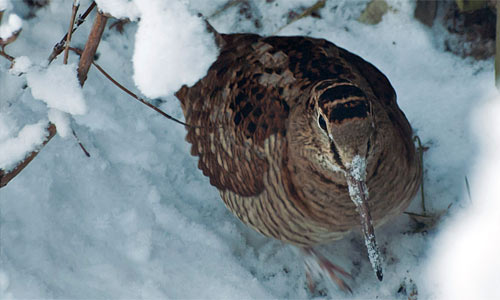
So rather than sightings of rare birds, the challenge is to photograph rare sightings of birds, or put another way, birds in places you wouldn’t expect to see them. A pigeon on top of Ben Nevis, terns in the middle of London, sparrowhawks in shopping precincts, blackbirds on a beach, or, like Phil Benton’s photo above, a woodcock in a back garden.
I'll review what pictures you’ve sent in so far next Friday (17 December), but I’d like to keep it going over the festive period. So keep your eyes and cameras focused over the holidays when you’re out and about.
The final cut-off will be 4 January, when I’ll post the best on the blog. No prizes of course, just a bit of fun.
How to enter? Simply post a link to your photo in the comments below. You could always add it to the Winterwatch Flickr group too (if it’s taken in winter).
A word of warning though: some birds may be in a strange places because they’re in distress. If you think that’s the case, the RSPB's website has advice on what to do.
The Curious Owl, a sideways look at British nature.

Comment number 1.
At 12:47 12th Dec 2010, joffley wrote:Last May I snapped a Kestrel perched on Nelson's Column in Trafalgar Square, something I didn't expect to see!
https://www.flickr.com/photos/joffley/4624587865/
Complain about this comment (Comment number 1)
Comment number 2.
At 11:59 14th Dec 2010, caperblue wrote:A Hawk once decided to sit on the birdbath in my back garden and was completely unfazed - in fact, I think that it was posing - when I got my camera and took as many photos as i could - one of which had it looking straight at the lens! WOW!
Complain about this comment (Comment number 2)
Comment number 3.
At 14:58 14th Dec 2010, Steve Maskell wrote:A Hoopoe has been spotted on the outskirts of Bournemouth this week, certainly more than a little out of place and season I'd say! https://www.flickr.com/photos/creivale/5255006091
Complain about this comment (Comment number 3)
Comment number 4.
At 21:51 21st Dec 2010, windrush28 wrote:Im not sure if its a rare snap or unusual but i had to upload my recent picture. https://www.flickr.com/photos/57315084@N07/5281425548/
Complain about this comment (Comment number 4)
Comment number 5.
At 12:44 22nd Dec 2010, Child of Herne wrote:Re: Steve Maskells comment on Hoopoe in Bournemouth, This is not the first record of Hoopoe in Southern Britain in winter. About five years ago there was one in Gosport for at least two weeks in January. I went to twitch it at the same time as Ring billed Gull and Black Brant.
Complain about this comment (Comment number 5)
Comment number 6.
At 14:10 23rd Dec 2010, WinterPoppy wrote:I found a small grouping of red winged thrushes in my garded in the Forest of Dean, I know that these birds are supposed to be alot further north in Scotland, I wonder what has bought them down here. https://www.flickr.com/photos/57322519@N07/5285026761/in/photostream/
Complain about this comment (Comment number 6)
Comment number 7.
At 11:01 27th Dec 2010, rutlandredwings wrote:In all our 43 years at our home we have seen many different birds in the garden. However our latest Christmas visitor has been very welcome. The bird is the redwing. At first we thought it was a thrush but on further inspection we noticed the stripe on its head and the red flush by its wings. At any one time on the 22nd December we counted between 14 and 16 redwings in the apple tree feeding on apples left on top. This tree has always been the doimain of our resident blackbird. To day the numbers have decreased and we are only getting one or two at a time so far today.
Complain about this comment (Comment number 7)
Comment number 8.
At 06:25 28th Dec 2010, vernon wrote:Since we started feeding the birds we've attracted three that I've never seen before:
A coal tit
A bullfinch
A jay
Not bad for an urban garden.
Complain about this comment (Comment number 8)