Lloyd Buck: Our life with birds
Post categories: Autumnwatch Unsprung
 |16:48 UK time, Thursday, 25 November 2010
Guest blogger: Bird specialist Lloyd Buck is a favourite guest of Autumnwatch Unsprung. Lloyd and his wife Rose have been involved with over 100 different film and television productions and are considered the world's experts at in-flight and tracking filming with birds.
Well this is a first for me. The guys from Autumnwatch asked if I would be interested in writing a piece for the website about my life with birds... so here goes.
During the past year many of you may have seen me appear on Unsprung with some of the birds that my wife Rose and I look after. But what you might not realise is that our birds are in a number of film and television productions.
In order to see this content you need to have both Javascript enabled and Flash installed. Visit BBC Webwise for full instructions. If you're reading via RSS, you'll need to visit the blog to access this content.
I say 'look after' intead of 'own' because our view is that you never own any bird. In fact it's the opposite way round. You are there for them. So they own you and if you take that point of view you should always develop a good bond and trust level with any bird as it shows respect for them as individuals. We have whooper swans, falcons, owls, starlings, a raven, a crow, pigeons, eagles and a goshawk, so they certainly keep us busy!
Over the years, you might have seen spectacular natural history film sequences of various birds in flight, including epic journeys of migration, the wild footage being interspersed seamlessly with close-ups from within the migrating flock. This is what we specialise in.
In order to see this content you need to have both Javascript enabled and Flash installed. Visit BBC Webwise for full instructions. If you're reading via RSS, you'll need to visit the blog to access this content.
By building a very close bond with our birds we are able to train them to fly alongside us and the cameraman. Some of our birds are happy to carry tiny mini-cams that give the viewer that unique in-flight feel. This allows film-makers to make the story much more dynamic for the viewer, making you feel like you are wing tip to wing tip inside the migrating flock rather than a dot in the distance.
Capturing these close-up images not only allows us to explore the internal flock dynamics, it also gives us a bird's-eye view of the migration landscape.
To achieve this level of training with any bird takes many hours of time and dedication. Bird characters are as diverse as human and you must learn what they like and don’t like. Take our seven starlings, for example. Arnie is cheeky and very bold whilst his brother Spadge is much more reserved and quiet. But it's only by spending time in their company that you're able to learn this.
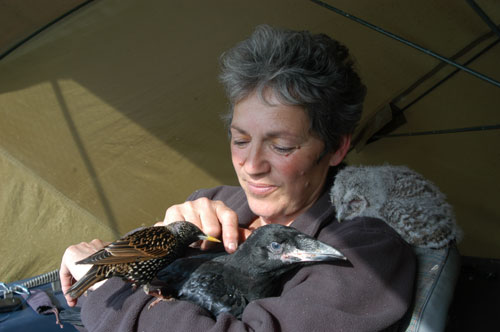
My wife Rose with Arnie, Johanna, the baby tawny owl, and Brann, the baby raven
Our birds are our business and our income but they are not just a way of making money. To us it’s a way of life. They're part of our family. The rewards are great. The feeling you get when you're with our female golden eagle, Tilly, in the Scottish Highlands is incredible.
I've watched her soar effortlessly on the wind before disappearing over the mountain tops for an hour or so then reappear on the horizon looking for me. The feeling I get when she stoops in from a thousand feet, flaring finally to land is something I cannot describe in words. I know - that at some point - she made the decision to come back. She has chosen to stay with us.
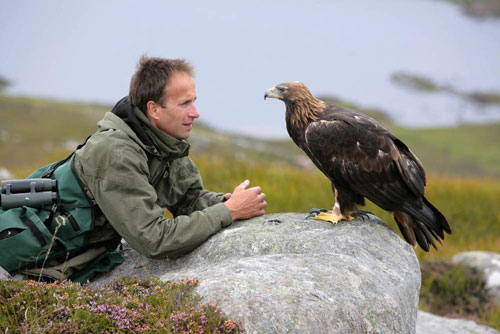
Me with Tilly in the mountains of Glenvagh national park in Ireland
Nearly all our family of birds were bred in captivity, the only exceptions being Simba, the carrion crow, who was a rescue bird and too tame to be re-released; and the starlings.
As everyone is always so enchanted by them, I see the birds as ambassadors for their wild counterparts. Most people cannot believe just how clever and beautiful they are. I never realised that so many people have a rather poor view of starlings, and we have already managed to change many people's view towards them.
They love classical music. In the evenings at home when they are in the lounge with us they love it if I play Schubert or Beethoven on the piano to them. And at the right time of year they all sing along!
I never stop learning either. On Monday while out flying Tilly, a wild flock of starlings (which easily contained a couple of thousand individuals) came and started feeding very close by. When Tilly took off to follow us she flew right by them. I expected them to fly up in alarm, as they would do in response to most raptors, but they took absolutely no notice of her.
I think this shows just how clever they are. They knew that a golden eagle is far too big and slow to be any danger to them. We sat and watched them feeding, with the birds at the back of the flock moving to the front, creating a wave of starlings, constantly advancing across the land. Amazing!
On the same evening at dusk, as we were cleaning out the starling aviary, a few goldfinches and tiny firecrests flew in to roost in a hazel tree right by us. They were only about 12 feet up and after flitting from branch to branch having a last feed for the day, they settled on the bare branches. You would never know they were there, perfectly camouflaged. It was one of those magical moments, when you get a close wild bird encounter. It can't be recreated in any other way... it is just brilliant.
Well, I hope I have given you a small insight into our life with birds. Bye for now.
Do you have a question for Lloyd about his work? Ever wondered whether birds sleep? Post your comments and questions below. Lloyd will be a guest on the last Unsprung of the series at 8.30pm, 25 November on BBC Two.

Comment number 1.
At 20:28 25th Nov 2010, EnglishFolkfan wrote:Thank you Lloyd for this lovely glimpse into the wonderful but so responsible job that you & Rose have chosen. It is a delight to see the Birds out in their element and with yourselves. Yes, I agree with Jeremy, you and the Birds are favourite visitors on the Watch programmes.
Complain about this comment (Comment number 1)
Comment number 2.
At 12:58 26th Nov 2010, Chimpling wrote:Thank you Lloyd. It has been wonderful seeing the Starlings and then last night the pigeon. I have a great affection for Starlings and love to watch them in the garden on the feeders. My partner actually makes them his own recipe cakes which they love, but then they seem to eat anything! It is amazing work that you and your wife do. We look forward to, hopefully, more visits on Springwatch. It was very interesting to read about the piano music, would it work for the garden Starlings I wonder?
Complain about this comment (Comment number 2)
Comment number 3.
At 16:50 1st Dec 2010, Lesley wrote:Many thanks for letting us see your lovely birds on AW. Starlings are wonderful - just a shame we don't get the numbers we used to around here (North London) up to 20 years ago - wonder where they all went. and why.
Complain about this comment (Comment number 3)
Comment number 4.
At 16:31 1st Aug 2011, KarineB wrote:Dear Rose and Lloyd, I'm a big fan of your work with birds and I'm so glad you are making more awarness, showing the beauty and intelligence of some of our birds.I'm very glad you have shown and changed people's thoughts about starlings and crows. I love my birds and wildlife,being active member of different wildlife group,ie badgers,league against cruel sports... I would like to follow a course about birds of prey,would love to be the carer or foster of birds(raven,crows,howls, birds of preys...)Any tips please?
Complain about this comment (Comment number 4)
Comment number 5.
At 21:15 21st Oct 2011, nick jepson wrote:I was very surprised this morning when I came face to beak with what I think was a Sparrowhawk. I went out because our chickens were making alarm calls, and this bird was in our garden, next to steps, so was at head hight when I git there. The hawk flew off and I then realised there was a very recently killed pigeon. Do sparrowhawks generally attack pigeons and do they usually land in a garden or was that an accident? I live in Polperro, Cornwall and our small garden is right in the middle of the village, surrounded with other houses (although a bit of a wildlife haven- various birds, squirells, toads, moles and much more!).
Complain about this comment (Comment number 5)