Migration news 18 November
Post categories: Migration news
 |20:54 UK time, Wednesday, 17 November 2010
Falling temperatures and an associated freezing of smaller waterbodies on the continent should see winter waterfowl featuring heavily in Britain over the next few days. Goldeneye numbers will start to build up and more smew should appear, both species possible to discover on gravel pits and larger park lakes anywhere in the country.
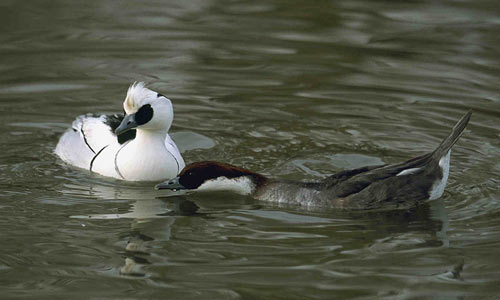
Male (left) and redhead smew (photo copyright Jill Pakenham/BTO)
The latter is wonderful bird with a fantastic name too: saying 'smew' a few times always raises a smile! So far this autumn there have only been about 20 records of this diminutive member of the sawbill family, so named for their serrated beaks which are used to grasp the fish they eat. Most of those that have arrived to date have been 'redheads' (females or immature males); adult males are a striking combination of white with black lines and patches and go by the nickname 'white nun'.
Another specialised waterbird, the long-tailed duck, has been seen at several inland locations recently. This species is a seaduck and typically spending the winter offshore around our coasts, particularly in northern and eastern Britain. Last week's strong winds may well account for the inland long-tailed duck sightings in Cambridgeshire, West Yorkshire, Lincolnshire, Norfolk, Hampshire and Cleveland in the past few days.
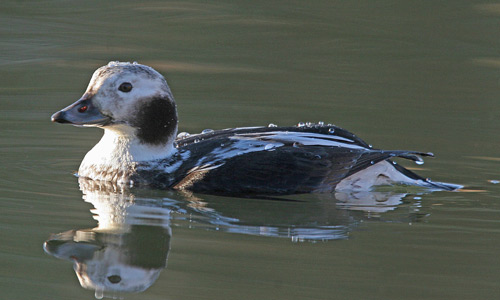
Long-tailed duck (photo copyright Ron Marshall/BTO)
Any short, sharp cold snap over the next few days should send more starlings our way from a cooling northern and eastern Europe. Blackbirds should start to increase in our gardens. So don't forget that at this time of year, the blackbird feeding in your garden could have travelled over 1,000km to get there, perhaps from as far away as eastern Europe, western Russian or Scandinavia.
Two swallows were seen moving south through Holme in Norfolk on Sunday, whilst another was seen in Dorset on the same day. There is an outside chance that a few could still be lingering in the country next week, but as temperatures drop they really will need to get a move on.
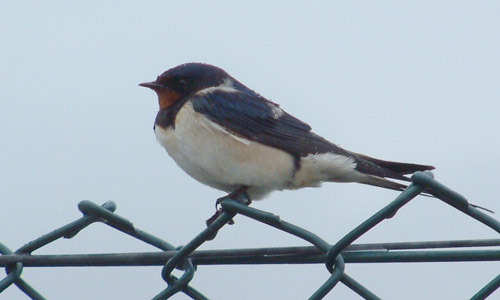
Swallow (photo copyright Stuart Newson/BTO)
Woodpigeons should continue to move; nearly 60,000 were seen passing over a site in Hampshire on Tuesday and 5,000 even reached the tiny island of Bryher in the Isles of Scilly earlier in the week.
Waxwings are still arriving and could now be seen anywhere in the country; we're pleased to say that they've finally turned up near BTO HQ in Thetford, Norfolk. There have been some fascinating movements of colour-ringed waxwings so don't forget to check any you see for 'bling', and please do add all sightings to BirdTrack so that they can be included in the Bird Atlas 2007-11! Waxwings remain very scarce in the south west, with 14 seen flying over Charterhouse in Somerset the only record since last week.
If temperatures drop dramatically and we begin to see widespread frosts, lapwings and golden plovers might be seen in large flocks overhead as they move south through the country.

Comment number 1.
At 23:35 18th Nov 2010, Snaz wrote:Nathusius pipistrelles migrate. I have had an unprecedented three female Nathusius pipistrelles into East Dorset Bat Rescue this Autumn after windy weather causing this rare bat to get into trouble. These bats were almost certainly migrating.
Complain about this comment (Comment number 1)
Comment number 2.
At 12:54 19th Nov 2010, jennifer wrote:We have two cygnets on our village pond in Leighterton Glos. Seems that they missed Slimbridge by a few miles while migrating in back there for the winter! Over the years we have had other birds land, notably a Barnacle Goose, which didn't bother to carry on to Slimbridge once it realised that they got fed and watered, and had the company of the ducks and Moor Hens. But will the two cygnets decide to stay, or will they rest up a bit and carry on to Slimbridge?
Complain about this comment (Comment number 2)
Comment number 3.
At 17:10 19th Nov 2010, BirdTrack Organiser wrote:Difficult to say, cyberbarn9.
If the cygnets are Whooper Swans, they should be with their parents as they migrate and spend the winter in family groups. This makes me wonder if they are perhaps locally-bred Mute Swans (which don't develop the distinctive orange beak until their second year)?
Complain about this comment (Comment number 3)
Comment number 4.
At 20:20 19th Nov 2010, Juli Okayama wrote:Yet to see any Waxwings just north of London. I live on the border between Hertfordshire and Greater London. Does anybody know a region nearby or around Herts or London where you can see these birds?
Thank You :)
Complain about this comment (Comment number 4)
Comment number 5.
At 10:30 22nd Nov 2010, BirdTrack Organiser wrote:I'm afraid you'll have to wait Juli Okayama; the only sightings in either Herts or Gtr London in the past 2 weeks have been a few one-off sightings of singletons and a flock of 38 that flew over Green Tye 7.11.10 but weren't seen again. As the northern berry crop is decimated and temperatures fall, more should appear in southern England though it may not be until the New Year.
Complain about this comment (Comment number 5)
Comment number 6.
At 00:09 21st Dec 2010, Juli Okayama wrote:Thank you. Still yet to see one, but positive I will.
Although this is probably impossible to answer, I was wondering which RSPB reserve is best if I were looking for a variety of bird species as well as number of birds; Rye Meads or Church Wood?
Much Appreciated, Juli
Complain about this comment (Comment number 6)