

The story of modern London retold
Thirty-eight years separate me and my youngest son.
I imagine that keeping both of us happy in an environment of high culture is going to be a tough order. That is the kind of pressure on modern museums to compete with the myriad of distractions available to Londoners.
That is the challenge facing the Museum of London as it opens the galleries closed since 2007.
The ethos of the new galleries, billed as "You are here", is that there is a slice of all our stories revealed in the exhibits.
The newly refurbished galleries of Modern London start the story just after the Great Fire in 1666 and come bang up to the modern day.
Visiting a modern museum of this quality is not the experience of the 1970s. Much has happened to transform this sector over the past 30 years.
For a start big museums are partnerships and rely on the generosity of foundations that want to be associated with dynamic organisations.
These galleries both as a public space and a permanent exhibition need to capture the zeitgeist. So what do we get for 20 million quid?
Starting with the architecture there is a lot more open space and at the heart of the galleries there will be a green garden space that is in the middle of being refurbished.
It reminded me of some clever outdoor features of American museums stuck in high rise blocks. As a consequence there is a lot more natural light coming into the exhibition space than I recall.
The exhibits themselves try to convey the pattern of living that has evolved for the inhabitants of London since the late 1600s.
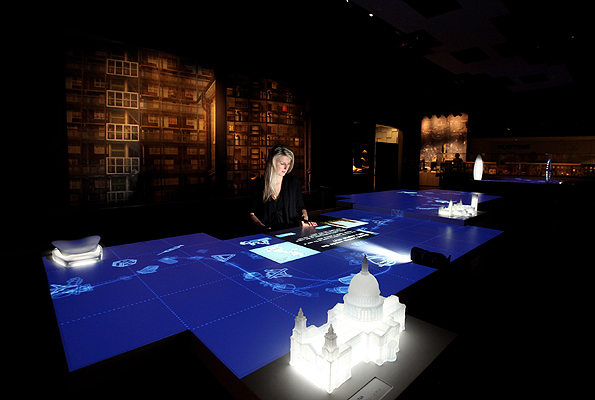
There are still some touchy feely bits like trying on hats or seeing a rats nest which my son was rather taken with. He was even more impressed with the interactive technology being used.
It works a bit like a touch screen application on an iPhone and as you peel away the layers more information is reveal, both audio and visual. The description from him was "so awesome".
Great care has been taken where possible to develop character narrative as you go through certain parts of the gallery.
For example a scallywag named Dick appeared in one interactive narrative and as a victim of justice in one of the more traditional displays of historical objects. In his case the judge's chair!
Modern day debt problems are put in context with a life-size recreation of a debtor's cell in Newgate prison. The really interesting feature is that the wooden walls and graffiti are original.
The Vauxhall Gardens, a popular 18th century pleasure spot are recreated in a sumptuous film and audio-visual experience of historical costumes. Much more engaging than rows of costumes on mannequins that used to be on offer.
Where these galleries really score though is with how they have enhanced the focus on 20th century changes.
A display of the suffragettes is thought provoking and at the far end of that corridor of the struggle for the female vote is a stark space of contemplation devoted to the struggle for survival.
The Blitz gallery has as its centrepiece a suspended German bomb. A film and audiovisual experience conveys eyewitness accounts of the trials and tribulations of living through wartime London.
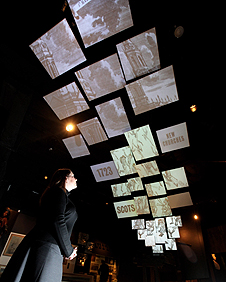
Actually this is one of the most emotive parts of the new galleries and its message of a "journey towards hope" may leave you needing tissues or a strong coffee!
If teachers can keep children quiet, they will really get a flavour of the terror their grandparents and great-grandparents lived through.
One of the most innovative parts of the new galleries comes as you complete your journey.
There on a "river of ideas", and using the same touch screen technology deployed elsewhere, visitors are invited to vote on the concerns of contemporary and future London. Co2 emissions, transport infrastructure, religious schools and a range of other topical issues.
This is designed to be a live exhibit. Voters get instant feedback on how their preferences fit in with those of all other visitors to the gallery.
The museum's management hope they can climb back up to the visitor levels of nearly half a million before these galleries closed for refurbishment four years ago.
It might not be very scientific but with a bit of work that's one giant living poll on attitudes to modern London's problems. It's potentially a means by which the curators can make this museum alive to change as well as capturing the story of our past.
And despite the 38 years separating us my son and I had an awful lot to talk about on the way home. Now that is clever.
The Museum of London reopens fully to the public on 28th May.

 I’m Kurt Barling, BBC London’s Special Correspondent. This is where I discuss some of the big topical issues which have an impact on Londoners' lives and share stories which remind us of our rich cultural heritage.
