

More local powers must mean more scrutiny too
An election looms. In fact if you live in London a couple of elections loom. As always, London seats will be key battlegrounds in the general election, but at the same time council chambers are also up for voter scrutiny.
With Parliament facing unprecedented, in recent times, criticism, local authorities are becoming ever more important in delivering open and accountable government.
Even if we are technically out of a recession, most economic forecasters expect the outlook to remain pretty turbulent for the first part of the next government's term.
In particular, public finances are in such a trough that some kind of limitation on public services seems inevitable. More for less is once again the watchword for local service providers.
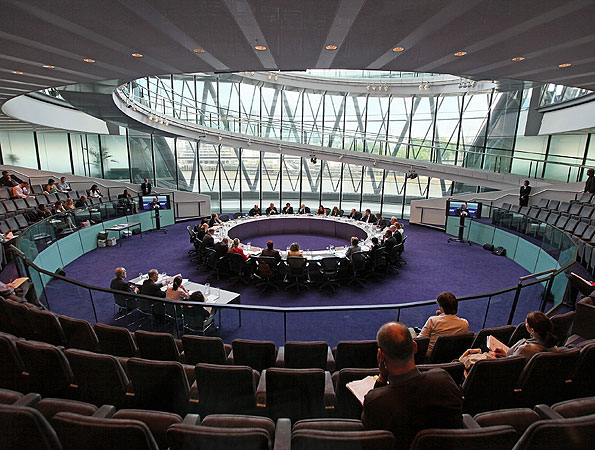
London Councils is the lobbying arm of local government in London. It represents all 32 London Boroughs and the City of London as well as the Metropolitan Police Authority and the London Fire and Emergency Planning Authority. It is an attempt to give London government a joined up feeling to central government.
Inevitably as a cross-party organisation it speaks to the general issues affecting Londoners rather than the specific solutions to these problems. It has produced a "Manifesto for Londoners" which it claims gives a template for a new approach to cut out waste and reduce costs in delivering public services.
It says that it can make this more efficient approach to government work if central government were to devolve more responsibility i.e. power to local London government.
In so doing the Manifesto argues delivering key services could become more accountable.
The Manifesto says that for too long Central government has operated a kind of one size fits all approach to allocating resources.
London is a city of such diversity in wealth and population that national policies need greater finessing to meet a wide range of local circumstances.
In an analysis of the likely financial benefits of devolution for London Councils, PricewaterhouseCoopers estimated savings from the public purse of around £11 billion each year. How would this be achieved?
It starts with the idea that the best solutions are created by the people who will be responsible for making them work on the ground.
In the NHS system it is argued for example that non-acute care budgets of Primary Care Trusts should become accountable to the London borough in which they operate as it would help define health needs more locally.
Improving the skills base of Londoners and sustaining people in work is another area where local solutions it is argued are proven to be more effective.
The Met Police have already reorganised their policing arrangements to coincide with borough boundaries and this has in practice enabled a greater degree of joined up thinking between the police and local public authorities.
Community safety initiatives across the capital are well documented and since last September the appointment of local police commanders is achieved in consultation with the local authorities.
Local authorities are also now more involved in helping find and deliver solutions to crime and disorder locally.
Getting Londoners moving around has become a key priority for London government and Transport for London have transformed bus travel, as has an underground and Overground investment programme.
This has started to deliver benefits but is being progressively hampered by the failing business model of their commercial partners and others argue the Private Finance Initiative.
Sustained investment, and an integrated transport strategy which includes roads, requires better co-ordination of passenger and traveller priorities according to the manifesto.
Since the LCC (London County Council) made the availability of homes to all Londoners a priority at the turn of the 20th Century, housing has become a central responsibility for local authorities.
Currently most authorities labour under a huge 350,000 waiting list for social housing.
A quick road trip around the A406 North Circular Road will reveal hundreds of empty properties, a chronic capital wide problem.
The log-jam in providing solutions to housing 50,000 London households currently in temporary accommodation needs, London Councils argues, a greater devolution of powers to local authorities to get new homes built.
All the mainstream political parties across London accept that these are the areas that should be a priority for devolved powers. But it can also be seen as a bid to grab more money from the Centre.
Over the next few months the different political parties will begin their round robin leaflet drops explaining their differences in delivering solutions. It is the solutions they offer which will now be put to the test.
But the premise that solutions should be found closer to home surely dictates that the levels of accountability should also much closer to home. Local authorities cannot afford to become fiefdoms. The examples of Councils ignoring local residents and then using the weight and resources available to the authority to silence critics are not that difficult to find.
If power is increasingly to be exercised locally then the checks on that decision-making power must be local too.
It will not be good enough to say local elections are the way that council taxpayers exercise that power. It is not inevitable that giving local politicians more power will make them any more agreeable.
Scrutiny of decisions needs to be more robust at the local level and the power to intervene to put things right needs surely to be swift and effective. Greater devolved powers and greater accountability must go hand in hand.
 I’m Kurt Barling, BBC London’s Special Correspondent. This is where I discuss some of the big topical issues which have an impact on Londoners' lives and share stories which remind us of our rich cultural heritage.

Comment number 1.
At 13:07 4th Mar 2010, Dervish Mertcan wrote:I would like to see the issue of parking taken away from local authorities and given to the GLA/Mayor - it's crazy that in some parts of London there can be two or three separate parking rules and restrictions within metres of each other. I’m an educated life-long Londoner who finds it all very confusing – I have no idea how visitors and other less well-educated Londoners navigate their way through it all. There's also far too much parking nimbyism and we need a far more strategic approach to parking across our city.
Complain about this comment (Comment number 1)