

Get onboard for the Thames Highway?
For much of the last century public transport on the Thames has been a hit and miss affair. For many Londoners it has seemed like a permanently missed opportunity to provide a practical way to move from east to west.
Long gone are the days in the 60s when the main reason for going on the river was to travel upstream to Hampton Court or downstream to Greenwich. On the way you froze and wondered why you hadn't taken the train which was far cheaper.
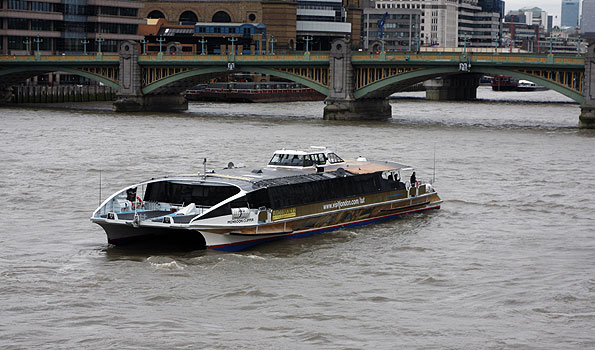
I recently travelled on the Thames Clipper service from Woolwich Arsenal all the way up river to London Bridge armed with nothing more than a one day Travelcard.
On the early evening run on a clear day the views travelling upstream were glorious as was the light of the setting sun. It was comfortable, warm and inviting.
The centre-right leaning Policy Exchange think-tank has just published a report on the future of Thames travel, "At a Rate of Knots: Improving public transport on the River Thames".
It's worth a read as it flags up both the history of failure and prospects for success on this arterial route through the heart of the capital.
It suggests that with a coordinated effort, river journeys could grow nearly three-fold from their current levels of a little over three million journeys a year.
The report makes it clear that river services, like the rest of the transport network, will need a public subsidy but argues at a far lower level of 14 pence per passenger than, for example, the Tube which runs at about 56p per passenger.
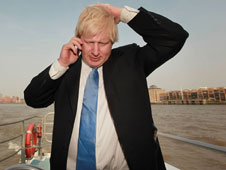
Ken Livingstone and his mayoral successor Boris Johnson have both been political sponsors of this reinvigorated mode of transport. Both have needed to overcome impediments to progress from institutional sources.
One key reason that the whole project is now seen as more viable is the movement of people back to residential sites along the Thames and the Canary Wharf development. The commuter option is a prudent and inexpensive one now that Oyster cards can be used on the system.
But the equivalent of investment in Tube stations on the river is money for pier improvement on the riverside. This is a Port of London Authority responsibility not Transport for London's.
A contribution from former London Minister for Transport, Stephen Norris, makes it that clear this is an obstacle that needs to be removed if capacity is to meet its full potential.
It's curious he didn't sort this when he had the chance back in the 1990s. Nevertheless it's clear that the launch of this document to reinvigorate the debate about travel by river is linked to an election. No harm in that.
The report perhaps surprisingly recommends increased responsibilities for TfL and strategic ownership of key piers to support the development of this mode of transport.
Of course this is an argument for greater state intervention to underpin the development of the commercial operators that service Thames commuters.
It's probably a debate in which east and west Londoners can find common ground. As yet the services upstream towards Putney and beyond are not a patch on those from the East to the Centre.
It perhaps reflects that dogma and ideology is slowly being driven out of debates, which are essentially about delivering a practical solution to Londoners who want to use the River Thames as a 21st Century Highway.
 I’m Kurt Barling, BBC London’s Special Correspondent. This is where I discuss some of the big topical issues which have an impact on Londoners' lives and share stories which remind us of our rich cultural heritage.

Comment number 1.
At 07:36 8th Jan 2010, Kenw wrote:The Policy Exchange report is riddled with inaccuracies and misunderstandings, which I hope are not deliberate attempts to misrepresent the current state of affairs.
To give one example, the Port of London Authority does not provide piers. As the safety and navigation authority, it must of course approve the location and design of piers, but anyone can build and operating them. All you need is a riverside property, approval from the PLA and planning permission from the local council. Oh, and a couple of million quid to pay for it!
Some of the main passenger piers are operated by Transport for London while others are run by commercial interests, for example Waterloo Pier below the London Eye.
And by the way, millions of Londoners and visitors already enjoy a trip on the river every year. It has, after all, been the capital's traditional playground for more than 100 years and over the past 15 years companies operating leisure and tourist services have invested more than £20m in new boats and the infrastructure to support them.
So yes, treat this report as a contribution to the debate - but don't believe all, or even most of it!
Complain about this comment (Comment number 1)
Comment number 2.
At 08:16 21st Jan 2010, Natalie Drest wrote:The Clipper is a really good way to travel into central London, though not without problems. The biggest issue as far as I can see, is not piers, rather the lack of parking at the Greenwich end of the operation. By it's nature the river takes a set route, so there are only a couple of places where passengers can board, unfortunately not many people live in central Greenwich, beside the Dome or beside Woolwich Pier. If the Clipper and other services are to make a bigger impact, the transport authorities have to grow up and understand that people are going to want to use their cars for part of the journey, there needs to be reasonable parking facilities near these places, particularly Woolwich and the Dome, because there is plenty of unused space there. I appreciate this is not practical in central Greenwich.
The other issue that I have, is that from somewhere around Wapping, right through to Westminster, the speed that these boats can travel at has been reduced to 5 knots (I believe), in the early days, it used to fly through London, it was a fast, efficient and spectacular way to arrive, now it creeps along even slower than a bus!
So as usual, the only thing holding back a good idea, is lefty government.
Complain about this comment (Comment number 2)