

And then the wall came tumbling down
Within a fortnight of taking up my first position as a BBC journalist, the unthinkable happened.
I was sitting in East Tower in the Television Centre complex at Wood Lane when the call went out from the head of department I was working in, did anyone speak German. That day the Berlin Wall had just been unexpectedly opened up. He wanted a team to head straight to the former German capital.
The Religious Programmes department wanted their flagship programme, "Heart of the Matter", presented by Joan Bakewell, to tell the story of the Protestant Church's role in the downfall of the bankrupt East German regime. As a German speaker I volunteered.
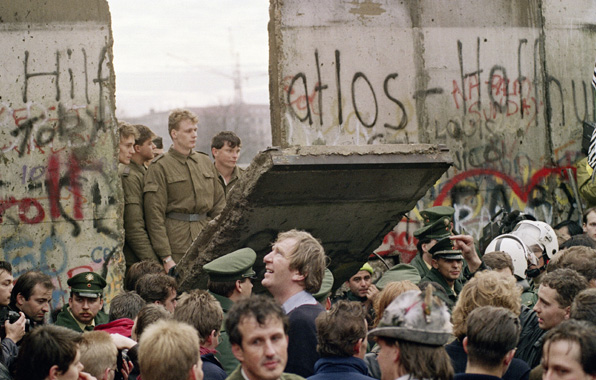 It was difficult to know what to expect. Flying into Tegel airport in Berlin the following day I was a touch anxious. This could all go horribly wrong.
The East and West had been at loggerheads for 40 years, it seemed improbable that that would all suddenly disappear. The East German border guards were not known for their friendly and forgiving temperament.
The first practical problem we encountered was how to get to Checkpoint Charlie. Even after the previous night's delirium it was still the only crossing point for most Westerners.
In the way, was possibly the largest ever traffic jam of Trabants (the only car available to most East Germans) seen in the West.
Over the previous 24 hours it seems thousands of East Germans had crossed the border in their 4-wheeled symbol of a clapped out regime.
The queue snaked for several kilometres up to the border crossing for those East Germans returning from their day trips to the West. It was unprecedented pandemonium in modern Berlin. But it was orderly.
I soon found that out as I got out of our car and sought out a back route on foot to our crossing point. East Germans had learned to be conformist. By walking I found a route to completely bypass the queues to get us into East Berlin by sundown.
As a student I'd been through Checkpoint Charlie several times before. It was always daunting; that day it was even more so. Now, as BBC journalists, my producer and I were expecting to be given the third degree. However it soon became clear that the border guards seemed pre-occupied with the anarchic scenes surrounding them.
I experienced tumultuous emotions; a combination of exhilaration and wracked nerves. After a cursory look at our papers, exchanging our West for East German marks, an official stamp and the usual look of contempt by those old communist officials we were waved across the border at what seemed a suspiciously brisk pace.
Half expecting to hear bullets whizzing our way we drove the rental new Golf through the border crossing maze. Our car wasn't even searched.
Something else struck me as odd too. The border guards wore these over-dramatic peaked caps which always seemed to cover their eyes when they talked to you. It added to the menace. Only on this occasion all the border guards seemed to have their hats cocked back on their heads.
Looking back on it they were probably getting ready to whip them off in the event the regime collapsed around them. It added a touch of the Monty Python to the whole proceedings.
Once through the Wall, East Berlin became eerily silent. We made our way to the Grand Hotel just a few hundred yards from the border a favourite haunt for Western journalists and spies. We got the last available hotel room in Berlin. It's the only time I've been obliged to share a room with a BBC colleague. History beckoned, rooming arrangements were a detail.
You have to remember here that I'd only been a BBC journalist less than a month. It was a baptism of fire.
When we arrived at the Hotel Bar for a quick bit of refreshment at around 9pm I was surprised to see a cast of the Great and the Good of British broadcasting.
Charles Wheeler, Brian Hanrahan, Olenka Frenkiel among them exchanging stories of the bizarre things that had happened over the previous 48 hours; everyone just trying to make sense of it all.
That same evening just 48 hours after the Wall had opened I took a walk in the pitch darkness (East Berlin was always a strange place particularly after dark) to see what activity was going on by the crossing.
A few days previously it would have been the scene of shootings if anyone had dared venture into the no mans land between East and West.
As I turned the corner of the main road where I was staying to head for the crossing point, I could see a figure in silhouette on top of the circular tube of concrete that ran the length of the wall.
I could vaguely hear the sound of a saxophone playing Glenn Miller's "In the Mood". As I approached the concrete I stood wide-mouthed as I realised silhouette and music went together. It was surreal.
A man on the Berlin Wall playing his Sax just about summed up his and others' private euphoria and contempt for the barrier which had separated East and West since 1961.
You see I have German heritage and as far as I was concerned the barrier built in the year of my birth would probably remain for at least my lifetime if not beyond. In earlier years I had spent days peering over the wall from a block of flats where you spit into no man's land.
We used to joke that you could see the whites of the eyes of the East German border guards we could see from the balcony.
That night the certainties that I and millions of others had learned to live with, were unceremoniously dumped. Frankly just seeing man and sax forced me back to the reality of how, in all this chaos, we were going to produce a 30 minute film on the role of the church. Apart from anything else it seemed all of East Berlin was on the move westwards!
The following morning a typical mist hung over the City and it was seasonally cold reminding you of the many winters Berliners had spent struggling to keep warm through the aftermath of defeat and the Berlin Blockade. Already at the crack of dawn orderly queues had formed in and out of the East. People were happy, smiling and laughing. All that hot chatter adding to the mist.
I have an abiding memory of a scene playing out in front of me largely in slow motion and black and white, except for the carrier bags being brought back from the West laden with oranges and bananas.
East Berliners who were about to leave the East for the day (most for the first time) exchanged excited observations with those who were already returning. Bananas and oranges were all most could afford from the West. No one complained.
From all this the "Heart of the Matter" team fashioned the first documentary from behind the Berlin Wall. It still gives me goose bumps to watch it. Most people I approached to interview were still terrified of retribution from the communist regime. Comment on bananas was fine, but not critique of the communists. Nobody at that point was confident that the regime was in its death throes, despite Erich Honecker having been turfed out by communist reformers.
But some people who did not know what the future held were incredibly trusting and did talk to us. One of them was Maik Hamburger the impeccably spoken voice of "Neues Forum" the civil group that had tried to encourage the government of Erich Honecker to relax travel restrictions (Born in Shanghai he remains Germany's leading Shakespearean expert). Hamburger had a prophet like quality, calmness and clarity.
Hamburger put us in touch with Ulrike Birkner a protestant pastor in Leipzig (and ironically the Last East German Ambassador to London before reunification a year later).
We spoke with a family who were desperate to be reunited with relatives in the West but remained uncertain about how safe it was to talk to us and what would happen once the euphoria had died down.
In that first week of untrammelled contact between East and West we fashioned a story about the role of the Protestant Church in providing a safe haven for dissenters.
It charted the movement towards a peaceful revolution; at the time no-one could have known that the East German state wouldn't turn guns and tanks on their own citizens. Not even the state itself. It is surely one of the few examples of an "established" Church actually actively assisting in overturning a political regime.
Within a year I had returned to tell a different story. As reunification approached and an effectively unified Berlin was being overwhelmed with refugees from the East and beyond, as German speaking minorities in Poland and Romania took advantage of the open border, new tensions were mounting.
Very little now remains of the Berlin Wall, a tourist to Berlin today could well find it hard to believe the razor wire and rabid Alsatian dogs ever ran through the City. But for those of us who were there it was all utterly unforgettable.
I have encountered many situations and people in the following 20 years of my career, none have yet surpassed that day. It was a time of unbridled optimism.
It seemed to confirm the old adage that if you want to, you can change the world. It was a day that taught me the value of not predicting political outcomes; a time when ordinary people showed that courage can move regimes.
 I’m Kurt Barling, BBC London’s Special Correspondent. This is where I discuss some of the big topical issues which have an impact on Londoners' lives and share stories which remind us of our rich cultural heritage.


Comment number 1.
At 00:03 11th Nov 2009, stephen ellery wrote:In 1988 I went to Poland to study orchestra conducting at the Krakow Academy of Music in Poland. After a year I got bits of jobs in various places and especially regularly in Hamburg. So I started passing Berlin, East to West, West to East back and forth thru Checkpoint Charlie or Friedrichstrasse and each time being searched etc passport stamped.
I started to meet people there too. Went to the Ballet and Opera etc and met up with people (I think it was illegal actually for them to make friends with me).
On one visit things were suddenly different. As usual, I hitched back to Berlin planning to get the train from Berlin Lichtenberg to Krakow. I knew something was going on because on the motorway there were loads of “Trabants” driving towards the west.
When I got to Berlin it was like arriving at a big party, a REAL party, not just a birthday or an xmas one or a rave, it was a party totally life-changing.
Usually I would get my sax out and earn a few “Westmarks” that were worth 11 Eastern marks if you bought them in West Berlin and stuffed them in your underwear or in your socks and with 20 of those “Westmarks” you could have champagne, caviar etc and watch the opera or ballet and have a slap-up meal in East Berlin.
This time I went up to the wall and climbed up, some people held my bags and sax and then passed them to me and I got my sax out and played Misty and In The Mood and all my favourites. Can’t remember how long I was up there because I was feeling a sort of buzz, something unreal, especially considering that if I had been up there playing sax 24 hours earlier I might have been shot.
I missed the Krakow Lichtenberg train because of drinking beers etc with people I met and got the Warsaw train later. I used to sleep with my sax as a baby in my arms but this time put it on the top bunk and slept downstairs and woke up in Warsaw without a sax, it got stolen somewhere towards Warsaw, a nice old silver Beuscher Sax.
When I reached Krakow I called my Dad and said I had played on the Berlin Wall and he said “yeah, yeah...” and then he was on a train in London reading the Independant and suddenly saw the picture of me on the wall and couldn’t believe it and showed it to nearly everyone on the train and sent me a copy of the newspaper.
I still go to Poland regularly to conduct orchestras (also Japan, Vietnam, India, Peru ...) and last week went to Berlin to take my promo DVD to orchestras trying to get concerts, in fact I am doing the same next week. I will try to find the place where I had stood and play there and get my friend to take a picture. My next London concert is January 14th at St Martin-in-the-Fields with the Locrian Ensemble playing music by Vivaldi, Mozart and Barber.
www.stephenellery.com
Complain about this comment (Comment number 1)