
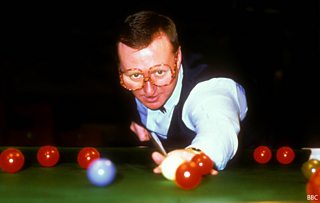
Dennis Taylor became the World Snooker Champion, beating Steve Davis in the now famous marathon "Black Ball Final" of 1985
The World Snooker Championship comes to a conclusion this weekend at the Crucible Theatre in Sheffield. So it seems a fitting moment to take a look at the history of how snooker has been covered on television.
Snooker was covered a handful of times in the early days of BBC radio, and later gained a foothold in black and white TV in the 1950s and 60s. But it wasn't until the late-1960s that snooker got its big break. Then-controller of BBC Two, Sir David Attenborough, was eager to find a format to showcase the ground-breaking invention of colour TV. After calling a meeting of BBC executives, they decided on snooker, and broadcaster “whispering” Ted Lowe came up with an idea for a new show - Pot Black.
Pot Black's format changed over time (it ran annually from 1969 till 1986 with sporadic tournaments thereafter) but the original series consisted of eight players, playing in a one-frame knockout tournament. The debut episode was broadcast on 23 July 1969, a couple of days after Neil Armstrong first walked on the moon. One small step for man and a giant leap in the history of snooker.
Alongside commentator Clive Everton, Ted Lowe went on to become the voice of the sport. However, it was Jack Karnehm who, in 1983, produced the most famous moment in snooker commentary history, by uttering the immortal line “good luck mate” as Canada's Cliff “The Grinder” Thorburn lined up the final black before sinking to his knees, having completed the first maximum 147 at the World Championship.
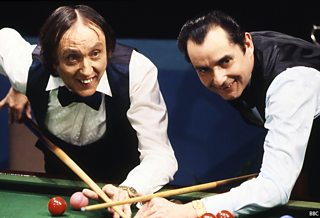
Ken Dodd uses a cue instead of a tickling stick to play six-time World Champion Ray Reardon
Nicknames have longed played a big role in the marketing of snooker. Winner of the first Pot Black final, Ray Reardon (he went on to win six world titles), was known affectionately as “Dracula” due to his sharp-toothed grin. While many nicknames reflected a player’s style of play (Jimmy “The Whirlwind” White and Ronnie “The Rocket” O'Sullivan are famed for their fast approach to the sport) Steve Davis acquired the ironic title of “interesting”. Davis dominated snooker for much of the 80s, playing in a methodical style that many considered boring in comparison to the risk-taking Alex “The Hurricane” Higgins. In later years Davis reclaimed the nickname “interesting” (it is the title of his autobiography), showing he was a man of many parts with his move from sport to broadcasting - even DJ-ing at Glastonbury Festival in 2016.
While Davis was undeniably the champion player of the 80s, the people’s champion was Alex Higgins. A complex character with a volatile personality, Higgins was a key player in the snooker revolution, as it moved from smoke-filled rooms at the back of pubs to prime-time BBC television. When Higgins won the World title for the first time in 1972 it wasn’t televised and the prize money for winning was reportedly just £400. Ten years later when he won his second title, the winner’s cheque had rocketed to £25,000.
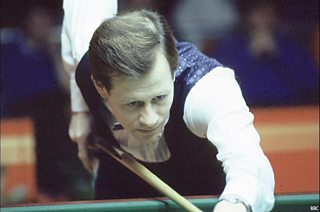
In 1982 Higgins won his second world title, his clearance when trailing 15 frames to 14 in a first to 16 frame semi-final match against Jimmy White is widely regarded as one of the finest in history. Higgins beat Ray Reardon in the final. With tears of joy rolling down his face he beckoned his wife and baby daughter from the crowd to celebrate with him. Although now ubiquitous across all sports, Higgins was the first sportsman to do such a thing – another indication of his unconventional style. It was the last time that the popular but troubled snooker-player won a World Title.
It was Dennis Taylor who was involved in quite possibly the greatest World Snooker Championship moment, in the 1985 black ball final. The schedule from 28 April 1985 shows that a dramatisation of Charles Dickens’ Bleak House should have gone out at 22:10 that night, but it wasn’t to be. The snooker continued until 12:30am (18.5 million viewers watched - still a record audience for BBC Two and for any UK programme broadcast after midnight), and the genial Taylor with his upside-down glasses eventually potted the final black to beat Steve Davis and bring the marathon to a close.
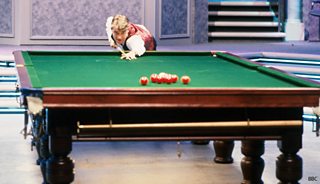
The precocious Stephen Hendry became the sport's youngest World Champion in 1990 at 21
The following year Taylor, Davis and a number of other players converted success on the table to success in the charts, and although the likes of Willie Thorne and Terry Griffiths seemed unlikely pop stars (more associated with break building than break dancing), such was snooker’s appeal at the time that for a few weeks in May 1986 (including an appearance on Top of the Pops). The Matchroom Mob (Steve Davis, Dennis Taylor, Willie Thorne, Terry Griffiths and Tony Meo) provided backing vocals to Chaz and Dave’s hit Snooker Loopy (hitting a chart high of six, and coming above Marvin Gaye with I heard it through the Grapevine and The Cure’s Boys Don’t Cry in the charts). Perhaps the players involved were right to stick to their day jobs, but they were probably better at singing than the average 1980s pop-star was at long-potting...
Stephen Hendry, who won seven world titles in 10 years, including four consecutively, dominated snooker in the 1990s. Hendry’s ruthless dedication to winning often saw him come up against Jimmy White in finals. White is a six-time world champion finalist and widely considered to be the best player never to win the tournament. Four of White’s world final losses were at the hands of Hendry with the closest and final one coming in 1994 when Hendry won a final frame decider. Immediately after the match when David Vine handed White the microphone a few feet from the trophy that had eluded him once more “The Whirlwind” uttered possibly the biggest understatement in the history of snooker on television “He’s beginning to annoy me”. White has never reached another final but did beat Hendry in the first round of the 1998 tournament.
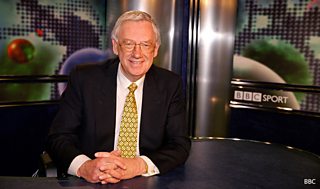
David Vine presented BBC snooker coverage for over 20 years
A change of century saw a new generation of players rising to the top of the sport. John Higgins and Ronnie O’Sullivan have both enjoyed considerable success, with O’Sullivan taking over the crowd-favourite tag from Alex Higgins and Jimmy White before him. In recent years the game has grown massively in China and across Asia.
In China, 250 million people watched the 2016 final featuring Ding Junhui (making the 18.5 million staying up to watch Denis Taylor’s 1985 win look insignificant in comparison). Who knows what Ted Lowe would have to whisper about that?
