Voices from the past at BBC Genome
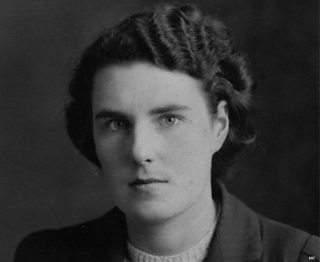
Kay Rumens (nee Watson) who joined the BBC at the age of 21, in 1941
A wartime role with BBC Engineering, a work romance and handling D-Day codes may sound like a plot from a WW2 spy-novel, but these were the experiences recounted by a former BBC staff member whose daughter-in-law recently contacted us at BBC Genome with this email:
Both my husband’s parents used to work for the BBC. His dad Len was a sound engineer; his mum was a design draughtswoman. During the war she was an Operator controlling World Service broadcasts - family lore says she was given the code to broadcast for D-Day operations!
Naturally our curiosity was piqued and we contacted our correspondent, Anne Ferguson, to find out more. Len Rumens and Kay Rumens (nee Watson) are both now dead, but with the help of their written recollections and information from their son Dave and daughter-in-law Anne we recall Kay’s career at the BBC.
Adventurous and determined, Kay Watson loved tennis, the outdoors and art. She had a natural curiosity for the radio, inspired by her brother, who was an amateur radio enthusiast. Together they had accidentally tuned into a conversation between aviatrix Amy Johnson and her mother in 1930, shortly after Johnson arrived from her solo flight to Australia. Kay’s lifelong interest in radio began.
The late 1930s and the 1940s were inevitably years that saw an increase in the Corporation’s intake of women. When World War Two began, some roles at the BBC were designated a “reserved occupation”. Former BBC Chief Engineer Edward Pawley noted in his book BBC Engineering that at the beginning of the war, BBC Engineering staff over the age of 23 were exempt from military service. However, as the war went on, more and more left for the forces and by the end of the war, 500 members of staff from that division had gone for military service.
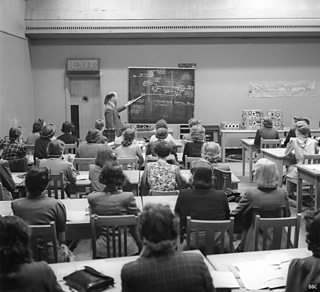
Women technical assistants in training in August 1941
Attitudes began to change too. In his book, What Did you Do In the War, Auntie?, Tom Hickman writes that it was a period in which the BBC stopped requiring the resignation of women upon marriage, (although a memo sent out by the Corporation to its staff still insisted that women – married or not - wear stockings). It was during this time that Kay was first employed by the BBC in November 1941, at the age of 21, one of 800 women to be recruited and trained by BBC Engineering over the course of the war. In total, by 1945, half of the BBC’s entire staff were women.
Kay Watson trained as a technical assistant, studying at Maida Vale and the Langham Hotel. It was then that she was briefly heard on the airwaves: Her mother, delighted, wrote in a letter to a friend: “[Kathleen] has gone to the Langham Hotel for three weeks. Did you hear that she announced the Music While you Work programme last week from the studio? Rather a thrill. I wish I had been able to listen in.”
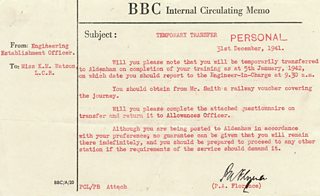
A memo informing Kay of her transfer to Aldenham, 1941
In January 1942 Kay was employed by the Engineering Division and transferred to Aldenham House in Hertfordshire and the recently rebranded Overseas Service (once the Empire Service and now the World Service). The number of programme staff for non-domestic output had risen dramatically between 1939 and 1941, putting a strain on Broadcasting House and Aldenham was one property requisitioned by the BBC during the war years. Like many BBC bases, its location was kept secret so as not to reveal the information to the Germans. BBC departments were also scattered to various locations around the country to avoid the risk of the whole BBC going off air if Broadcasting House was heavily bombed.
Kay was pictured in the month of her arrival in a Sunday Express article operating volume controls alongside an article with the headline “Secret mansion is heart of Empire radio” and the quaint caption: “Most of the volume control is done by girls.” Despite the increase in the number of women operators, the Engineering division was still seen by some as a traditionally male environment. Tom Hickman reports the early war experiences of women on duty in "H" auxiliary transmitter stations being expected to work in pairs when on duty with men.
Kay was still working at the base at Aldenham when in early June 1944, according to her family, she arrived at the studio to be passed a note with the code that would make her responsible for transmitting information to France and other countries to advise them that D-Day was imminent. BBC memos from the BBC's Written Archives Centre in late-May, 1944 show the organisation was busily planning the exact protocol to transmit information communicated by SHAEF (Supreme Headquarters Allied Expeditionary Force, led by General Eisenhower) about D-Day. One memo, dated 31 May 1944 reads: “When controllers receive… warnings they may inform those members of their staff who will be concerned in operating the agreed plan for the broadcasting of the first communiqué…” Perhaps Kay Rumens was one of these unidentified members of staff… On 6 June 1944, the BBC announced to its listeners that D-Day had arrived.
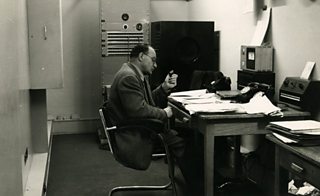
Kay's husband, Len Rumens, pictured at Bush House. The couple met at the BBC.
In 1948, after the war had ended, Kay was offered a position as draughtswoman – no doubt drawing on artistic skills she had developed during her education at a school of arts and crafts. But her position there was short-lived. Kay had met her future husband Len at Aldenham where he worked as a Senior Sound Engineer. She married him the same year, and true to the traditions of that time, tendered her resignation the following year when she became pregnant with their first child. So ended that stage of Kay’s BBC career… but she was to return later as the family’s main bread-winner when her husband (19 years her senior) retired. As a draughtswoman with technical expertise, she was accepted into the Planning and Installation department, a sub-department of the BBC’s Engineering Division. A Five-Year Plan announced in 1953 had called for a 25% increase in the technical staff as the BBC continued its onward march to colour television and a second channel.
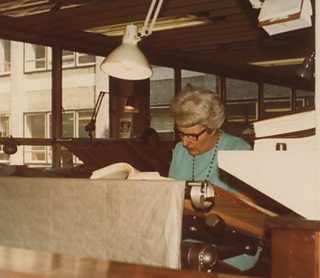
Kay in her later role as Draughtswoman
Here, she formed part of the team that delivered the technology for regular phone-in programmes. Her family describe her natural love of user-friendly design and her keenness always to consider the best layout for design instruments from the user’s perspective, rather than thinking solely about the layout of electrics.
Kay Rumens died in 2016. It is extraordinary to think that her life spanned the BBC’s. Among the listings in BBC Genome will be countless examples of programmes that Kay Rumens contributed to, helped to create and listened to or watched throughout her long life and career.
Images, unless otherwise indicated, courtesy of Rumens Family.
(This article has been reedited since publication, to clarify that the rule about women having to work in pairs applied specifically to "H" stations.)
