
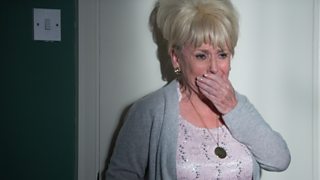
Lorna Fraser reveals how Samaritans has been working alongside the EastEnders team as they took on the sensitive subject of suicide for Peggy's heart breaking departure.
We were really pleased that EastEnders got in touch with us as they started to develop Peggy’s story, inviting us to work with them, clearly very keen to produce this in a way that was as safe as possible for viewers.
High profile and public discussion can go some way to help reduce suicide if the issue is handled sensitively and carefully. Research shows that coverage of suicide in the media can encourage people who are struggling to cope, are feeling overwhelmed and have considered taking their own lives, to speak out and seek help. This can be life-saving.
People do get in touch with Samaritans prompted by something they’ve seen on TV. For some, this can be their first step in talking about a problem they have been suffering with alone, in some cases for many years.
However, covering the topic of suicide in the media does also carry risk. A number of studies in the UK and abroad show links between inappropriate coverage of suicide in media, with increases in suicidal behaviour among vulnerable people, making careful handling of this crucial.
This is particularly challenging for soaps, where the pressure to write compelling drama has to be balanced with the responsibility to produce scenes that are safe and avoid exposing viewers to harmful content.
Samaritans’ aim is not to discourage or shut down coverage of suicide, as this adds to the stigma, encourages people to look for help in the wrong places and could prevent people from speaking out if they are experiencing suicidal thoughts. Our role is to work with programme makers, helping them to create safe, responsible content, which can help to raise awareness and promote discussion of what is a very delicate issue.
Covering suicide in programmes, including soaps, can be very effective in reaching wider audiences and can be very helpful in showing people the reality of suicide, for example, the devastation that is caused when someone takes their own life – an issue EastEnders have starkly depicted through Peggy’s story.
When a person reaches a point of becoming suicidal, they can lose sight of this, sometimes even believing their loved ones would be better off without them. This is clearly not the case – the impact of suicide leaves behind severe and long-lasting repercussions.
We know that if people are more aware of the reasons and possible causes of suicidal feelings, and the signs that may indicate a person is struggling to cope with life, people generally will know what to look out for and be better equipped to look out for one another.
We also know that people can feel apprehensive about approaching a conversation with a person they think may be going through a tough time, or feeling suicidal. It can be hard to know what to say and people can be afraid of interfering, or even making things worse.
The reality however is that for many who are experiencing significant difficulties in life, and struggling with these alone, being able to share this with another can be extremely helpful.
If you are concerned about someone you know but aren’t sure how to approach it, there isn’t really a right or wrong thing to say. The best approach is simply to start that conversation and ask if they’re ok. Samaritans has over 60 years of experience in being there for people when they are struggling to cope. We know that really listening to a person, giving them the space to talk through how they feel and completely unburden themselves, can be the first step to them addressing their problems and seeking further help. We could all do with becoming better listeners. It transforms relationships and really helps people to be honest about their feelings.
We are delighted that EastEnders continues to work closely with us and urge other TV dramas and news organisations to do this, together we can ensure that the topic of suicide is covered in a way that is safe and helpful.
If you have been touched by Peggy’s story, or if you feel low and need someone to talk to, Samaritans is here for you to listen and offer confidential support. You can call Samaritans for free, round the clock, on 116123, or email us at: jo@samaritans.org or find the details for your local branch at www.samaritans.org.
To find out how you can support Samaritans, go to their website.
