Newsgathering for social media - a case study
Stuart Hughes
is a BBC World Affairs producer. Twitter: @stuartdhughes
In recent months, social media - and Twitter in particular - has become an indispensible tool in my job as a BBC World Affairs producer. Along with an increasing number of BBC journalists, I now use it constantly to monitor breaking news, spot potential story ideas and make new contacts. For me, the traditional newswires are now a secondary source of information. HootSuite has replaced ENPS as my first port of call for the latest details on unfolding events.
For a while, I've been interested in exploring whether there is a place within our newsgathering for a World Affairs journalist dedicated to gathering material for social media platforms.
So, when dozens of foreign ministers gathered at Lancaster House this week for the London conference on Libya, I decided to try an experiment. Armed with a Macbook, digital stills and video cameras, recording equipment and a wifi connection, I provided a steady stream of content through the day via Twitter (below).
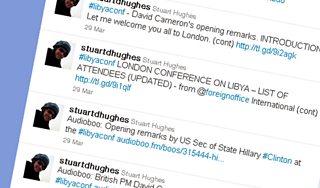
Stuart Hughes' tweets
Official Foreign Office press releases and communiqués were cut and pasted onto Twitlonger. Using a Marantz digital audio recorder plugged into the conference pool feed and Adobe Audition for Mac, I was able to 'top and tail' press conferences and statements from the likes of David Cameron and Hillary Clinton (below) and post them as Audioboos within seconds of them finishing. The boffins at Audioboo spotted what I was doing and kindly allowed me to upload files that were longer than the usual five-minute limit. This meant I could upload press conferences in their entirety.
Although I planned to use a Flip camera to post video onto YouTube as well, the demands of my 'real' job as the newsgathering radio producer meant I didn't have time to do this.
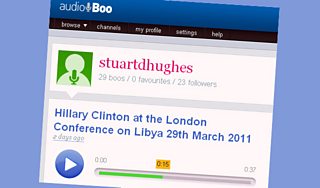
StuartHughes on Audioboo
While flagship BBC News outlets will still need satellite trucks, radio cars and crews, broadcast-quality material can now be turned around in seconds by a single journalist working in the field with just a laptop.
I was pleased that there seemed to be an appreciative audience for the content I provided. I received a tweet from a Danish diplomat who said she was using my Twitlonger posts as her primary information source because I was getting material out far faster than the official channels.
"The only problem, though," she told me, "is that some non-tweeting diplos still want all their information to come with a Foreign Office logo on it." I'm sure that in time that credibility gap will narrow.
Most gratifyingly of all, I made new contacts. Other journalists who were following my tweets came over to me in the press centre to say hello. I was delighted to be able to put faces to the names of fellow tweeters whose posts I trust.
One word of caution, though. My one-day social media experiment added additional demands to an already full workload. In the long run, it would be unreasonable to expect a journalist with other BBC outlets to serve to provide engaging content for a number of social media platforms in addition to their normal duties.
Providing material for social media cannot just be an afterthought in the newsgathering process. It needs to be properly resourced if it's to be done at all.
