Newsnight takes audience on virtual ride

Anna Holligan
is the BBC Hague correspondent. Twitter: @annaholligan
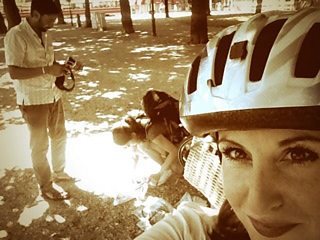
Anna wears controversial helmet
Before our collective feet hit the pedals, I tweeted a photo of my traditional Dutch ‘granny bike’ propped against a flower-festooned bridge, as producer Hannah MacInnes and cameraman Suraj Patel strode towards our meeting point.
The instant show of support - 15 retweets and 10 replies - demonstrated that there was a hungry audience online (though admittedly one of those messages was from my mum). I wondered if they might like to join us on the journey.
Twitter already has an active cycling community: if we were able to tap into this it could potentially give our report valuable insights as well as increase our engagement with the audience.
We were in a unique position to share, in real-time, the cultural and structural differences that make the Netherlands the world’s most celebrated cycling utopia. And television is inherently exciting - especially if you’re a viewer who doesn’t have to drag the tripod and all the rest of the kit around with you.
So we decided to tweet little teases along the way. Not the whole story but snippets, or appetisers, to get people talking.
At midday we met Dina, a young mum who was transporting daughter Charlotte in her ‘Bakfiets’. These cargo bikes are popular among Dutch parents: ‘It gives me freedom to go anywhere.’ I tweeted Dina’s words along with a shot of us chatting outside a cafe. Twenty-three retweets, nine favourites. Not bad.
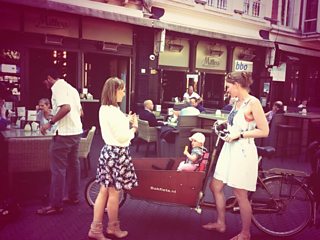
Dina with Dutch cargo
I tweeted a photo (top of this post). The helmet spurred a mass response.
“Why are you wearing one?”
“There’s no need for it.”
“I adapt to local culture.”
“It’s safe in NL.”
This gave us a ‘steer’: the helmet issue illustrated a symbolic difference between Dutch and UK cycling cultures. We could use that.
A tweet showing Dutch rush hour gave audiences a flavour of how cycling accounts for more than 60% of journeys around cities like The Hague and Amsterdam.
As we sped through the dunes, I captured a shot of Hannah, loaded with broadcast kit, cycling past the setting sun. One person responded, advising his followers to check out my photo stream for “great pix of Dutch cycling culture”. The audiences were sharing and spreading our story.
We asked cyclists on Twitter for tips to help us prepare for Britain’s roads. At sunrise we set up on the deck of the ferry to shoot the Twitter-generated advice. We showed the audiences that they had played a valuable role informing our reporting, and we used their interaction to give another dimension to our creative treatment of the great Newsnight bike ride.
At 11am the next morning we disembarked and, after dodging lorries and searching for cycle paths in east Essex, we came across a couple of signs on a post. The words showed the kind of contradictions that are notorious for fuelling cyclists’ frustration on the roads: “North Sea cycle route" and "Cyclists dismount.”
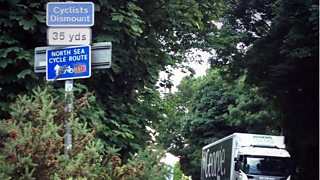
British cycling culture?
Tweet. Seventeen responses and 14 retweets.
We reached the multi-million pound blue paint of the Cycle Superhighway. Alongside it another road sign warned: “CYCLE LANE CLOSED.”
I tweeted the image accompanied by the words “Can’t wait to share our BBC Newsnight cycle stories.”
And the audiences obviously felt the same:
“Fantastic - when will it be broadcast?”
“When when when”
“Looking forward to it J.”
Anticipation was building as we sped towards Westminster, as quickly as our Dutch bikes would carry us.
We stopped by Broadway Market to interview the colourful bike blogger Lady Velo. She has more than 3,000 followers, most of them passionate cyclists, and shared images of our shoot.
The day before TX, I tweeted a shot from inside the Newsnight edit suite, asking for recommendations for our cycle feature soundtrack. Another way to incorporate audience expertise and remind them that tomorrow night was the night.
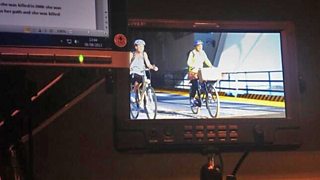
In the Newsnight edit
Three and-a-half hours before the show @BBCNewsnight tweeted: “What are the Dutch doing right + what are we doing wrong when it comes to cycling? @annaholligan sets out on her Omafiets to find out 2230 BBC2.” It generated 101 retweets.
When our Newsnight feature was broadcast (amid a flurry of excited and reactive Tweets) those audiences were already invested. They became part of the story as we were ‘living it’. Inviting them along to be part of the ride culminated in a self-perpetuating cycle that resulted in one of Newsnight’s most successful corresponding online articles.
It was the ‘most viewed’ article online with more than 600,000 views and is now at 50,000 shares and counting.
The great Newsnight bike ride has shown how the BBC can benefit from communicating with audiences in real-time online.
Newsnight is pioneering new ways of generating social media interest - tapping into the power of Twitter and sharing our insights and experiences with audiences beyond the TV screen, and creatively intercepting the places where they are increasingly watching.
Jamie Angus is aware of the potential: “The nature of Twitter and Facebook means that a very few shares and retweets can put your story in the timeline of hundreds if not thousands of people. That's a fantastic way to build a buzz around your story, and it works particularly well for narrative stories like Anna's where you want to post the developing story in real time.
“Stories have an audience on the night but also increasingly a 'long tail' who will use extra digital features in the online story, like the time-lapse vignette, maps and graphics.
“For a programme like Newsnight, some audiences will never come to us on TV because the programme is on quite late, and so being able to represent our stories online is crucial for us to reach new audiences who may choose to watch in future.”
Now I’m checking Twitter for ideas on other stories that could benefit from similar treatment.
Tweet me if you have any thoughts.
You can see Anna’s Newsnight film here.
