A social media swap shop of ideas #smsnyc

Mark Frankel
is BBC News social media editor. Twitter: @markfrankel29
This was ‘Lessons from the other side’ - a Social Media Summit discussion around “what social media techniques journalists and news organisations can borrow from the worlds of politics, branding, marketing and advertising”.
Panelist Jen Nedeau (@JenNedeau), director of Bully Pulpit Interactive, kicked the session off. The challenge for brands, she said, is to rebuild trust with consumers. Social media can provide new opportunities. It's easy to do your “digital door-knocking” to an online audience if you're a brand with money to spend, but social media allows you to have a unique selling point - a case of "more intimate" relationship building.
Content promotion is key, she argued. Brands need to know how and when to harness social media to “capture the moment” for their audience. But first and foremost they need to really understand their fans. This is about data gathering, tracking and testing. Success is born out of experimenting with sponsored posts, search ads and retargeting. Your audience does not inhabit one magic space on the web.
So what's worked well recently? Jen pointed us towards The Washington Post’s Twitter module on its homepage during the 2012 US elections. The Post was able to engage directly in its audience’s conversations and drive traffic back to its website.
Time magazine and Foursquare had a successful partnership during the US political conventions. The collaboration helped a politically engaged audience to find much more of what they wanted with well-targeted tips, lists and guides.
Jen's key conclusion? There are great returns for brands using social media but co-ordination and collaboration are vital. Brand owners need to think carefully about how best to reach their audience through multiple channels - whether TV ads, YouTube, Twitter or Facebook.
Tim Nolan (@tim_nolan) was up next. The interactive group creative director for BBH NY began with questions: should newsrooms act more like advertisers, and should advertisers act more like newsrooms?
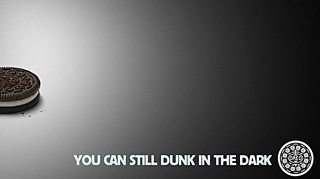
How can you best capture the moment and respond in kind in real time? Tim cited the Oreo cookie 'You can still dunk in the dark' campaign (pictured above) that was an immediate response to the power failure at the Superbowl as a great illustration of real-time advertising. It was simple, slick and powerful, and was widely shared across social media.
So how does this relate to journalism? Well, we're all citizen journalists today. Whether people are breaking stories or just breaking news, they are changing from being passive consumers to active participants using smartphones. The "democracy of social media" means that we're all using fragments of information to piece together a story - as just last week after the Boston Marathon bombings.
Tim's key message: as journalists we need to find a balance between capturing the immediacy of the moment and maintaining our professional integrity.
And so to Kyle Monson (@kmonson), CEO of Knock Twice. He wanted to talk about a Facebook page started by a student, Elise Andrew, called ‘I fucking love science’. Elise (now at LabX Media) just loves great science facts. She sticks them up on her Facebook page and gives people space to comment, share and create a buzz. "We're dedicated to bringing the amazing world of science straight to your newsfeed in an amazing and accessible way," she says. And it's been a big hit. The page has attracted 4.7 million fans in just 12 months.
Kyle's point was that any science organisation could have done this but Elise got in there first and does it really well. He showed us the Facebook page of another science organisation where engagement had been far less successful. I won't name it but, suffice to say, he argued that the page has too much aggregated content and too little curated content.
'Virtual summer camps' for children had proved just as engaging as Elise Andrew’s Facebook page. So-called ‘maker camps’ live on Google+ hangouts and focus on unleashing children’s creative juices through live online demonstrations from experts and ‘influencers’. By the end of last summer there were more than a million 'makers’.
Projects have involved, among other things, robotics, the CERN lab in Switzerland and the Ford innovation lab. Children relish the challenge of design and DIY and, as Kyle explained, have demonstrated extraordinary innovation. Tap 'maker camp' into YouTube to watch for yourself.
Kyle’s pitch was that publishers and journalists can use social media more creatively to advance their mission rather than just use interns to tweet headlines.
Last up was Shankar Gupta. He started with a quote from Jeff Bezos: "The brand is what people say about you when you are not in the room." It's time, he argued, for marketers to start talking like real people and engage with consumers as equals.
Shankar pointed to a number of useful case studies on how to succeed: Reddit AMAs with actor Bruce Campbell and Australian journalist Tracey Shelton (on Syria), Starbucks asking consumers to share tangible business ideas, and a RadioShack ‘maker’ camp.
What if you used pop culture conventions to cover hard news? What if you wrote about a community as an insider rather than an outsider?
Shankar told us about a woman who couldn't decide whether she preferred Oreo cookies or KitKats. It was a great opportunity for the brands and they took the battle to Twitter as a campaign, with great visuals and a pitch-perfect tone. It could only work to the benefit of both brands. So, having a recognisable tone and distinctive voice is critical to brands on social media.
Shankar's parting shot? We need to think about how and what we would change if we were to "popularise" our writing style, and "brands must talk more like human beings”.
Citizen journalism meets old-style investigation in Madagascar #smsnyc
Social media deniers have disappeared - next stop New York #smsnyc
