Podcasting on the rise… and why it’s the starting that counts

Helen Zaltzman
is a podcaster, writer and broadcaster @helenzaltzman

After more than a decade - or far longer if you consider ham radio to be the true origin of the medium - podcasting is at last having its moment in the sun.
Over the years it has been stealthily increasing in listenership, quality, legitimacy and accessibility; people no longer respond with 'what’s that?' when I say I am a podcaster. But the big kicker came in autumn 2014 with the arrival of Serial (above): a 12-part dissection of a 15-year-old murder case made by several alumni of This American Life, which was until then the biggest podcast in the world.
Unprecedented in podcasting, Serial attracted the kind of fervour usually reserved for televisual events like the last run of Breaking Bad. Fans counted the minutes until the next episode, gobbled every scrap of information they could find about the case, scoured for potential clues, and diligently dissected the show on Reddit. The likes of Slate and the AV Club produced weekly podcasts about the podcast; Saturday Night Live parodied it. When you’re being parodied and there are shows commentating on your show, it’s safe to say you’ve arrived.
There’s no doubt that for many listeners Serial is when podcasting itself arrived. It lured them in and when the season finished they realised they could fill that gap with some of the several hundred thousand other podcasts that are available.
Not only that: they realised they could make their own. There’s a podcasting gold rush on at the moment and it’s easy to participate because all you need to make a podcast is an internet connection and a recording device - even just a phone.
Really, any idiot can make one. I know because I am that idiot. I knew absolutely nothing about podcasting when I started doing it in January 2007, but fortunately that didn’t matter nearly as much as if I had fancied taking up, say, cardiovascular surgery or ballet.
Things were different back then. Back then, on the ‘Respectable Broadcasting Media Scale’, podcasting fell somewhere between ‘standing next to Topshop with a megaphone and shouting about god’ and ‘farting into a paper cup’.
Back then, Facebook and Twitter were only just hatching, and the iPhone was still being gestated. Back then, on-demand media was still fledgling, so we weren't yet in the habit of consuming the content we wanted whenever we wanted it, regardless of commissioners and schedulers. Back then, podcasts were a pain to publish and almost as much of a pain to receive: both ends of the transaction required far more tech knowhow and patient faffing about than they do now.
All these things have changed and continue to change, I'd say for the better. People ask me all the time about how to start a podcast; luckily for these pre-podcasters much from my first attempts is now obsolete. They'd scoff if I suggested trawling for new listeners on MySpace, as we did; or wrestling with unnecessarily labyrinthine software, as we did; or going to Luxembourg with the express intention of breaking its iTunes top 20, as we did.
But one piece of advice remains the same. Start. Just START. Heed me, pre-podcasters: don’t wait for an invitation. Don’t wait for a mythical time when you’ll feel completely ready, because there’ll never be a better time than now. Don’t worry if you have hardly any time or resources. In podcasting, you can do an awful lot with slender means.
Don’t think you can’t begin until your show is perfect - you’ll learn far more by actually making it than you possibly can by theorising about it. Don’t fixate upon the first episode, because after you’ve expended all your energies upon buffing it to a high shine you’ll receive a rude shock when you realise that you then have to make another one, and another one, and another one… You might think starting is difficult, but keeping going is far more so.
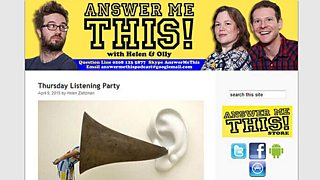
I’ve made more than 300 episodes of my podcast Answer Me This!, which frankly is a hundred times more than I would have predicted.
It doesn’t matter that when you start you’re unlikely to be immediately as good as 99% Invisible or This American Life or Radiolab or Welcome to Night Vale or UnFictional, or whichever show it is that fills your ears with love and envy. Listen to the stuff you like to listen to; think about why you like it; then steal those qualities and adapt them for your own show somehow.
And remember: they took their time to become really good as well. The only real difference between them and you is they started.
Helen Zaltzman presents and produces The Allusionist and Answer Me This! podcasts and is a member of the Radiotopia crowdfunding network.
The art of podcasting, with Helen Zaltzman and Olly Mann
More podcasting advice from the BBC Academy
Our section on presenting skills
Ten lessons learned from the Radiotopia crowdfunding campaign
