Innovative journalism thriving on transparency

Cathy Loughran
is an editor of the BBC Academy blog

The four panellists, Andrew Jaspan, Sarah Hartley, Luke Lewis and Anette Novak, were all genuine journalism pioneers. But if innovation was their game transparency - in one form or another - was their stated aim.
Take Jaspan, former editor of the Observer and founder and chief executive of high-brow website The Conversation which was piloted in the UK last summer, having started life in Australia two years ago. It’s one of those aspirational ideas that probably shouldn’t work but looks like it might. Unpaid academics write deep explanatory articles from within their field which are then knocked into shape by a few paid, professional editors.
With no advertising other than through social media, Jaspan says The Conversation has acquired 1.6 million unique users a month for its seriously serious content, and a stable of 9,500 contributors. An examination of the cosmic web, how to get ants to solve a chess problem, the musical legacy of Pete Seegar and whether there is still a sex bias in journalism are a taster menu of what’s on offer from the site’s ‘accredited’ authors.
And there’s the clue. Only vigorously vetted experts can join The Conversation, under its strict operating charter, says Jaspan. There is full disclosure of the writer’s credentials, contact details and any vested interests upfront, and they’re only allowed to write on their specialist subject. The venture also has an overseeing editorial board of academics.
For Caspan, whose website has already been a scourge to Australian politicians less wedded than he is to openness, ‘transparency, disclosure, credibility and expertise’ is a winning formula in the digital world: “The days of just asking people to trust your content are over.”
Asked by session chairman George Brock to single out one factor that has changed things for journalists, Hartley unhesitatingly answered: “The way digital has allowed for transparency in the process.”
Journalist Anette Novak, ex-editor and chief executive of Sweden's experimental Interactive Institute, has history in the transparency stakes. She was editor-in-chief of the regional media house Norran which opened up its newsroom to readers through social media as far back as 2009 - with readers helping to produce news content.
She had some big ideas to share, including about big data: predicting a “war over who actually sits on the data” and advocating a society that “embraces transparency”. She explained: “I see us moving to an era where we all live in glass houses, especially journalists - a move from objectivity to credibility.”
Would journalists change the way they worked if they really had to work in glass houses, she mused, arguing: “We should show all our sources, show all our evidence. The public no longer buy our shortcuts.”
And so to Luke Lewis, former award-winning editor of NME.com and for the last year editor of the UK edition of BuzzFeed.com. To be fair, Lewis was more interested in making published stories transparent - especially the ones that don’t stack up. And he was pretty open about how he and his colleagues go about blowing fakes out of the water, with benefits.
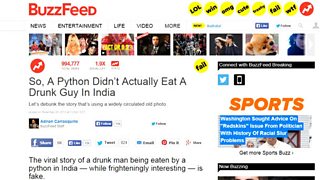
Buzzfeed’s So, a Python Didn’t Actually Eat a Drunk Guy in India debunk took about five seconds using a Google reverse-image search, said Lewis, who recommended Topsy as another debunking aid.
Viral news stories need to be interrogated, he argued. No, Greater Manchester Police Haven’t Seized ‘the UK’s First 3-D Printed Gun put paid to a speculative story running in the Telegraph, Guardian, on Sky News and BBC Radio 4’s Today programme last October. It took BuzzFeed staffer Tom Phillips about half an hour to crack that one open, Lewis said. And it’s worth the effort: “Debunking a viral hoax can itself go viral.”
There was a lot of debate around new funding models, including those represented on the panel (a whole different subject for another day) and a loose consensus that there was still probably room for a mixed digital economy.
But there was another old saying that came to mind in that City University auditorium - packed as it was with a healthy mix of fresh-faced journalism undergrads and research students and some seasoned hacks (including the respected editors of The Conversation who happen to operate from a rooftop berth at the university). It was the one about ‘a week being a long time in’… politics, usually.
Lewis had a vivid example to quote on this, about the unstoppable march of citizen journalism. It’s almost exactly five years since the dramatic plane landing in the Hudson River when a member of the public took and posted that single iconic first picture that went around the world.
“ONE picture, taken in that moment. Now, we’d be drowning in images,” he said. Couldn’t be clearer.
Creating journalism from academia: A pilot project
Searching social media? Don’t miss what’s hiding in plain sight
Long-form writing blogs by Hugh Levison
Is this the real Pope? Five ways to spot a fake Twitter account
The Pope, the dictator, the fake photo: It pays to check social media
Crowdsourcing with #nhswinter is for team players
