Iranian journalists face growing threat of imprisonment in pre-election crackdown
Hossein Bastani
is a BBC Persian journalist
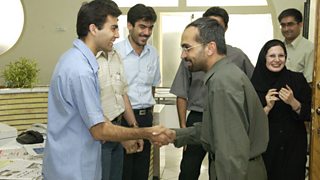
Despite the smiles (above), it was freedom at a price. Controversial former prosecutor Saeed Mortazavi had personally given me the choice to give up journalism or face further imprisonment. It still shocks me to see how much weight I lost after just 10 days in solitary confinement, blindfolded and continually interrogated. Solitary confinement was the worst part of all, as I recalled in a recent interview (listen about 8 minutes 30 seconds into the recording).
I resumed my work as a journalist, but after increased threats made the difficult decision to leave Iran for France a year later, joining the BBC Persian Service in London in 2010. Now, as Iran gears up for presidential elections on 14 June, the conditions faced by Iranian journalists once again make depressing reading.
At the end of 2012, Iran was the fourth-highest imprisoner of journalists in the world, according to Reporters Without Borders. Just three months later, in March 2013, the UN’s special human rights rapporteur put Iran top of the list. About 50 reporters are currently jailed.
On a single day in January, 16 Iranian journalists were arrested. A few weeks later the country’s ministry of intelligence claimed that it had uncovered “a network of 600 individuals” from amongst journalists who opposed the regime.
Many of the tactics Tehran uses to exert pressure on journalists, such as summons and arrests, are similar to those used in other parts of the world. But particular tactics are unusual. Systematic threats to journalists’ families are one. Families of dozens of foreign-based Iranian journalists have been the target of threats or other pressure tactics by Iran’s security apparatus. In some cases such threats have included holding journalists’ families hostage.
In one instance a foreign-based journalist was forced to respond to questions from an Iran-based intelligence ‘interrogator’ over the video chat website site Oovoo, for more than 40 minutes, because the agent had the reporter’s terrified sister sitting next to her.
Another rare type of pressure used by the Iranian regime is a media campaign against independent and dissident journalists aimed at personal vilification. This method, which has picked up momentum since last year, includes organised, extensive and serious accusations in addition to the spread of misinformation about journalists, broadcast through the country’s state-run media network.
Hundreds of fake blogs and Facebook sites have been created in the name of journalists, particularly people affiliated to the BBC Persian Service, where fabricated, self-incriminating material is published in their name. Accusations include descriptions of fake “collaboration with Western intelligence agencies” and detailed accounts of sexual activity with multiple people. These fake ‘self-confessions’ are subsequently published by numerous government-affiliated websites and newspapers, appear in news agency reports, and are even broadcast on Iran’s official state-run television.
Iranian journalists working for independent or dissident media outside the country are also under constant cyber-attack. Personal information related to dozens of journalists has been hacked and passed on to the intelligence services in Tehran.
Many of the targeted journalists now use complicated security-protection mechanisms for their personal email accounts, but they are still under attack. Dissident journalists who use a two-step verification method to access their email or Facebook accounts are continually woken up in the middle of the night by text message alerts on their mobiles, exposing the determined efforts of hackers trying to break into their accounts.
Should the hackers succeed, the consequences can be devastating. One recent case was that of Sattar Beheshti: the 31-year-old blogger who posted his material anonymously, was arrested last November, and then found dead in a police detention centre. He was seized by security agents after government hackers eventually broke into his internet accounts and uncovered his true identity.
When this new wave of confrontation with Iranian journalists began, the country’s minister of intelligence openly said that the reason for such actions was to prevent “sedition” during the election period. Under normal circumstances it is unclear why journalists would be arrested to prevent “sedition” in elections. One explanation is that the regime may want to keep certain vital issues out of the public eye - away from public scrutiny - as Iranians prepare to go to the polls. In that sense their concerns about journalists may be justified.
BBC College of Journalism’s Persian website.
The BBC College of Journalism and the University of Sheffield’s Centre for Freedom of the Media (CFOM) held a special briefing on journalists’ safety in London last October. Watch a video of the London symposium and read blog posts by some of the front-line journalists who attended the event:
