
What hope of success do women have if those with the greatest influence on their career literally aren't following what they have to say?
It got me thinking about the potential of these new social media frontiers. In an office environment that kind of gender imbalance would be unacceptable. On Twitter, evidence suggests that both men and women are perpetuating it by promoting men’s ideas over women’s.
A study by the Harvard Business Review (2009) found 45% of Twitter users are men, 55% women. Other more recent studies by the Pew Research Center (2012) have generated similar results.
On the face of it, then, women would seem, if anything, to be slightly over-represented on Twitter. But according to the Harvard research, men have 15% more followers than women, and are more likely to ‘follow back’ when someone follows them.
An average man is almost twice as likely to follow another man than a woman. Even more surprisingly, the average woman is 25% more likely to follow a man than a woman, according to the Harvard study.
Women are also “less driven by a desire to accumulate followers”. Follower count is often used as a measure of influence on Twitter. If women are not as motivated by amassing followers, they’re less likely to develop large audiences.
Do men pay more attention to how they tweet in order to increase their followers? If so, the way women use Twitter might actually be working against them: if a man follows two men and a woman, those men are more likely to follow each other back and retweet each other - a double blow for the influence of the woman.
So what is the impact of this gender imbalance?
Diane Kemp is principal lecturer in broadcast journalism at Birmingham City University and consultant on a Council of Europe/EU project about more inclusive reporting: “Imagine seeing a world in which you don't appear. It makes no sense; it makes you doubt the veracity of the rest of the report you're watching, and if that happens too often you'll go away and find other sources that you trust.
“Everyone accepts this, and no-one wants to lose audience, which is why we're seeing efforts being made to address it. If you think there's nothing wrong… you are out of date.”
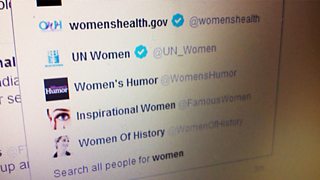
Are there simply fewer women in positions of power - so more worth following in a professional context? Is it just a reflection of gender bias in society?
Technology appears to be neutral: perhaps we aren’t accustomed to looking for gender bias in it, as we might in a boardroom. For journalists using Twitter for quotes and leads, there is a tendency to see it as a reflection of the offline world, rather than having its own particular biases and norms. But maybe it’s time for an online reality check - to see whether we are guilty of unknowingly perpetuating a gender bias.
In fact there is already a tool created by scientists in Sweden that can help, if you’re brave enough to have a go: Twee-q - which gives you a gender breakdown of the authors of your retweets.
There’s no doubt Twitter has been a revolutionary tool for gauging audience interest, sourcing opinion and accessing new ideas. But in my experience men are far more likely to respond to journalists’ requests for information.
I was working on story recently; it was late and I was attempting a ‘Twitter vox’. I asked followers to send their opinions via audio files to use in my radio package. The respondents were overwhelmingly male. It would have sounded ridiculous to have only men in the mix so I pushed harder, asking explicitly for women, explaining the importance of having both men and women contribute. Then they did. All it took was patience and encouragement.
I have never felt different or disadvantaged by my gender. But when I see the people at the top of my industry giving so little space on their Twitter feeds to women it really does shake my faith in gender equality.
If you have unconsciously been giving men more prominence on your own timeline, perhaps this is a good time to question how that might be affecting your life. And if you have answers to any of the questions we pose here I’d be delighted to hear them. You can tweet me @annaholligan
All of this demonstrates that the real obstacles men and women face do not vanish in social media. For the same reasons that paying more attention to men in the workplace wouldn't be tolerated, so we must ensure that recent strides in moving towards gender equality aren't being reversed via this most modern and powerful of mediums.
Anna Holligan would like to thank Matthew Knight for contributing to this article
