How to tell seven murder stories in 60 minutes

Charles Miller
edits this blog. Twitter: @chblm
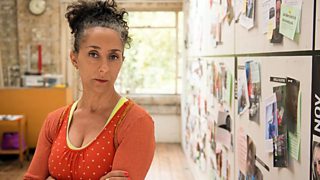
Vanessa Engle in front of the victims' wall she created for her film.
If you were interviewing people about the brutal murders of their closest friends and relatives, how would you play it? Would you stay coolly professional, or would you let yourself get emotional in sympathy with the grief of your interviewees?
Vanessa Engle, the acclaimed BBC documentary maker, told a BBC audience that during the making of her film Love You to Death: A Year of Domestic Violence, she “quite often was crying”. But she was careful to cry silently “because you don’t want to mess up your soundtrack”.
The juxtaposition was typical of Engle’s self-effacing account of the making of the film, in a conversation with Clare Paterson, commissioning editor for BBC Documentaries.
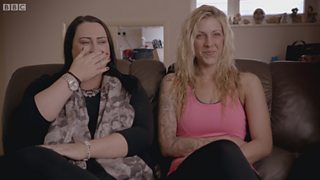
Paterson’s first question was about how Engle managed to elicit often startlingly unguarded comments from her subjects.
“There is no trick”, said Engle. It’s just a matter of establishing trust. She said that two young women (above) who talk touchingly about the murder of their friend were people she hadn’t met or spoken to until the day of filming. When they turned up, one of them hadn’t even known she would be asked to be filmed.
Engle said she didn’t go in for a long preamble before recording. The camera was usually running in “minutes”.
So far, so casual. But for anyone starting to think there was nothing much to it, alongside the informality, there was a different message. Engle said her cameraman, Johann Perry, had worked on her last 21 films. He and his sound recordist are “large, but invisible”. Engle said she had a special abhorrence of camera crews who think it is their job to put contributors at their ease - because crews won’t know all the sensitivities.
Engle’s crew “know not to say anything”. Instead they exude “experienced, professional calm” and play an important part in creating “a very safe environment”. Their “benign presence” helps everyone feel they’re in good hands. It’s like when you’re giving blood, she explained: you don’t want the nervous nurse.
As far as her own routine goes, Engle said she carefully prepares questions and has them on paper in front of her, although she doesn’t feel she has to stick to them. She’s scathing about documentary-makers who arrive empty-handed to an interview as “a badge of honour”: that’s just a kind of snobbery.
So what of this particular film? It told the intimate stories of seven women who were killed by their husbands and partners in Britain in 2013. Simple text on the screen told us there were 86 such cases, representing over half the women murdered during that period.
The film was structured to remind us constantly that each detailed story was an example of the wider group of 86: Engle asked her contributors to read out the names of other victims and created a huge board on a wall with photographs and press cuttings of each murdered woman, arranged by months. The effect, with Jack Ketch’s subtly powerful music, was shocking and slightly hypnotic.
Again, the apparent simplicity of the wall idea was made possible, Engle explained, by some complex calculations about how many and which names each contributor would have to be asked to read in order to provide the flexibility needed in the cutting room to cope with different combinations of featured stories.
With a subject like this, the question of tone was critical. “It’s tabloid material”, said Engle. She wanted to make a “very responsible film” – and nobody would accuse her of sensationalising her murder stories. But neither did she want to sanitise them.
She navigated those issues in the cutting room. It was there that she decided how to shape the huge storytelling job she had set herself. Each case included a back story of a relationship, sometimes of 30 years, a detailed murder story, a police story and court case, together with the impact of the death on her contributors. She decided to announce each story with the victim’s name on screen, and later, to signal the murder with a date caption.
The fact that the film was easy to follow is a tribute to Engle’s skill in filleting her interviews and using what she called the “lexicon” of shots gathered during filming that appeared “metaphorically” to illustrate her stories.
On the question of tone, Engle said simply that films “find their own tone in the cutting-room: only when someone else watches it do you know what kind of film you’ve made”.
In my view, there are so many ways in which a film on this subject could have gone wrong – in tone, content or storytelling - that it wasn’t really the film that deserves credit for its own success. Instead, it was Engle’s ability to define and control the task she had set herself, turning the bleakest of stories into something that was not only praised by the audience and critics, but, as she told Patterson, by her own contributors too.
Love You to Death: A Year of Domestic Violence (which contains disturbing stories) is available on the BBC iPlayer until 15 January 2016.
