Going mobile: A beginner’s tips for film-making journalists

Navtej Johal
is a video journalist for BBC East Midlands Today
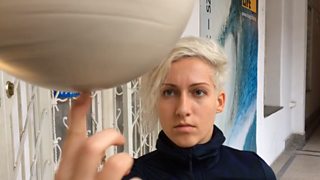
Kitti Szasz, football freestyler
I was one of 20 regional broadcast journalists from around Europe who travelled to Hungary to learn how to film and edit a TV news report using just my smartphone.
That was the goal of a brilliant and thought-provoking week’s training in Budapest that I recently completed with CIRCOM, the European Association of Regional Television.
It was one of the best experiences I’ve had since joining the BBC as a trainee three years ago. It may also be one of the most important for the future of my job.
The participants were split into advanced and beginners groups. I joined the first-timers to the world of MoJo (mobile journalism). Three days of intense training followed where we learned how to use apps for filming, audio recording and editing. We were taught to think like stills photographers, accept the limitations of the mobile device and embrace its possibilities.
On the fourth day we set out in driving rain with our phones and their various attachments (tripods, microphones, etc) to film a news report, which was expected to sit comfortably alongside the normal output of TV news programmes. I had arranged to film with one of the best female football freestylers in the world. Her name is Kitti Szasz and she happens to live in Budapest.
Kitti is also passionate about women’s football so I decided to use her to tell the story of why women’s football lags so far behind men's in her home country. We arranged to film Kitti showing off her skills near her home and around the city. We also filmed at a women’s football training session and planned to end the day with vox pops of Hungarian men’s thoughts on women’s football.
Navtej Johal's prize-winning film
On the final day of the course, we edited our reports on iMovie, using either an iPhone or an iPad. Despite having no idea of how to use the apps at the start of the week, by Friday afternoon I had edited a package of which I was very proud.
Although it may seem daunting, filming on a smartphone can be remarkably liberating and surprisingly easy. As a video journalist for East Midlands Today, I’m used to large cameras that take a few minutes to set up for filming, and a laptop or computer on which to edit material. With my phone, I was filming in seconds and the editing process was streamlined, yet still allowed for enough attention to detail to make a really smart piece.
If you enjoy filming with a ‘real’ camera, you should give MoJo a try; the skills are transferable and the technology is simpler to use and cheaper. Everything from the larger screen of a phone compared to a camera viewfinder, to the less intrusive nature of a small phone compared to a camera, make it a great option - even if you only use it as back up.
Many of the latest smartphones can shoot 4K video. That’s four times the quality of HD. That’s staggering - and shows the potential of phones. If the device in your pocket can film better quality video than the heavy piece of kit in the boot of your car, then why wouldn’t you at least consider using it every so often?
There are drawbacks, of course. In Budapest I had issues with my phone’s battery life and storage and the camera app we used didn’t work properly on the day of filming. Some people also struggled with editing on a phone as it is so much smaller than a computer screen. Still, we all came out of it with a report and I was delighted to be awarded a prize for mine. A few days later it was also on the homepage of the BBC Sport website.
At East Midlands Today I am lucky to have a supportive editor, Emma Agnew, who is happy for us to try new things and be creative. Another of our reporters took part in the MoJo challenge last year and as soon as Emma heard I wanted to be involved she was keen for me to make it happen. I hope to continue using the skills I gained in Budapest and enhance my reporting by using my phone to do more than just make calls.
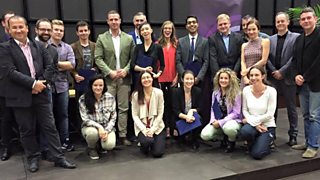
The mobile journalism trainees, picture by kind permission of Guillaume Kuster
So here are my top MoJo tips:
- Use the phone in ways you wouldn't use a normal camera - it's small and can get into places a camera cannot
- It works really well on close ups - try to take advantage of that when filming
- Think like a stills photographer and you will get better shots
- Avoid pans, tilts and too much movement, as the picture can be jittery - even with an app like Filmic Pro, which has image stabilisation
- Zooms also don't look great and should be avoided
- Avoid using the selfie camera when filming as it is of significantly lower quality
- A battery pack and memory card will make life easier when you’re using your mobile for journalism
- Rather than a selfie stick, use a monopod: it's much sturdier when you want to do a tracking shot or get above the scrum at a press conference
- Time-lapses and slow-motion shots are easy with a phone and can be simple ways to add a bit of flair to your report
- Look for the money shot. We were shown a report about a coffee shop (below) where a barista pours coffee beans into a cup. One of the shots was from inside the cup as the poured beans covered the lens - something a camera couldn't do.
The King of Coffee, used with kind permission of RTÉ News
Marc Settle, the BBC Academy’s smartphone journalism specialist writes:
The fruits of the three days’ training Nav had with Circom are impressive – and it would be great to see more BBC journalists using smartphones in a similar way. There’ll always be a place for the expert skills of a camera crew but the flexibility, portability and sheer ubiquity of mobile devices mean we could and should be getting more content for on-air, online and for social media than we currently do. If you work with the BBC, you can sign up for my one day intensive training course here.
