Impartiality: the politics of Russian radio debated on Twitter
Stephen Ennis
is Russian media analyst for BBC Monitoring.
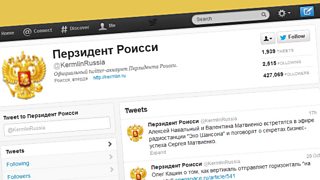
KermlinRussia Twitter account: not the Kremlin
Aleksey Venediktov, editor-in-chief of one of Russia's leading talk radio stations, Ekho Moskvy, has crossed swords with Twitter users who have questioned his editorial independence. While some accuse him of cosying up to the authorities, others say he has let Ekho become a mouthpiece of the opposition.
The row started when Venediktov tweeted on 28 October that protest leader and anti-corruption campaigner Aleksey Navalnyy and Valentina Matviyenko, speaker of the Russian upper house of parliament, would be guests on two consecutive shows the following evening. "There's your answer to any question about Ekho's editorial policy," he added with evident satisfaction.
But to the anonymous owner of popular satirical spoof account KermlinRussia, having politicians from opposing political camps on two separate programmes was a cop-out. "I wouldn't have any objections to your editorial policy if they were on the same programme," the satirist tweeted, adding that the programme should ask questions about the business affairs of Matviyenko's son, Sergey.
KermlinRussia went on to insinuate that Venediktov's "professionalism" was undermined by his "friendship" with the likes of Matviyenko and former education minister Andrey Fursenko.
Venediktov makes no secret of his social contacts with members of the ruling establishment. While presenting a show this May, he said that he counted President Vladimir Putin's press secretary, Dmitriy Peskov, "among my friends". Some listeners were appalled, especially as Peskov had reportedly said that opposition protesters should have "their livers smeared on the pavement".
Venediktov's response to KermlinRussia was prickly to say the least. He replied that he "couldn't care less about your objections". Then he got personal: "Has no-one called you stupid before - plain stupid? No? Then let me be the first."
Others quickly piled into the bust-up. TV presenter and opposition activist Kseniya Sobchak tweeted that she had "had it up to here with these 'uncompromising' fighters who are at odds with anything that moves", and who objected to Matviyenko being on Ekho because she is a member of the "bloody regime".
But journalist and IT expert Arkadiy Sukholutskiy said it was not a matter of inviting or not inviting Matviyenko onto Ekho but rather whether any question could be put to her "regardless of friendship".
Venediktov pointed out that it was "journalists, not the editor-in-chief, who draw up the questions" for guests. He also said that he did not want Ekho to become like the state media holding VGTRK "only in reverse".
Some Twitter users think the station has already gone too far down this road. One complained that his "favourite radio station" had turned into Radio Navalnyy or Radio Udaltsov (another protest leader). Another complained that one of Ekho's regular presenters, Yevgeniya Albats, was "very fond of Navalnyy". "There's nothing wrong with this," he added, "but PR for guests and impartial interviewing are two different things."
Venediktov retored that Albats is not on Ekho’s staff (she is editor-in-chief of opposition weekly The New Times), so was not subject to the in-house rules about impartiality. "I don't think a presenter has to be impartial - a news presenter, yes, but an ordinary radio presenter, no," he tweeted.
Venediktov is strict about enforcing impartiality rules among his staff. He has not voted since becoming editor-in-chief in 1996, so as to forestall accusations of political bias.
In general, though, Venediktov is dismissive of his Twitter critics. He blocked a number of them and told malcontents to go and listen to Radio Shanson, a popular music station. Many were offended. "The suggestion to change radio station is no better than Putin's suggestion to change countries. It's not just your radio station, we, too, have contributed to it," wrote one.
Commenting on liberal website OpenSpace, journalist and opposition activist Oleg Kashin said the row revealed the cultural gulf between a "hierarchical" media boss and the "horizontal" world of Twitter, where "there are no bosses and never can be".
But Venediktov is one of the few Russian media bosses to be democratically elected by their journalistic staff. He is also a stout - if sometimes haughty - defender of his station's editorial independence against all comers - whether the majority shareholder Gazprom-Media, Vladimir Putin, who accused Ekho of serving the foreign policy interests of the US, or opposition activists demanding a ban on ads for the ruling One Russia party.
