A radio studio in my hotel room, ten minutes after checking in

Stuart Hughes
is a BBC World Affairs producer. Twitter: @stuartdhughes
Tagged with:
Twenty years ago, a correspondent wanting to go live from the field ran a real risk of developing a hernia.
During the Bosnian war of the early 1990s, long before the iPhone and Blackberry, the state of the art in 'mobile' newsgathering was one of the first-generation satellite telephones. They came in heavy flight cases and included a clip-together satellite dish as wide as the wheel of a car (below). Correspondents and producers hated them because they were so bulky and temperamental. Even so, in newsgathering terms they were revolutionary.
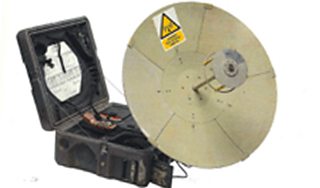
Inmarsat kit
For the first time reporters working in remote locations were no longer tied to fixed and often congested telephone landlines. They could head into the field carrying with them everything they needed to send reports back to London.
Primitive in-vision was soon a reality via videophone, although the kit was still bulky and took time to set up.
When I first started working as a field producer a decade ago, one of the first tips I learned was to carry a compass and always ask for a south-facing room with a balcony when checking into a hotel.
The reason? You needed to point your dish in a southerly direction to pick up a signal from communications satellites hovering high above the equator. Tales abound of producers who went to bed with their satellite dish set up on the balcony ready to go live on the Today programme, only to find in the morning that a nocturnal gust of wind had sent their kit crashing onto the street below. Take it from me, it's a mistake you only made once.
Thankfully broadcast technology hasn't stood still. I was recently able to record, edit and file a radio dispatch in broadcast quality from northern Spain using nothing more than an iPhone, the VC Audio Pro app and a 3G connection.
And last week I set up a fully operational radio studio in my hotel room in Paris within ten minutes of checking in, thanks to a good wifi connection and a MacBook running Luci Live and Adobe Audition.
Stuart Hughes' shed
No more compasses or south-facing rooms. No more shattered satellite dishes on the pavement. Best of all, no more standing in a hotel car park in the rain at five in the morning searching for a satellite signal.
However, the ease with which it's now possible to go live brings with it new pressures. As my colleague BBC Special Correspondent Allan Little told me: "Almost nowhere is inaccessible now.
"When I went to Baghdad in 1991 you could be incommunicado for a whole day," recalls Little. "You gathered all the material, thought about it and got it straight in your mind as you went back to the hotel. Only then did you go on air. Nowadays you'd be under pressure to go live before you'd had a chance to do all that scrutiny and asking of questions."
As technology continues to advance I hope the temptation is resisted to go live just because you can, regardless of whether there's anything new to report.
But I'm also thankful that those cold early mornings spent searching for a satellite signal in the car park are becoming a thing of the past.
Stuart Hughes is a BBC World Affairs producer.
