Mental health stories - a difficult sell?

Tina Stallard
is a freelance film-maker and photojournalist
As dementia - with all its social, economic and political implications - rises up the international news agenda, other mental health issues struggle to get media attention, as former BBC News producer Tina Stallard discovered:
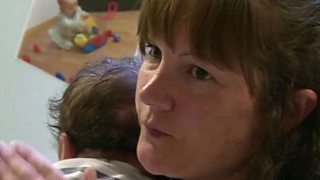
It was shortlisted in the current affairs category along with four other stories, two of which were also Newsnight films. When presenter Scott Mills announced we had won, I was surprised and thrilled. The award was particularly significant for me as it felt as though someone was saying: ‘You see, you were right.’
Of all the stories I have worked on over my nearly three decades in television journalism this was the most difficult. In 2010, when I started work on this film, I had naively assumed the hard part would be persuading women who had been affected by this devastating condition to take part. But thanks to the support of perinatal psychiatrists across the country it did not take long to find Jo Lyall, who had fully recovered from this severe mental illness and wanted to spread the word, and to meet Dave Emson, who had lost his wife and baby daughter.
It was always going to be more difficult to film with a woman who was both pregnant and at high risk of being affected (the risk of developing postpartum psychosis is one in 500 for most women but jumps to one in two for those who are bipolar). So it was particularly challenging when I tried to film with a pregnant bipolar woman in Southampton who repeatedly agreed to see me then pretended she wasn’t at home. It took a further six months to find Shelley Blanchard, who agreed to allow me to film during her pregnancy and afterwards.
But these setbacks were minor compared with trying to get the film broadcast.
As a freelance film-maker I come up with my own stories and find an outlet for them. This story seemed to have great potential and I approached various commissioners both at the BBC and at Channel 4 before I started filming.
No-one showed any interest. One person told me that she felt there had been “too much on mental health recently”.
I began to question my journalistic instincts, but kept returning to the conviction that this was a serious illness which few people knew about.
I had found three women whose stories showed the profound damage the condition could cause and how it could be treated. Although it was not a cheerful subject, it was important. Surely this had to be a story viewers would want to hear about.
I was determined to continue with the film - working alone and fitting the shoots around other commitments so that the only cost was my time and expenses. I finished shooting in September 2011 - 18 months after I had started researching the story. I cut a ‘taster’ to give a feel for the story and returned to the commissioners who had rejected the film a year earlier. I also approached independent production companies.
This time I was told I should have found a celebrity who had experience of the condition to act as the reporter (there was no reporter).
Another asked me to go back to the featured mother and baby unit to find a woman who was not thought to be at any risk and film her being admitted and treated. (My filming of Shelley in the unit was the first time that a patient had been filmed, and had only been possible because of the numerous consents I’d secured before she became ill.)
Another suggested combining the story with another he had come across where a mother had become convinced her baby was a slug…
I had promised the contributors that I would tell their stories, but I was running out of options.
Then finally it all came together. Mary Wilkinson, commissioning editor at BBC World News, took one look at the taster and immediately offered me a half-hour slot. Within a couple of days Newsnight had come on board and offered editing, and Caroline Hawley as a reporter.
On the night of transmission (21August 2012), Newsnight took the bold decision to lead with the story, and followed it with a studio discussion. The Today programme ran a feature, and Woman’s Hour picked it up too. A few months later the Sunday Times Magazine ran a story with my photographs.
Looking back now I don’t know whether I was simply unlucky in my long search for people prepared to broadcast this story, or if there is a wider reluctance to commit to stories about mental health. But I am deeply grateful to the Mind Media Awards for highlighting the importance of continuing to tell such stories.
