How do you report a Falklands trial fairly when you know everyone involved?

Peter Stewart
is a journalist with BBC Surrey and author of Essential Radio Skills
In my several weeks on the Islands I realised that reporting there can catch you out. Because everywhere is so ‘British’ you forget there are slightly different systems of government and judiciary. The Falkland Islands government fulfils both national and local roles (from education and health to road maintenance) including some that in other countries would be run by private companies, such as power provision. So there is no demarcation like there is in the UK.
There is no jury system in general, because of the number of residents on the islands and their likelihood of knowing each other. So a senior magistrate hears most cases, with the chief justice of the Islands visiting at least once a year to hear any serious or complex cases, or appeals.
One of my training sessions at the radio station was based on the BBC’s editorial values, during which I was able to raise several unique questions: how do you report fairly on a trial if you’re likely to know those involved? Are you running a story, or not running it, because of a personal interest or your relationship with the person involved?
Listener feedback can be almost immediate and direct. A huge proportion of the population will know a lot about a local story and won’t hesitate to let you know if you have got it wrong - by simply stopping you in the street or the pub. On the other hand, doing vox pops is virtually impossible. You’d soon run out of people to ask and in such a small community people don’t necessarily want other people to know what they think.
The size of the audience was brought into stark relief when I helped staff report on the trial of a young lad charged over the deaths of passengers in his vehicle which overturned on a road just outside town. Reporting on any death, a broadcaster would think about the words and tone they use. In this place such sensitivity is even more important.
I was told that to use the formal name of a victim as it had been read out in court would have been insensitive to the family and would instantly distance the reporter from the community. Instead we should use the name everyone knew him by. And reporting details of how he met his death was presented in a more sensitive voice than would be appropriate in the UK. All of his family, friends and colleagues were listening closely to every word.
Is the judiciary kept busy? The Falkland Islands enjoy almost crime-free status with an annual police detection rate of around 95%. As residents say: ‘We know everyone so there’s no need to lock our houses or even take the key from the ignition. If someone takes your car people will soon realise that it’s not you driving it… and where would the thief go anyway?’
When I was there recently the station reported on a spat between the senior magistrate and the MLAs (Members of the Legislative Assembly) over the laws of the islands. In general they follow English law, but with local changes and additions. The senior magistrate has recently become publically frustrated that some laws have not been updated so loopholes are appearing. When I was there a case was dismissed when UK-trained police made an arrest under a law that was subsequently found not to exist locally. The senior magistrate is attempting a large review of the content and wording of many of the more common, and serious, laws.
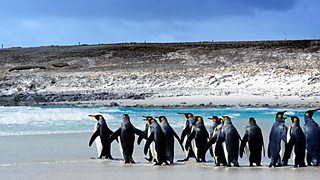
But I wasn’t at Falklands Radio just to give two solid weeks of training in editorial guidelines and court reporting. The Islanders are hugely hospitable and I count many as my personal friends. It has to be said a lot of socialising goes on in pubs, but one weekend I was taken on a ‘battle day trip’ to visit sites made famous by the 1982 conflict. I remember back in 1982 having breakfast before school and listening to Radio 4’s updates on the war. Now those locations were in front of me: Tumbledown,Goose Green, Fitzroy. We toured the British and Argentinian war cemeteries; overlooked ‘bomb alley’ near San Carlos, the scene of repeated air attacks on British ships by low-flying Argentine jets; saw where Col ‘H’ Jones fell; and climbed through the wreckage of the now derelict field hospital as penguins played in the surf just feet away.
The Islands are a unique place in so many ways, and so much more than ‘a bit of Britain in the south Atlantic’. The local people are proud of their British roots but at the same time fiercely proud and independent. After visiting them three times I can understand why.
Read part one of Peter Stewart’s Falkland Islands blog
