From Our Own Correspondent: A sweep of history in one human story

Humphrey Hawksley
BBC World Affairs correspondent @hwhawksley
In the second of our posts to mark 60 years of From Our Own Correspondent, veteran contributor Humphrey Hawksley describes how he sets about crafting a ‘FOOC’ dispatch:
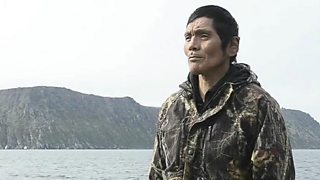
Eskimo tribal leader Robert Soolook gazes out towards Russia from Little Diomede
A 'FOOC' is the shortest of short stories, and ideally it needs a character, a setting and a narrative arc, sprinkled with surprise and tension - all of which fit elegantly into 750 words or so. At its heart is a glimpse of humanity.
Some FOOCs are drawn from a familiar story flooding the headlines. Others are obscure or from a rarely reported place, such as when Andrew Harding on the Somali coast captured our imagination by describing the head scarves of women “flapping in the wind - a bright splash of colour against the white sand”. Or Hugh Schofield delivered us a frustrated chuckle with his take on plumbing pitfalls in Paris.
It’s useful to know what type of FOOC you are writing and what it’s about - just as we might pitch Hamlet as the story of a young man who returns from college and finds his uncle has killed his father and married his mother.
I broadcast my first FOOC from Sri Lanka in 1986, and they neither become easier nor less satisfying.
One of the latest came from the rarely visited US-Russian border in the Bering Strait where Russian and US islands (pictured above) are barely two miles apart. Listeners might not know this or the issues enveloping the handful of people living there. It was important then to first draw them into the setting: “The Island of Little Diomede rises out of the Bering Sea, tall, isolated, its steep sides covered in green plants, grey rocks and faded wooden crosses of village burial sites…”
In another written at the height of Egypt’s turmoil, I began hard in on the character because listeners would have been familiar with the main story: “Badr Houssana is a slightly built man, 53 years old, dignified and measured with neatly cut grey hair and moustache…”
I try to deal with setting and character within the first 150-200 words because of the need to explore what my characters want, and what’s stopping them from getting it.
On the US frontier island of Little Diomede, veteran Eskimo hunter John Ahkvaluk wants to get rid of the border with Russia. (In Alaska, unlike Canada or Greenland, the term 'Eskimo' is considered correct.) Everyone on the island has relatives on the other side whom they can no longer see. The context, historical and complex, needs to be told, but has to remain within the story.
The border that angers John was created in 1867 when the US bought Alaska from Russia. While explaining this, John and I are walking through the village where we meet other characters who corroborated the community’s sense of injustice. As one says: “Whoever comes along and buys your country makes you one of them. Next time it’ll be Japan and they’ll try and make me Japanese.”
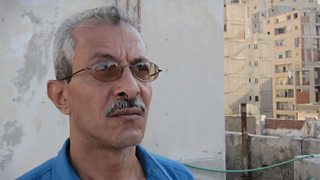
In Egypt, I tracked down Badr Housanna (above) after seeing a YouTube video of rioters killing his son, Hamad. They threw him off the roof of an apartment block. Hamad, a student, had a love for caring for stray dogs. He was caught in the wrong place at the wrong time.
Badr Houssanna hadn’t yet had the courage to go to the place where his son died. So we went together.
By now, having set up the characters and story line, I am about 500-550 words into these dispatches and know I have to bring them to a strong close.
How will John learn to live with this hostile border? How will Badr Housanna come to terms with his son’s murder?
Their stories are told against big backdrops of the Arab uprisings and US-Russia tensions. Therefore the conclusion needs to reflect that the stakes are larger than just one person.
Even though living right on the border, the villagers of Little Diomede don’t fly the US flag. They see themselves as people who have lived in the region for thousands of years before governments and borders were invented. As John says: “I’m a native of these islands. I’m an Eskimo. I’m not an American.”
In Egypt, we follow trails of blood to the roof of the scruffy apartment block where Hamad died, and we learn his father’s first thoughts. “I didn’t know if I wanted to come,” he says. “But now I am here I don’t want to leave.”
In the middle of his sad and angry reflection, he answers a phone call. His eyes lighten. One of the dogs Hamad had rescued was a pregnant German shepherd and her puppies have just been born.
At that moment, on that rooftop, Badr Houssanna - a quiet, lone figure caught up in a violent sweep of history - has just been offered hope of how life can go on.
A discussion programme at London’s Frontline Club to mark FOOC’s 60-year milestone
The first of two special anniversary editions of the programme
From Our Own Correspondent: A writer’s guide
Watch our video on From Our Own Correspondent with Stephen Evans
How to craft a radio dispatch - Jonathan Marcus
Principles of good writing: Allan Little
Our wider section on writing skills
