Where’s my phone? Five big trends in digital journalism

Charles Miller
edits this blog. Twitter: @chblm
The march to a brave new world of news continues apace, according to Nic Newman, co-author of a third annual report on digital news for the Reuter’s Institute for the Study of Journalism.
Speaking to a BBC News audience this week, Newman outlined the most striking trends he’s identified from the international study. Based on surveys of more than 18,000 people in 10 countries by YouGov, the project is sponsored by Google, BBC Global News and Edelman, among others.
Here are five trends in news consumption that Newman picked out:
1.Smartphones are mainstream, making news more personal and social
More than half of those surveyed had an internet-connected phone, with the fastest growth now in countries like Germany and France, playing catch-up with the early-adopting UK. Thirty-seven per cent said they use mobile phones to access news weekly.
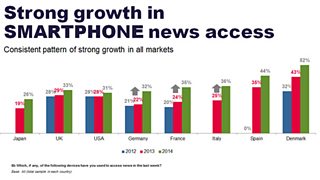
On the heels of the smartphone comes the tablet: a third of respondents had access to one, and one in five used it to find news. The numbers are smaller, but growth is faster. Tablet demographics are older than those for smartphones.
Phone and tablet users are switching from using an internet browser to using apps. This leads to smartphone users visiting fewer news brands. Between last year and this, apps have overtaken browser use for news, according to the survey:
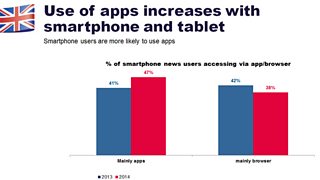
To succeed in this world, news brands need to have strong apps, said Newman. This favours big brand news organisations with quickly changing content, rather than aggregators. For instance, Sky and the BBC are stronger on mobile than on a computer, whereas Yahoo! and MSN are stronger on computers than on mobile.
2. New devices are producing new patterns of consumption
From a world in which news consumption peaked around daily programmes or bulletins, we are moving to one in which consumption is more continuous. That flattening effect is happening fastest in younger groups (the red line below). In mid-afternoon and late morning, the younger audience is accessing more news than the older, but the pattern is reversed at the time of traditional news programmes - early morning and early evening:
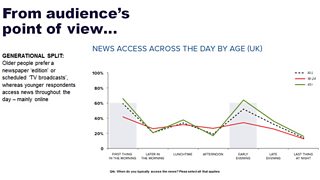
Some news organisations are adapting their news production cycle to cater for new patterns. Newman said the Financial Times, for instance, is launching more early morning stories for people checking their smartphones, “trying to hit these very different internet peaks with different products”.
3. Changing habits of consumption are putting more pressure on business models
The impact of these changes on mainstream media varies widely between countries. While new players like the Huffington Post and BuzzFeed are still quite small in most European countries, in the States, HuffPo has twice the reach of the New York Times website, with BuzzFeed getting about the same.
In the UK, traditional media is still strong and new players haven’t had the same impact because of the continuing hold of media brands like the BBC, the Mail and the Mirror.
Differences between countries relate to how people find digital news. There are three main ways: by going direct to a brand (through an app or the website), by using search, or through social media.
In some countries, including the UK, people tend to go direct to the brand when they want news. In others, like Italy, France and Brazil, search is more important: Google News is the top news destination in France and Italy, whereas only 5% go to it in the UK.
For young Americans, the entry point is Facebook or Twitter rather than either brands or search: they are twice as likely to find news through social media than through brands. The new digital brands do well in this environment: 75% of BuzzFeed’s traffic comes through social media.

Changing ways of finding digital news are accompanied by an increasing willingness to pay it. There’s a "dramatic move to subscription", said Newman, with the Sun and the Telegraph, for instance, putting up paywalls in the past year. It’s the older, better educated users who are most willing to pay, and they are more likely to be using a tablet.
4. Social media play different roles for different kinds of audience
While “news lovers” gravitate to Twitter, Facebook is “the largest network by a long way” in all countries. YouTube is “one of the coming platforms”, and WhatsApp is not to be overlooked: 60% of the population in Spain use it.
The relative popularity of social platforms doesn’t tell you how much they’re used for news: for instance, in Brazil, Facebook is five times more likely to be a source of news than it is for the Japanese. And it’s used for news by 80% of the population in France, Germany and Italy, but not much in the UK despite its general popularity.
The interactive nature of different social networks varies: Twitter users are more likely to share content; Facebook users are more inclined to comment. Despite hardcore news lovers preferring Twitter, it’s Facebook that provides the most referrals to news sites overall.
News in social media appears among content often produced by the users' friends or acquaintances. It too has a more personal tone: most of the professional news accounts followed by Twitter users, for instance, are from journalists themselves. “Social media encourages journalism with a human face,” said Newman. The top journalist followed by a sample of Twitter users studied for the report was Caitlin Moran. The BBC’s Robert Peston and Nick Robinson were in the top five.
5. Video requires something different online
When it comes to online news, small numbers are using video heavily, and then mostly as a supplement to text.
Its popularity is limited by the small screen on a phone, the fact that it doesn’t always work, or works too slowly. Newman characterised the problem demographically as the young being too impatient and the old being too set in their ways.
What does work in video are news clips that add drama to a story, or a piece that provides context or analysis - something different, therefore, from a traditional news report put online.
In terms of subject matter, entertainment, culture, sport and local news all do well as video.
Newman concluded the extremely well-attended presentation of his report with an irresistible invitation to go away and study its “96 pages of really exciting charts and data about your industry”.
This is the first of a series of blog posts about innovation and change in journalism and media organisations. Coming next: how the BBC is experimenting with ebooks to accompany television programmes.
