Changes in news are part of a much bigger picture: A radical theory

Charles Miller
edits this blog. Twitter: @chblm

Jaron Lanier
Lanier’s an interesting-looking guy - a middle-aged white man with dreadlocks. His books, such as the latest, Who Owns the Future?, also combine elements you don’t usually find together: technology, economics, ideas about public policy, snippets of autobiography.
Lanier sees the crisis in the business of news journalism - the collapse of newspaper advertising and competition from ‘free’ social media - as just one example of a bigger trend.
Today, he says, we are all encouraged to add value to big tech businesses like Google, Twitter and Facebook in return for the illusion of free stuff they give us. He calls the new tech businesses Siren Servers after the alluring but treacherous Sirens in Greek mythology who drew hapless sailors to the rocks. Today it’s not sailors but members of the middle class - writers, journalists, teachers, lawyers, shopkeepers, doctors - whose livelihood is in danger.
Like Marshall McLuhan, the media guru of a previous generation, Lanier has a talent for aphorisms. Here are some of my favourite from Who Owns the Future? Any of these would make a great exam question for a media or journalism course. Just follow the quote with ‘Discuss’.
- It is all too easy to forget that ‘free’ inevitably means that someone else will be deciding how you live
- We will not have to call forth what we wish from the world, for we will be so well modelled by statistics in the computing clouds that the dust will know what we want
- The more dominant information becomes in our economy, the less most of us will be worth
- The exhilaration of accelerating change leads to a religious emotion in some of the most influential tech circles
- The recent breakdowns of finance can be understood as the symptoms of a fallacious hope that information technology can make promises on its own, without people
- The primary business of digital networking has come to be the creation of ultra-secret mega-dossiers about what others are doing, and using this information to concentrate money and power
- Great fortunes are being made on shrinking the economy instead of growing it
- The information economy that we are currently building doesn’t really embrace capitalism - rather a new form of feudalism
- We used to imagine that elite engineers would be automation’s only puppeteers. It turns out instead that big data coming from vast numbers of people is needed to make machines appear to be ‘automated’.
Those will give you a flavour of Lanier’s thoughts. He argues for the continuing central role of people - what he calls “a humanistic approach to future digital economies” - rather than the fashionable but, he says, flawed Silicon Valley orthodoxy. According to that view, technology is determining its own direction like a sci-fi plot, with humans fitting in as technology demands. Lanier says that makes us all the servants of technology except for the owners of the Siren Servers, who still have plenty of control over how tech develops.
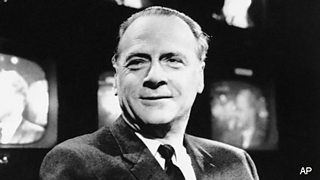
Marshall McLuhan, 1967
Lanier combines McLuhan’s pithiness with an ambitious plan to get us out of the economic and social problems he describes. It sounds far-fetched but what he wants to see is a radical transformation of the way the web works. His analysis centres on something that might appear a technical detail but which Lanier sees as an arbitrary but unfortunate choice in the way the system was set up: links between web pages are only visible and clickable one way.
If I make a link to Lanier’s website, like this, the link is part of this page and visible from it. At the other end, on his page, the fact that his website has been linked to from here is not visible. Because it’s not recorded on his page, Google has been able to make its fortune by crawling the web and putting together data that reveals who links to a page as well as where a page links to. That way, Google decides which pages deserve to be highlighted: pages that other pages link to are more deserving of prominence. Google has discovered they are influential.
Lanier’s point is that those links represent tiny units of financial value, created by people who don’t get credit for them. They lead to and from content that people have made and deserve paying for. If online value relates to people wanting to see what you have written or linked to, then, says Lanier, it shouldn’t just be the likes of Google and Facebook which profit from it. If links were more visible and the origins of what is shared more accountable, the information economy would create worthwhile opportunities for individuals as well as for massive, aggregating tech businesses.
This is an argument to which journalists, and anyone else who wants to live by their wits in making stuff online, should be sympathetic. Lanier doesn’t underestimate the revolution that would be required to bring about such a change. But he’s sufficiently pessimistic about the problems created by existing trends that he believes one day a more equitable system will have to evolve.
It’s not often you come across someone so passionate about trying to save the middle classes.
