An experiment in remote learning: If it’s fun, it works

Sam Peacock
is a trainer in business systems at the BBC Academy
Next year the BBC will be running a major initiative, 2015: Make it Digital, to inspire a new generation to get creative with coding, programming and digital technology.
In preparation, the BBC held more than 26 staff sessions on 10 December, teaching some foundation principles of computer science in an hour reinforced with examples from the BBC website. People watched Bill Gates, Mark Zuckerberg and other celebrities such as NBA star Chris Bosh explain coding concepts. And there were 20 short puzzles with simple drag-and-drop programming to learn about Loops and If Else functions, all with the help of angry birds, zombies and Scrat from Ice Age!
Most of the sessions were face to face at the bigger BBC sites in the UK, but, to reach further, additional sessions were hosted on Lync. People booked in from Sydney, Hong Kong, Delhi and Sao Paulo as well as York, Taunton and Dumbarton.
This ‘All Around the World’ virtual course was a first-time experience for the BBC Academy that involved a number of challenges outlined in Kym Rawlings’s post.
We played music and showed a slide for 30 minutes before the session, which allowed us to check that people could see and hear, and gave us enough time to resolve any issues.
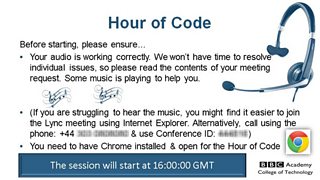
Hour of Code instructions
In the first session I used a headset as planned. Although it went well, the delegates didn’t interact quite as much as we’d hoped.
From then on we chose to use a speakerphone so the delegates could see me at all times. At the start they also saw Kym briefly, and they could hear her chipping in, so it was more of a double-act!
A quick glance through the participant list at the end of the first course showed we had a few people drop out of the session. We knew they could see the trainer’s screen but they didn’t have audio for one reason or another. Because we asked delegates to download Chrome for the Hour of Code puzzles, we think Lync didn’t launch properly because it requires Internet Explorer.
So we sent an email to all delegates in the following courses explaining how they could phone in to the meeting if they were experiencing audio issues. This reduced the dropout rate.
Before the second and third sessions, we used the instant message window to check that anyone who didn’t have audio knew how they could dial in. During that 30-minute lead time, we chatted to each other and to delegates who did have audio.
There were some specific track requests, such as Pharrell Williams’s Happy, which we were not only happy to play but also to sing along to! Because we were having fun, the mood encouraged the delegates to interact, which provided a richer experience for them.
When we were guiding staff beyond the ‘Code with Anna and Elsa’ exercise, Kym played the track from Frozen!
To address interactivity concerns, we had warned selected delegates that we might ask them to take part in the session via email. We also gave them a heads up during the session, using the instant message window, when they were about to be selected.
One of the limitations of Lync is that if you play video on your computer the other people in your meeting cannot hear the audio. As a result, we had previously timed the videos, advised delegates where to find them on the website, and how long they should last.
We had also gauged how long each set of puzzles should take, giving them five minutes to complete Puzzles 1 to 5, for example. As delegates completed them, we muted ourselves so they could concentrate. When the time was up, we unmuted ourselves so everyone knew to regroup in Lync again. In the later sessions, because delegates were happier to interact, we decided to end the practice after three or four delegates had completed the exercises.
Kym awarded gold stars (and cocktails) using emoticons, congratulating the delegates as they completed the exercises. This allowed us to move through the content slightly faster, ensuring we finished comfortably within the 60 minutes.
Overall, we had a fantastic response, and people seemed to really enjoy the session. Next time we want to give staff longer to book, and we’ll definitely follow the same ethos: if we’re having fun, the delegates will too!
Here’s some of the feedback we received:
Mohammad Naim - Kabul: Thank you !!!!!
Emma Taylor - Dumbarton: Enjoyed the coding! I just worked through them all at my own pace then did the Frozen ones too…
BBC staff can watch a video about Wednesday's Hour of Code.
