Kelvin, Cleggy, Stringys and the News Bunny: The wonderful world of Nick Ferrari
Charles Miller
edits this blog. Twitter: @chblm
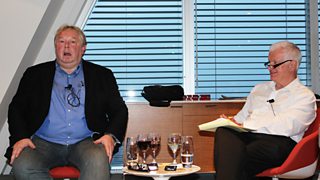
Nick Ferrari, left, and Phil Harding
Today Ferrari hosts the morning show on LBC, where he also invites politicians - Nick Clegg, Boris Johnson and recently Nigel Farage - to take questions from listeners in their own regular shows. It was Ferrari who hosted LBC’s Euro debate between Clegg and Farage.
But at Wednesday’s Media Society evening Ferrari reflected on a long and distinguished career in journalism - distinguished by being about as deeply marinated in tabloid culture as it is possible to be. And by surviving it to remain, according to the evidence of Wednesday evening and his impressive range as a performer on LBC, a decent, sharp, opinionated and surprising empathetic human being.
The household in which Ferrari grew up was itself powered by the UK press. His father, as night news editor (and later news editor) of the Daily Mirror, brought the next day’s papers home from work. Ferrari remembers visiting the Mirror newsroom as a boy: it was “like theatre” with a looming four o’clock deadline followed by the shaking of the building as the presses in the basement started to roll.
As teenagers, Ferrari and his brothers used to phone local stories through to the newsdesks of the nationals, a practice which he said they assumed happened in every home.
Today he still gets the papers early, after his three alarm clocks wake him at 05:45 and he’s driven to LBC for the start of his show at 07:00. Phil Harding, interviewing, and an ex-editor of Radio 4’s Today programme, was astonished when Ferrari said he arrived at the studio 10 minutes before he went on air, and that there’s no script for his three-hour show.
The secret, Ferrari said, is to make any subject work as a phone-in: “You can get people to ring in if you pitch it right.” The years as a tabloid editor came into their own.
On his politicians’ phone-ins, Ferrari talked affectionately of “Cleggy” (“I really like him as a person”) and said it hadn’t been hard to persuade him to commit to the weekly slot, partly because he was aware of a similar show that had run in New York with Michael Bloomberg when he was mayor.
When someone in the audience pointed out that his roster - Clegg, Johnson, Farage - was lacking a Labour politician, Ferrari was quick to come back with “we’d love to welcome Ed Miliband”.
In remembering the glory days of the Sun under editor Kelvin MacKenzie, Ferrari was unsentimental but without regrets: the culture was one of “a bear pit... effectively bullying”. But MacKenzie was “absolutely fantastic” to work for, and Rupert Murdoch “absolutely inspirational”.
If MacKenzie ever felt he’d gone too far - as when he humiliated Ferrari in a news meeting by telling him to clean the office windows, sitting the displaced window cleaner in his seat (great story, brilliantly told) - the remedy was always an invitation to “some splosh at Stringys” (Stringfellows nightclub).
Ferrari went on to set up Murdoch’s Live TV in 1995, alongside MacKenzie and Janet Street-Porter. Live TV was famous for two Ferrari creations. The News Bunny was a work experience person in a rabbit suit behind the newsreader, commenting on news items with either a paws up sign or by holding his head to protect it from the disaster being described.
And then there was Topless Darts. This was an idea Ferrari said he’d made up on the spot in response to an irate MacKenzie demanding some better ideas for the station. It was a simple format: two women removed their tops and threw darts. The one who got closest to the bull's-eye won a toaster.
Ferrari said that today’s newspaper culture is different from his tabloid editing days: “The British press is muzzled in a way I’ve never known before." Retractions are printed prominently where before “journalists would do anything in their power not to print an apology".
Now it’s the police rather than the press who need regulating, he said, citing the aggressive tactics used by police investigating and arresting journalists. A supportive voice from the audience turned out to be Roy Greenslade, taking the opportunity to plug his column on the subject in the Evening Standard that evening.
If Richard Curtis did write a film around a Nick Ferrari character, its ending might have to be fictionalised, if we can believe what Ferrari said last night. No, it wasn’t true, he insisted in answer to repeated questions from Harding that he was thinking of running for Mayor of London. No, the subject hadn’t arisen in his recent private dinner with Boris Johnson. They only talked about Boris’ holiday. But if he did ever find himself as mayor his first ruling would be that he’d still be on the radio every day.
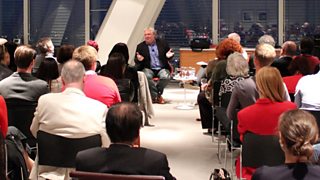
With thanks to Shruti Jozwik of the Media Society for the photographs
