Covering trials on Twitter

Philippa Thomas
is a BBC News correspondent. Twitter: <a href="http://twitter.com/#!/PhilippaNews">@PhilippaNews</a>
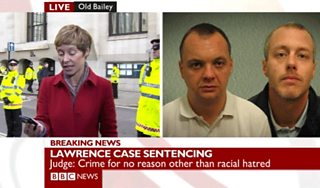
Philippa Thomas reporting
I'm not a legal expert. I'm not even a regular court reporter. But I was one of the BBC team covering the Stephen Lawrence murder trial at the Old Bailey in November.
I am also the BBC broadcaster who used Twitter to break news of the verdicts and sentences for Stephen Lawrence's killers.
This is not a polished article. It's my attempt to reflect on the uses - and perils - of Twitter in our courts. Thank you for your comments on the issue; do keep the feedback coming!
A little about me first. I love using Twitter. It keeps me in touch with stories and contacts around the world, and I enjoy what we've come to call the curation of news - sharing links on everything from London life to 'Arab Spring' politics and the US election campaign.
But this was the first time I'd used social media as another form of broadcasting.
What follows are some reflections about my experience of tweeting the trial. It's a story of two halves - the weeks of the case where I was tweeting about the evidence as it was presented in court, and then the fast-moving hours covering the outcome, where I was talking to camera, using BBC reporters' Twitter accounts as my primary source of news.
From the first day of the trial on Monday 14 November to the day of the verdicts on Tuesday 3 January, I sent out hundreds of tweets from my @PhilippaNews account.
At first, it was just something I wanted to do for myself. I don't have an official BBC Twitter account. But, as the lawyers delivered their opening statements, newsroom editors were keen to encourage the stream of information coming from me, from Home Affairs reporters @mattprodger and @BBCDomC, and from BBC London's @GuySmithreports.
It's not something a reporter should be obliged to do. I think it depends on the way you work. There is a danger when writing notes, thinking about scripts and texting tweets that you will miss the subtleties of legal argument; the way that a line of questioning is being developed.
Whenever the judge told the jury to take a break, we would make a beeline for the BBC's Jeremy Britton - our hugely experienced court producer - who would invariably have taken an immaculate shorthand note of the key quotations, from his bench at the back of the courtroom. Because of our ability to tweet and to file copy directly by computer from Court 16, the BBC had less need of news agency copy and could be more self-reliant.
We were able to tweet because the trial judge decided we could. Thank you, Mr Justice Treacy! From now on, following a ruling last month by the Lord Chief Justice, it will be the norm in England and Wales. I believe we're in the middle of a revolution in the way journalists cover justice.
The Twitter stream is a supplement - an extra service for a minority of the audience. Twitter followers are there by choice. Hundreds more followed me during the trial because they wanted the key developments and dramatic quotes 'in real time'. They liked spreading the word within seconds of it happening in court, to others - often family and friends - who felt passionate about the Stephen Lawrence case.
I expected the service would work for those who were already following the case in detail. What I didn't anticipate was the appetite from people who use social media as their core news services.
I was intrigued by signs that I was reaching new audiences. When we broadcast on TV news bulletins, viewers tend to be older. But on Twitter it seemed that many were younger. Many were from ethnic minorities. Many felt strongly about the core issues of the case: racism, violence and justice.
I had responses from followers who were dipping in and out of the story during the day on their work computers or mobile phones, rather than waiting to get home to view TV news.
Here are a few of the comments I received:
"Guess using Twitter puts more focus on Trial, esp. for younger generations who're always out & about that don't watch TV much."
"For me the character limitation was useful given the pace. The tweets I read were consequently fact - direct quotes and stage directions, omitting comment which in this case would not have been appropriate. Useful in that it also made me aware of more up and coming journos rather than the main faces."
"I dont watch much news, prefer twitter feeds from misc journos. TV news tends to be inane, but you were great."
So was it good journalism? Well, I actually found that thinking for Twitter helped to focus my mind: it made me work harder on choosing the words to sum up forensic evidence, for instance. But, as noted above, there are pitfalls for journalists in trying to do too much and failing to do anything properly - the common lament of our multitasking, multimedia age. It's something we have to address, however enthusiastic we are about using social media to reach out to new audiences.
With court reporting, it's critical to deliver exact quotations, not paraphrases. That doesn't tend to work on Twitter, which requires you to be succinct. On occasion we found that, where a headline quote emerged, we had to follow up, letting the newsdesk and the website know precisely which words came from the barrister and which from the twittering broadcaster.
And it's critical not to lose bits of the argument. The unfolding of evidence in court can be subtle, complicated and time-consuming. We might be writing a series of tweets to cover a single concept but in our followers' timelines those tweets can be interspersed with others, leaving it up to the Twitter user to reconstruct the full picture.
There are also potential problems with the nature of Twitter activity, where followers can retweet and embellish your original posts. My colleague, the experienced BBC correspondent Daniel Boettcher, raised the issue today: what if your name is on a tweet which is circulated elsewhere, appearing in isolation and out of context? As journalists, we're trained to deliver contemporaneous court reporting and to be impartial. Once your tweets are out there, you can lose editorial control. The same could be said of an online commentary, I guess, but again it's a risk we should recognise.
In the second part of this blog I discuss my reporting of the verdicts.
