BBC tips for curating Twitter feeds - from the Russian election

Anna Vissens
is interactive editor at the BBC Russian Service. Twitter: @avissens
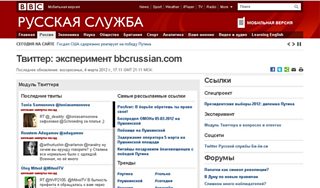
BBC Russian Service with live updates from Twitter
BBC World Service Future Media together with Tweetminster (the media platform that specialises in monitoring political discussions in various languages on Twitter) developed a visualisation module with live updates from Twitter (above). The module highlighted the latest live tweets from a pre-approved group, trends (keywords used by that group), most shared URLs within the group and most active users.
We weren't sure if this would work. The big worry was around editorial control - which is hard to maintain when you are dealing with content generated independently and streamed live to your website.
So we selected our Twitter accounts carefully. We had extensive and very detailed conversations with BBC Editorial Policy around post moderation, potential defamatory tweets and creating a FAQ page to explain the experiment. According to Fair Trading agreements, the Tweetminster logo was nowhere to be seen on the site and Tweetminster itself was fine with that.
When I first saw the list of accounts we were going to use it looked well-balanced, with many big names, media accounts, governmental and NGO organisations on it. But I was not sure how the feed would look live, in terms of the actual content. Although we checked all the accounts and their last tweets, we could not really see the whole picture until we saw it live. So I created my own new Twitter account and added all the selected users to see how it would look for real.
At that point we had around 50 accounts on the list. After monitoring the feed for several hours, I realised we needed more. I started selecting accounts, focusing on activists, both pro- and anti-Putin. I added more than 200 users I thought were worth looking at. I removed all official media accounts because their tweets were duplicating our live coverage and clashed with the editorial purpose of the experiment.
The feed started looking more relevant and dynamic. I monitored it for a couple of days, removing and adding some accounts, tuning and optimising the list.
I can summarise some useful tips from the process:
Activity: The official (Government-related) accounts were not all that active. This pushed the editorial balance towards the opposition significantly. So I tried to add more pro-government activists to keep a balance in the feed.
Quantity: The more accounts you have the better. I found that 200 let us get a variety of views. It is better to use people on the ground: activists, reporters, bloggers. They are more active and their tweets are usually more relevant.
Quality: Before going live I contacted all users, notifying them that their accounts had been added to our experimental tool. It was an editorial decision, of course, but I also hoped that this would reduce swearing and make moderation easier for us. I am pleased to say I was right. I blocked only ten to 15 comments from tens of thousands that poured into the feed over three days. We received no complaints from our audience about comments on the feed.
Hashtags: We didn't use hashtags. First of all because a lot of people who tweeted about the elections didn't use hashtags and we didn't want to cut them off. Tuning your feed is the best option if you want to see certain content.
Timing: On the day of the election the feed suddenly started looking different. If before there were quite a few tweets that were irrelevant to the election, on the day of voting and on Monday, when protests began, the feed was all about the election - ballot-stuffing, pictures of buses with fake voters, pictures from meetings, describing arrests etc. You could follow events live as they happened by reading our feed, which was exactly what we were hoping.
We switched the module off after protests eased off in Moscow. I caught myself thinking I was sorry to see it go. It was an exciting experience; very unpredictable and full of adrenalin.
The module was one of the most popular stories on the site straight after its publication. Our Twitter audience grew by two thousand followers during these days. But, most important, it brought a unique editorial angle to our coverage of the election; colourful and vibrant.
We are already discussing the possibility of having a module like this as a permanent feature, switching it on and off when we need it. At the same time, the scalability of the module means that other World Service language sites can use it for their elections. World Service Future Media is talking to BBC Mundo and BBC Arabic about the polls in Venezuela, Mexico and Egypt, to start with.
