Rise and rise of Arabic on Facebook in Middle East

Damian Radcliffe
is professor of journalism, Univ of Oregon @damianradcliffe
Both Facebook and LinkedIn opened their first offices in the region - recognition of the growing importance of their MENA (Middle East and North Africa) membership base. Here are a few examples which show some of the key regional trends from the past year:
Take up
A report into ‘Arab ICT Use and Social Network Adoption’by the Madar Research & Development Center in Dubai contains a treasure trove ofdata on this front, including the revelation that mobile phone subscriptions in the Arab world nearly matched the region's population - 346 million at the end of 2011. In countries such as the UAE and others bordering the Gulf, penetration rates exceed 125%, with Saudi Arabia enjoying a mobile penetration rate of 189.24%.
Anecdotally, I can report that in Qatar it is not uncommon to see drivers working multiple phones at the same time as negotiating rush hour traffic or a three-lane roundabout. As someone who is still a relative newcomer to the region, I confess this is not a trick I have managed to master (or indeed attempt). Yet.
Over the summer it was reported that one hour of video per minute is uploaded to YouTube in the MENA, with users consuming 167 million video views a day. This is second only to the US. How many of those were PSY - Gangnam Style is hard to say but, given the popularity of the song on the radio - and indeed with young dancers at various public events, my guess is probably quite a few.
Either way, bandwidth consumption in the region has grown by an average of 40% over the past year, leading Cisco to predict that the MENA will be the fastest growing region for internet traffic across the globe in the coming years.
Social networks
Social Bakers reported that Facebook had grown by 29% in the region during 2012, adding over 10 million new registered users, a quarter of whom were in Egypt alone. Membership is growing fastest in Qatar, Libya and Iraq, with more than 115%, 86% and 81% new users respectively.
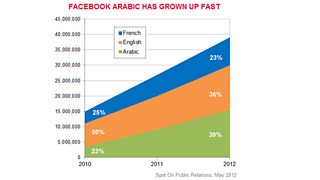
Twitter is also growing fast with 17 million tweetsevery day in Arabic. That is 1 billion tweets every two months. Much of this, about 40%, comes from Saudi Arabia, but the volume of Arabic tweets is increasing across the region. The Dubai School of Government is reporting that the percentage of Arabic tweets in the region had increased from 42% of activity in September 2011 to 62% in March 2012.
In the same month the main Twitter site was made available in right-to-left languages for the first time, a service recently introduced to its mobile site too.
Looking ahead
I expect that we will see these trends continue in 2013, but one area to potentially watch is e-commerce. Ofcom may have recently reported that UK consumers are a nation of online shoppers, but the picture in the Middle East is much more mixed. Even among ‘Digital Natives’ many still prefer to buy in person, even if they’re increasingly researching products and services online.
But in a region where many nationals love to shop that may start to change. Arabian Business recently referred to e-commerce in the Middle East as a "virtual gold rush", with sites like Namshi - an online shoes and clothing retailer which recently secured $20 million financing from JP Morgan Chase and Blakeney Management. For them, and others, 2013 promises to be a busy year.
Elements of this story were reported a round-up of social media developments in the Middle East during 2012. (English version, Arabic version)
