Journalists in danger: A roadmap for fighting impunity

Joel Simon
is executive director of the Committee to Protect Journalists. Twitter: @Joelcpj
Joel Simon was one ofdozens of international journalists, editors, representatives of NGOs, diplomatic and legal figures who took part in this week’s London symposium Making the Protection of Journalists a Reality: Time to End Impunity.
A collaboration between BBC Global News, the Centre for Freedom of the Media (CFOM) and the College of Journalism, the conference sought to produce actions and strategies to combat impunity for violence against the media. It took place on the 100th day of detention for the al-Jazeera journalists imprisoned in Egypt. The CPJ executive’s proposals were some of the most compelling shared on the day:
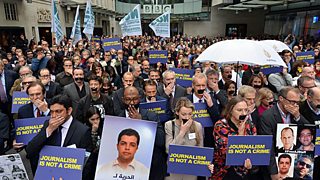
What can be done to break the cycle of impunity? Based on a decade of working intensively on this issue, here are some simple, practical suggestions:
Define success
What is success in the campaign against impunity? Is it an overall reduction in the global impunity rate? Is it convictions in a certain number of cases? CPJ’s Impunity Index, which uses data to highlight the countries around the world where the killers of journalists go free, can help establish a baseline. My own suggestion for an ambitious but realistic goal would be to reduce the impunity rate in targeted countries through campaigning and advocacy and to document, as a result, a corresponding decline in violence. (Note: the 2014 Impunity Index will be released on 16 April.)
Select emblematic cases
To engage the public effectively we need to humanise the issues, and that means selecting compelling cases to highlight. After all, not every journalist killed is a crusading truth-teller. We should identify particular cases in particular countries and use their stories as the basis for broad, systematic efforts that attract public attention and drive change.
Engage the media
If the media doesn’t care about the issue of impunity, who will? But the media is not always a natural ally. In some countries the media and journalists themselves are riven by competitive pressures or politics; in others journalists are resistant to covering the issue of impunity because they view this as a form of special pleading that undermines public trust.
This resistance can be overcome by employing the arguments suggested by Paul Steiger. The media should cover the issue of impunity not out of solidarity but because the killing of a journalist is a newsworthy event. And journalists should cover the issue with the same level of scepticism and scrutiny they apply to every story.
Support the families
Over many years of anti-impunity advocacy, I have observed that the single most important element in a successful prosecution is deep and sustained engagement from the families. Media organisations simply don’t have the drive, commitment and determination to sustain engagement over the many, many years it takes to achieve justice.
Family dynamics being what they are, it’s not always possible to find a family member who is willing or able to devote their lives to justice. But where the commitment exists it must be supported - and supported over years or even decades if necessary.
Families need resources to hire lawyers, rally the public, challenge the legal process, engage local human rights and press freedom groups, and press the authorities. We need to commit to being with them at every step.
Obtain high-level commitments
The CPJ recently completed a mission to Pakistan where we met Prime Minister Nawaz Sharif and other high officials. We presented them with a list of unsolved cases and a series of specific recommendations to address the issue of impunity, and obtained, as a result, specific, verifiable commitments that we have summarised. These kinds of commitments don’t immediately change behaviour; nor do they change the political dynamic that makes violence possible. But they significantly raise the cost of government inaction and provide a framework through which the diplomatic community, civil society and the media itself can engage around the issue.
Hold the UN accountable
Last year the UN Security Council held two debates on journalist security and impunity. The General Assembly passed a resolution. Over the years the secretary general has spoken out on impunity and called for action. Member states have endorsed Unesco’s plan of action for the safety of journalists. There are important milestones and commitments but they are meaningless unless they lead to real progress. And this will only happen if the media community closely monitors actions and highlights shortcomings.
Later this year the CPJ will release a report tentatively entitled The Road to Justice. It will look critically at what is being done, what is working and what is not, and will focus on the UN commitment. We should ask the UN the same question we are asking ourselves: how is success defined? And how will we know if it’s been achieved?
Don’t give in to despair
Let’s face it, this is a depressing business. And it’s all the more depressing this week in the aftermath of the terrible killing of Anja Niedringhaus and the wounding of Kathy Gannon in Afghanistan. In most cases we campaign for years and never obtain justice. Violence against the press may decline - and then surge again. But fighting for justice for the murder of colleagues is a commitment and a responsibility.
In recent years we’ve had some significant successes. Four countries with historically high rates of impunity - Brazil, Russia, Pakistan and the Philippines - have convicted killers of journalists. These convictions came about as a result of years of sustained advocacy involving the strategies described above, including: courageous efforts from families and colleagues; sustained public pressure through media, local and international campaigning; diplomatic pressure from the international community; and measures implemented by the state to ensure safe and fair proceedings and political will.
Joint statement issued at the London symposium on 7 April 2014
Committee to Protect Journalists
Journalists in danger: Action not outrage will end reporter death toll
Journalists in danger: Support press freedom groups or risk lives
Journalists in danger: How can international law help fight impunity?
Journalists in danger: Threats, torture and censorship in Pakistan
Reporting: Foreign assignments
Jailing of al-Jazeera journalists in Egypt highlights need for new defences
Global media to monitor a UN plan to protect journalists from assassination
Other blogs by William Horsley, CFOM international director
London symposium on the safety of journalists - video
Iranian journalists face growing threat of imprisonment in pre-election crackdown
