Freelancers organise to help each other

Stuart Hughes
is a BBC World Affairs producer. Twitter: @stuartdhughes
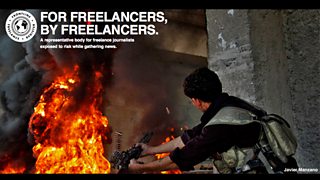
The event came about as a result of the lively debate sparked by a piece I wrote for the BBC College of Journalism with the deliberately provocative title Unprepared, inexperienced and in a war zone.
A number of core issues framed the article and the ensuing discussion.
The first is that our profession is becoming increasingly dangerous. According to the Committee to Protect Journalists, the number of media workers killed last year was up more than 40% on 2011.
The second is that budget pressures and job cuts mean that the news industry is becoming increasingly dependent on freelancers to provide much of its foreign news coverage.
And the third - and perhaps most important - factor is that in many cases the journalists taking the most risks to gather news in conflict zones from Syria to Somalia are the least supported - in terms of feeling they belong to a wider community, in terms of training, equipment and insurance, and in terms of back-up when things go wrong.
The participants in February’s debate were under no illusions: there was no knight in shining armour waiting in the wings to fix these problems. The solutions to the challenges facing freelance journalists had to come from the freelancers themselves.
I ended the discussion by expressing a hope that, unlike in Las Vegas, what was discussed that evening at the Frontline wouldn’t stay at the Frontline, and that instead it would spur people to take practical action.
Now, after several months of dedicated hard work by a group of young freelance journalists, it has.
Crucially, it has put responsible newsgathering at the heart of its remit, requiring its members to sign up to a safety and ethics code.
The expensive hostile environment training and protective equipment offered to staff journalists at large news organisations are beyond the reach of many freelancers. The FFR plans to look at ways of providing cost-effective training, kit and insurance which is consistent with industry-established safety standards.
Freelance safety report
Some may feel that words such as 'collaboration' and 'cooperation' run counter to the independent, self-reliant spirit of the freelance journalist.
I would suggest that the opposite is true.
As the team who have created the Register explain, “There is a new hunger within the freelance community, born of the extraordinary dangers and difficulties on stories like Syria, to work together to take their collective security more seriously.”
With a new body of peers to represent their interests, freelancers can hopefully begin to look forward to a future in which they are able to focus on doing what they do best - gathering compelling and original stories that can shape and inform the way we understand the world.
