Video clues aid verification amid confusion in Ukraine

Vitaliy Shevchenko
is a senior BBC Monitoring journalist specialising in the former Soviet Union
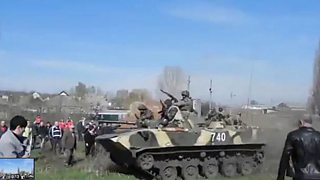
YouTube videos of a tank convoy in Kramatorsk, Ukraine all showed similar surroundings
There is no shortage of videos on YouTube purporting to show the latest dramatic developments in Ukraine. Verifying them is not always easy amid the intense propaganda offensive surrounding the crisis in the country. There are few hard-and-fast rules, but here are a few tricks I've been using to check the veracity of such videos:
Language
There are sometimes clues in the vocabulary, accents and pronunciation used by those filmed and recorded. It has to be said that Russian dialects in eastern Ukraine and neighbouring regions of Russia are very similar, and it's all but impossible to tell them apart. However, the further away you travel from Ukraine the more different Russian sounds.
For example, in this video from Kramatorsk a masked armed man tells onlookers to get back behind a pavement's kerb. He uses the word 'porebrik' which is common in St Petersburg but not the rest of Russia or Ukraine, where the word 'bordyur' is used instead.
There are also phonetic differences between Russian dialects in Ukraine and the language spoken in Russia. For example, 'g' and 'v' before vowels are often soft, so that 'god' (year) sounds like 'hod' in Ukraine and 'vot' (here, this) sounds a bit like 'what'.
Weather and surroundings
The sheer number of camera phones used by Ukrainians has meant that different videos of the same event are uploaded to YouTube. For example, there are a number of videos like this showing the same location outside Kramatorsk, identifiable by the railway tracks, single-storey houses, sunny weather etc - all corroborating details.
Landscape
While verifying videos from Ukraine, it's worth remembering that its eastern parts tend to be mainly flat, with plenty of arable fields. By contrast, there are many wooded areas in the north, along the border with Russia.
Social media profile
It is obviously worth checking the profile of whoever uploaded the video in question. Do they appear to be local? How long have they been active on social media?
Date stamp
Finally, you need to be aware that the 'published on' line on YouTube is US time, not local time. For example, this video of the aftermath of an attack on a pro-Russian roadblock in the Donetsk region (which allegedly happened in the early hours of 20 April) was posted on YouTube the day before.
This prompted Ukrayinska Pravda, an authoritative Ukrainian website, to suspect foul play on the part of LifeNews - the pro-Kremlin Russian TV channel that uploaded it. In fact, the video was posted on 19 April, US time.
Searching for people online: Advanced techniques
UGC: Source, check and stay on top of technology
Blogs by BBC internet research expert Paul Myers
Ukrainian media staging own revolution in face of Russian propaganda
Blogs by Stephen Ennis, Russian media analyst, BBC Monitoring
