'Fisked' by the international press corps
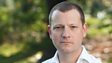
Stuart Hughes
is a BBC World Affairs producer. Twitter: @stuartdhughes
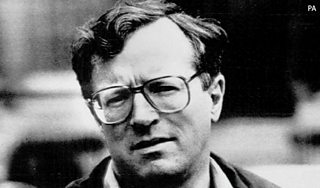
Robert Fisk
For more than three decades, Fisk's impassioned writing on Middle Eastern affairs, and his sustained criticism of Israel and the United States, has won him many awards and many more critics.
Conservative commentators in particular have long dissected and rebutted his articles line by line - to the extent that "fisking" has become a term in its own right, defined as "the practice of savaging an argument and scattering the tattered remnants to the four corners of the internet."
Last weekend, Fisk (above) was in typically combative form. Instead of attacking Western foreign policy, however, he turned his ire (not for the first time) on another of his favoured targets - his fellow foreign correspondents.
Reflecting on recent news coverage from the Syrian city of Homs, Fisk made a number of claims. They included the accusations:
- That the "heroic myth" of the war correspondent has pervaded the public's consciousness to such an extent that journalists sent to cover conflicts now regard themselves as more important than the people on whom they are reporting.
- That an increasing awareness of safety in the news industry, and in particular the wearing of protective flak jackets, has created a sense that the lives of Western reporters are more valuable than those of 'foreign' civilians.
- That privileged and pampered members of the press, who jet into hostile environments and are able in Fisk's words to "fly home if the going gets too tough, business class with a glass of bubbly in their hands", can access counselling if they encounter psychological difficulties, whereas those left behind in war zones are forced to cope by themselves.
The article - published just over a week after the deaths in Homs of Marie Colvin and Remi Ochlik - provoked a furious response. Many senior and well-respected journalists voiced anger at what they regarded as Fisk's disrespectful, out-dated and even dangerous views.
"Fisk correctly identifies there are plenty in our profession with an over-healthy appreciation of their own ego," the BBC correspondent Gabriel Gatehouse told me in an email from Libya.
"He should know, for Fisk is one of the most egregious practitioners of this kind of journalism," Gatehouse added archly.
In a Facebook group for foreign correspondents and aid workers, Lourdes Garcia-Navarro from National Public Radio in the US dismissed the article as "claptrap".
"It's dangerous and patronising after YEARS of getting organisations to acknowledge and treat PTSD to now say we are weak and self-obsessed to need and get help," she wrote.
The foreign editor of The Times, Richard Beeston, questioned why Fisk himself isn't doing more to cover the violence in Syria.
A colleague of Beeston's at The Times, Middle East correspondent James Hider, took issue with Fisk's criticism that the 13 activists who died in the operation to evacuate injured Western journalists from Homs have not been named. "In Syria, most activists don't want their names published, dead or alive, because the regime will kill their families," Hider explained.
But, despite the overwhelmingly negative reaction, a few brave souls did come to Robert Fisk's defence.
"I think Fisk (has) got a point," said writer and journalist Alfred Hackensberger.
"Right now there are... war refugees in Mali. No headlines."
Why, Hackensberger asked, are some wars more "attractive" to newsroom editors than others?
BBC producer Darius Bazargan suggested it was reporters like Fisk who inspired many of the current generation of foreign correspondents to enter the profession in the first place.
"However much you don't like his rather snotty self-aggrandising tone, he has worked the hard yards in the past," Bazargan wrote.
"In his day, he was brilliant."
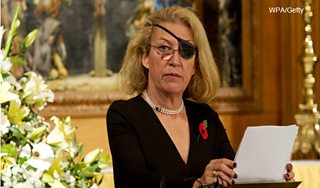
Marie Colvin
In November 2010, Marie Colvin gave a speech (above) in which she spoke of the risks and rewards of reporting conflict.
"We go to remote war zones to report what is happening," she said.
"The public have a right to know what our government, and our armed forces, are doing in our name. Our mission is to speak the truth to power."
"We can and do make a difference in exposing the horrors of war and especially the atrocities that befall civilians."
For many of the journalists who are left to follow in Colvin's brave footsteps, it is this calling, and not the 'heroic' war correspondent myth of which Robert Fisk is so scathing, that drives them to put themselves in harm's way.
