The Falklands for journalists: the ultimate embed experience
Caroline Wyatt
is the BBC Religious Affairs Correspondent: @CarolineWyatt
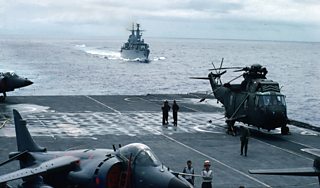
The Falklands task force
But one element is still very much the same for an embedded reporter today: that sense of voyaging into the unknown and of surrendering your own personal safety and destiny into the hands of strangers - and fate.
I vividly remember volunteering to embed with British forces in Iraq to report for the BBC in 2003, wrestling over many sleepless nights with my own fears about the weeks or months that lay ahead and asking myself again and again whether embedding was worth it.
Would Saddam Hussein's forces fight back? Would journalists be a target? And just how long could we eat US Army ration packs (MREs, 'meals ready to eat', given the un-PC nickname of 'meals rejected by Ethiopians') before our delicate journalistic stomachs rebelled?
But there were crucial differences between embedding in the Falklands and doing so some two decades later in Iraq. In 2003, we had satellite phones, and while still close to Kuwait, our mobiles also worked, leading to a surreal phone call from an elderly relative ringing for a chat just as we were crossing into Iraq on the first day of the invasion.
'Can't talk now - I think we're in Iraq, and there's a sandstorm - and this will be a very expensive call'. She rang off rapidly.
In 1982, the war in the Falklands between Britain and Argentina was rather different. It remains a unique case of modern embedding in circumstances unlikely to be repeated - thanks partly to the remoteness of the islands themselves.
It was a war in which a small group of correspondents and crews sailing with the Royal Navy were almost entirely dependent upon the military - not only for access to the conflict, but also for the means of reporting it back to the UK. It was the era before mobile phones, BGAN satellites or the rapid dissemination of information (and misinformation) via the internet.
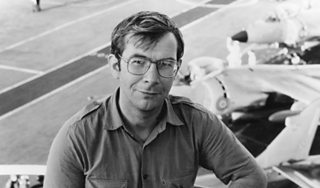
Brian Hanrahan
In 2010, I asked the BBC's Brian Hanrahan (above, on HMS Hermes in June 1982) what it had been like for those embedded in 1982. Despite initial tensions, he said, it had proved an effective means for the military to manage the coverage while still allowing journalists to tell the story of what was happening.
"It is a kind of pact with the devil. Inside the military machine you get much greater access, but in return you give them the opportunity to limit what you can report. It is a devil's bargain that you strike and hope you can make the best of it. In theory the military had absolute control, but in practice it wasn't enforced very strongly at all," he told me.
His memorable phrase about watching British Harrier jets leaving and returning safely came about thanks to the strictures of the military censors. "I counted them all out, and I counted them all back" was a clever ruse to get around reporting restrictions, so that he could say all the jets had returned even though he was not allowed to give the numbers.
For Hanrahan, the Falklands marked a turning point in the military management of the media as the realisation dawned that "the press are a part of the public debate and part of democracy - and are needed for these military ventures. We have evolved from a position where people thought it was odd and wrong that things should be reported to one where it is accepted that reporting is a part of war."
Robert Fox, who was also embedded for the duration of the Falklands campaign as the BBC's Defence Correspondent, described his experiences in a piece for the Independent in 2007:
"We were, in all, a party of about 32-34 accredited journalists, photographers, television crew members. We were all white, male and British. There was no embedded reporter from Europe, the Commonwealth or the US (though they tried hard enough), let alone from Latin America. Imagine trying to keep CNN or Al Jazeera out of British bases in Basra and Lashkar Gah today. And besides, who would want to?
"Further, the sheer physical circumstances made our band of fractious brothers more constrained than any accredited reporter of a campaign in living memory. The military and political powers were able to control who of the media they took with them, what they could see and do, and how they got their dispatches and reports back. The soldiers and marines got to know us, and we them, and the flow of information was pretty good. It got even better once we were in the thick of it together."
That close proximity between the media and the military over several months undoubtedly led to many of the journalists identifying with their military compatriots, though the relationship wasn't without its frictions.
The BBC at the time fought a running battle with Margaret Thatcher's government over terminology, refusing to use the term 'our' troops, but instead saying 'British' troops, while it also caused displeasure by repeatedly questioning the sinking of the Belgrano, even as the Sun newspaper celebrated it with the headline 'Gotcha!'
Once on the islands, though, the journalists had more freedom to move around than modern "embeds" do. Robert Fox and Max Hastings were able to walk across the front line on their own as the Argentines surrendered. Military planners subsequently noted (with quiet approval) that reports from the Falklands at times took longer to reach London than some despatches from the Crimean War in the 1850s.
A second part of Caroline Wyatt's reflections on the Falklands experience for reporters will be posted tomorrow.
