Finding the news: Mobile and social revolution gathers pace

Nic Newman
is lead author, Reuters Institute Digital News Report
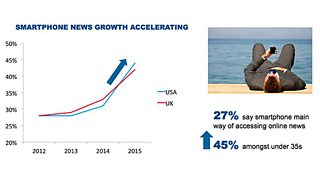
News consumption is going through a further period of rapid change driven by mobile and social media, and this year’s digital report shows that these trends are not just confined to the UK and US but are playing out everywhere. The implications for publishers are fundamental both in terms of audience reach and future profitability.
News accessed from smartphones (above) has jumped significantly over the past year with average weekly usage growing from 37% to 46% (31% to 44% in the US and from 33% to 42% in the UK). But this growth does not benefit all providers equally. Our data shows that smartphone news is often dominated by a few successful brands, with others struggling to reach a wider audience, both via apps and browsers.
On average people use a small number of trusted news sources on the mobile phone - just 1.5 per person - significantly fewer than on a tablet or computer.
Although 70% of smartphone users have downloaded a news app, only a third use news apps on a weekly basis. The reality is that only the most loyal users are downloading and using apps. For others social media, messaging apps, email and mobile notifications are becoming an increasingly important route to news.
Across all platforms, significantly fewer people are accessing the front page of a news website where a list of stories is displayed. More people are going directly to stories via search or social media.
Facebook, the grand daddy of social networks, is increasing its focus on news with an average 41% of our sample using it each week to discover, share or discuss stories. Referrals to top news sites are up 42% year on year (according to data from NewsWhip).
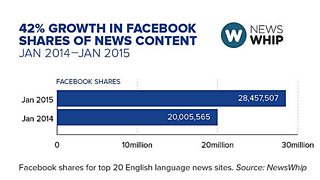
The implication of all this is that for many people - particular the young - news apps, news websites or even news brands are no longer the starting point for news. Publishers are increasingly creating raw material that is fed into and accessed on broader platforms.
In the last week or so Apple has announced a beautiful new space for aggregated news (below) with monetisation opportunities attached. Facebook recently offered publishers a similar deal with Instant Articles; Snapchat began the process earlier this year with its Discover platform.
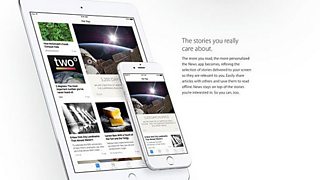
Josh Benton at Nieman Lab has called 2015 the year of distributed content, while Emily Bell warns in this year’s report that the growing power of platforms and news fragmentation has weakened the bargaining power of journalism organisations. “The only remaining question is how fast will we see a shift from the old models of distribution to the new“, she says.
But while these are fundamental changes, we shouldn’t get too carried away. The future is more likely to be a shift than a wholesale move away from destinations and strong news brands. Our data shows that three quarters of our entire sample (74%) still look to a traditional newspaper brand in print or online, while 89% continue to access news from a broadcaster via TV, radio or online. Facebook and Apple won’t be in the content creation business any time soon - indeed they need interesting and timely stories and original reporting to drive conversation and ultimately revenue.
It is the discovery mechanisms that are changing as social and mobile speed up the news cycle and make it easier for consumers to find the stories that are relevant to them.
News brands will need to adapt to a more personal, atomised and distributed world - and hope that along the way there are at least some opportunities to make money.
Read more on the Digital News Report 2015 website or download the full study.
