
The peace process in Northern Ireland in 2013 is facing the twin challenge of dissident republican violence and loyalist street protests. For BBC Ireland correspondent Mark Simpson, the job he started four years ago has changed significantly.
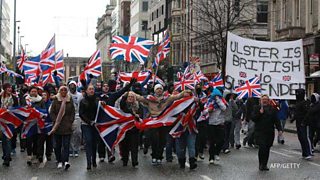
Loyalists march at a flag protest in Belfast
I was standing outside a fire-bombed building in Carrickfergus attempting to talk to presenter Sophie Raworth in London while White Christmas by Bing Crosby was played full-volume beside me through a battery-operated CD player.
My pleas for some temporary quiet were in vain.
“We’ll turn our music down when we get the Union Jack back on top of Belfast City Hall,” responded one of the loyalists.
“At least play me something more modern than Bing Crosby,” I said, in a feeble attempt to lighten the mood.
I thought the music could not get any louder. I was wrong. The volume was switched to maximum and Bing’s singing could now be heard right across County Antrim.
The loyalist flag protests and street violence made December a busy month for news in Northern Ireland. The protests were widespread and, although most were peaceful, some turned very ugly. More than 30 police officers were injured.
The previous month dissident republicans killed prison officer David Black in a drive-by shooting.
Just before the New Year, dissidents tried to murder an off-duty police officer with an under-car booby trap bomb in east Belfast.
For journalists in Northern Ireland, it was anything but a quiet Christmas.
Over the festive period, I bumped into my predecessor, the long-serving Ireland correspondent Denis Murray who retired in 2008. His award-winning career epitomised the transformation of Northern Ireland. It spanned multiple atrocities, countless funerals and marathon political negotiations, but ended with the remarkable sight of power-sharing being agreed between old enemies Ian Paisley and Martin McGuinness.
After calm finally arrived at Stormont in 2007, Denis was last seen on TV doing a report about Dustin the Turkey representing Ireland in the Eurovision Song Contest.
When our paths crossed over Christmas, I asked him: “What happened to our deal, Denis?”
“When I took over from you four years ago, I said ‘You did the war, I’ll do the rest of the peace’.”
It has not quite worked out that way. The violence is not like 30 years ago, but it’s still unwise for a Belfast journalist to be too far away from a telephone.
Although the news agenda has changed, and economics makes more headlines than politics nowadays; barely a week goes past without a security story.
It may be relatively minor - the arrest of a terror suspect, or the discovery of a weapon - but it demonstrates that the peace process still faces threats.
One of the biggest challenges is to explain the outbreaks of violence to a UK-wide audience. There is a whole new generation of viewers, listeners and readers who do not remember the Troubles.
Although dissident republican groups - including the so-called New IRA - are armed and dangerous, they have only a fraction of the weaponry the Provisional IRA possessed in the 1980s and their violence is sporadic, not sustained.
In reporting their attacks, there is a constant need for context.
As for the loyalist flag protests, the explanation is complicated. Yes, there is genuine anger about the removal of the Union Flag from its permanent position in Belfast, but there is also a loyalist element simply bent on causing trouble.
A wider issue is the fact that the peace process has left some people behind who feel their lives have got worse rather than better.
Now, try fitting all that into a 75-second report for Breakfast TV? Or a 40-second report for the Radio 4 8am news bulletin?
Then how about a tweet?
The danger is that the context of the story outweighs the content, or vice-versa. Striking the right balance is never easy.
Reporting on the trouble isn't straightforward either. A Belfast newspaper journalist and a photographer were injured during recent flag-protests which turned violent.
My own reporter riot-kit has had a busy six months, with disturbances in July, September and December.
Included in the kit is a hard-hat, a mini fire-extinguisher and flame-proof trousers. During all my years reporting, the equipment has never let me down.
Mind you, it was pretty useless when it came to dealing with that onslaught from Bing Crosby.
