The news with feeling: How technology can read an audience’s mood

Charles Miller
edits this blog. Twitter: @chblm
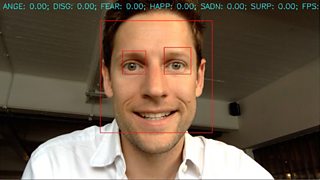
CrowdEmotion technology measures emotions from facial expressions
And there are more evaluative measures: BBC programmes, for instance, get an Appreciation Index (AI) - a figure out of 100 for how much a programme was liked by a sample of its audience.
But the founders of a start-up company based inside a BBC building argue that until now what’s not been successfully measured is an audience’s feelings about the output.
CrowdEmotion is developing ways of turning audience feelings into numbers, drawing on a well-established academic field.
In the 1950s the US psychologist Dr Paul Ekman began studying the relationship between emotions and facial expressions. Since then his work has described how a human being’s 42 facial muscles can be used in multiple combinations to create 10,000 different expressions. He believes 3,000 of them relate to feelings.
CrowdEmotion’s technology aims to capture those facial expressions using large samples of people - now relatively easy thanks to the cameras built into so many devices. It then classifies them in terms of what some psychologists see as the six basic emotions: happiness, surprise, anger, fear, disgust and sadness.
When someone watches a piece of video, a recording of their face is translated into a constantly changing measure of each of those six feelings. When CrowdEmotion’s technology combines the results from a large sample, it can offer an idea of what parts of a film ‘work’ in terms of engaging an audience, and which fail to produce a reaction.
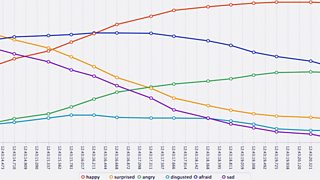
The technology analyses expressions into six basic emotions
BBC Worldwide was sufficiently interested in the possibilities that it gave CrowdEmotion a place on its Labs programme, a start-up accelerator offering new businesses a temporary home, mentoring and partnership opportunities.
It’s relatively easy to imagine measures of feelings being useful to drama producers, who are trying to evoke all six of the emotions that CrowdEmotion aims to track. But how would it work with factual content, and news in particular?
The company met with Kitty Brown, Head of Audience and Business Insight for BBC Global News Ltd (the international and commercial business that brings together the BBC World News television channel and bbc.com/news and bbc.com/sport). Brown says she was intrigued by the idea that detailed research could be done remotely rather than having to assemble a focus group in a room. That would be a huge cost saving for a business with a worldwide audience.
But as to what might come out of a study of audience feelings for news, there are some obvious complications: how much would the results tell you about the editorial decisions behind the programme, rather than simply offering audience reactions to its content? Anger or sadness may not be triggered by the presenters or storytelling techniques, but by the powerful subjects being reported on.
Matthew Celuszak, chief executive of CrowdEmotion, doesn’t play down the complexity of what it’s trying to do, but suggests some early ideas about the kinds of interpretation of its data that might work with factual content.
For instance, by combining the figures for all the emotions over the duration of a piece of video, he can offer an index of “journey size”: it’s the difference between the peaks and troughs, or the range between indifference and engagement. There are indications that on a documentary, for instance, a large journey size is preferable to constantly heightened emotions: being ‘on the edge of your seat’ the whole time is not necessarily what an audience wants.
Similarly, for factual material there may be a kind of Holy Grail facial expression, which Celuszak describes as “puzzled but happy”. That’s how people look when they’re processing information.
Celuszak has a commercial background, although you might imagine something more academic. CrowdEmotion is, in a sense, still a technology in search of a role.
The strategy is to refine it and offer it broadly, rather than trying to target a particular sector. The website mentions education, HR, sales, gaming and health as areas where it might be useful. Film and TV is only the first field it’s trying to conquer. So how do you feel about that?
