Egypt: two key Facebook groups behind the protests

Muhammad Shukri
is Middle East Media Analyst at BBC Monitoring.
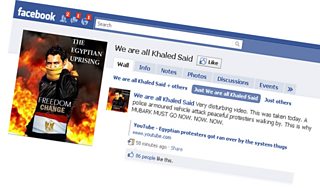
We are all Khalid Said screenshot
The first, We are all Khalid Said, was created in June last year, and named after a 28-year-old Egyptian from the coastal city of Alexandria.
According to the group, Sa'id was beaten to death by two Egyptian policemen in the street. "The incident has woken up Egyptians to work against the systematic torture in Egypt and the 30 years running emergency law," the group says. "We need international supporters to help us stand against police brutality in Egypt. We invite you to support our cause."
Several reports said that, according to eyewitnesses, Khalid Sa'id was taken by the two policemen into the entrance of a residential building where he was brutally punched and kicked, with his head banged against the wall, the staircase and the entrance steps.
This reportedly happened after Sa'id posted a video on the internet showing officers sharing among themselves the spoils from a drug bust.
After Sa'id was killed, the police authorities refused to investigate his death, saying that he died because he swallowed a pack of marijuana. Another official statement said he was an army deserter. The authorities then refused any further investigation.
But with pressure mounting, and European Union representatives in Egypt asking for an impartial investigation, the Egyptian authorities questioned and arrest the two policemen involved. They were subsequently charged with two counts: "using excessive force" and "unjustified arrest" of Khalid Sa'id. No-one was charged with his murder.
Sa'id has become the symbol for many Egyptians, and today the Facebook group (above) is busy with comments about the current situation, such as:"Thirty years of Mubarak are 30 years of emergency law, systematic torture, thousands killed, widespread corruption, all elections rigged, poverty, humiliation, police state, clampdown on freedoms, clampdown on freedom of speech & injustice."
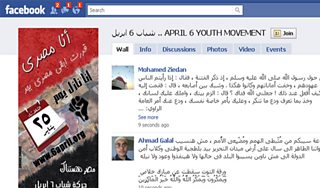
The April 6 Youth Movement
The strike was held in solidarity with textile workers from al-Mahalla (100km north of Cairo) who had announced they would go on strike on that same day. The group gained momentum and eventually coalesced into a political movement known as the April 6 Youth Movement.
As with Egypt's other protest movements, the April 6 Youth Movement is not a formal political party, but it nonetheless provides an outlet for a new generation of politically conscious Egyptians.
Two of the movement's founding members, Israa Abd-al-Fattah and Ahmad Mahir, were under the age of 30 when they created the original Facebook group. The group functions as a forum and powerful organising tool for the movement's members, who frequently post comments, photos and news reports to the page.
Leaders meet online to debate issues, plan events and mobilise the group's members to participate in specific demonstrations. Members of the movement have used various Facebook features - including profile pictures and status update boxes - to protest against police measures and express solidarity with fellow activists who have been arrested or harassed.
The site has many recent entries, some of which say that what has been achieved so far is enough: 'Mubarak is finished, let's move on.'
As an informal group, the April 6 Youth Movement does not enter into official alliances with political parties. However, party leaders are attuned to its activities and have occasionally expressed solidarity with the movement. According to media reports, individual members of al-Ghad, Tagammu and the National Association for Change participated voluntarily in the April 6 Youth Movement's 2010 demonstration, although their parties had not officially endorsed the protest.
