Why social media in Pakistan is unlikely to spark an ‘Arab Spring’

Sajid Iqbal
is an Urdu media analyst with BBC Monitoring
"Helicopter hovering above Abbottabad at 1am (is a rare event)," he wrote on Twitter. "A huge window-shaking bang here in Abbottabad... I hope it's not the start of something nasty."
On the map, maybe, but not on a par with some other countries in terms of usage, media culture and response to recent events. The Pakistani social media scene thrives across all platforms but has failed so far to challenge broadcast and print media in the way that has happened in other regions.
Social media often highlight stories that traditional media are unable or unwilling to cover, but activists are not in the same position to usher in political change as their peers in the 'Arab Spring' countries, for instance. It’s a complicated picture, for a variety of reasons.
According to the social media monitoring site Socialbakers, the number of Facebook users in Pakistan stands at more than 8 million and is increasing at a brisk rate of 7% or more a year.
YouTube is also popular. According to the Alexa monitoring site, it is the second-most popular site after Facebook - ahead of Google, Yahoo and Blogspot.
The ProPakistan technology website says that YouTube is the favourite social media platform of more than 25% of Pakistani internet users, second only to Facebook, on 53%.
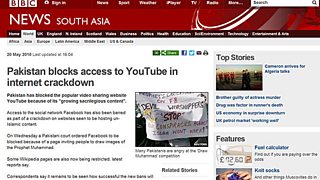
The authorities in Islamabad have blocked access to YouTube several times. The Pakistan Telecommunications Authority ordered internet service providers to block it over the Danish cartoons depicting the Muslim Prophet Muhammad.
Access was blocked again in May 2010 when a campaign started on Facebook to draw images of Muhammad. The latest block on YouTube came in September 2012 when it refused to heed Pakistani government requests to remove the film Innocence of Muslims.
The number of Pakistanis on the more immediately newsy Twitter platform is much lower than on Facebook. A German report on social media in Pakistan released in December 2011 gives a figure of 2 million users.
A major reason why social media lag behind in Pakistan is one of credibility. On one hand, Imran Khan's Tehrik-i-Insaf party successfully used Facebook to mobilise support for its major rally in Lahore in October 2011, sparking hope of large-scale youth participation in the political process. But many social media enthusiasts were dismayed to see Facebook also used to post doctored images of the attacks on Rohingya Muslims in Burma, and to portray the young schools campaigner Malala Yousafzai, who was shot and seriously injured by the Taleban, as a CIA agent.
This was a serious blow to Facebook's credibility as a reliable source of information. And there are allegations in the Pakistani media that many Facebook campaigns are manipulated by a small group of users.
YouTube has also been used for good and ill. A controversial video ridiculing Pakistan's powerful military and attitudes towards minorities went viral in October. Produced and performed by the pop group Beygairat Brigade (Shameless Brigade), it poured scorn on political leaders and the army chief. Without YouTube it would not have had an airing.
A video of the public flogging of a teenage girl in the north-western Swat Valley sparked such outrage that some commentators see it as a prime mover behind a Pakistani Army operation against the Taleban.
On the other hand, some Islamists have used YouTube to generate sympathy for Mumtaz Qadri, the bodyguard killer of Punjab governor Salman Taseer, raising serious public doubts about the virtue of this social media.
And so, to Twitter: Sohaib Athar’s historic Abbottabad tweeting aside, Twitter is notorious throughout the region as a battleground for trolls of rival political parties.
In one such attack last June, supporters of Imran Khan targeted respected lawyer and human rights activist Asma Jehangir with hate messages and ridicule after she spoke out against their party.
So why have social media been ineffective in bringing about social change?
Pakistan's media environment is a major reason. Private media outlets are feisty, and even confrontational, towards the government, in contrast to Arab Spring countries where the traditional media were stifled.
Low penetration is certainly another reason for the relatively slight impact of social media. A report by the think-tank the Norwegian Peace-Building Resource Centre puts Pakistani internet users at 20 to 30 million, or 11 to 17% of the population.
“Pakistan's internet penetration rate exceeds that of some of its South Asian neighbours, yet [it] lags well behind those of Arab Spring nations such as Tunisia (36%) and Egypt (26%),” the report says