The challenge of reporting history in two and-a-half minutes

Phil Harding
is a journalist, broadcaster and media consultant, and a former controller of Editorial Policy at the BBC
Two dates in the Queen’s diary and two more royal events for the BBC and the media to cover. But a couple of this week’s engagements were trickier to report than most.
First was the handshake with Martin McGuinness in Belfast. Then, the following day, came the unveiling of the memorial to Bomber Command in London.
Both were redolent with history and conflict. Both still engender controversy, even though in one case the events commemorated took place more than 60 years ago.
And that’s where the tricky bit comes in. How should journalists deal with history? How do we give a real sense of episodes from the past that still arouse strong arguments - especially when, as here, the events we’re reporting on today are about reconciliation?
One reason journalism struggles with the past is that it can be difficult to portray the raw emotions that past events have provoked. No matter how good the research, how evocative the library film, or how expert the pundits, the result never quite recaptures what it was really like then.
That’s why one of the most illuminating pieces of journalism about the McGuinness handshake was Peter Taylor’s report on Tuesday night for Newsnight.
It was a brilliantly simple idea. In 1977, Peter had made a film for the then ITV company Thames about the Queen’s visit to Northern Ireland that year.
The province was a very different place then. There were riots in the streets, the IRA bombing campaign was in full flow and the Queen didn’t stay overnight. For reasons never entirely clear, the film was pulled from transmission ten minutes beforehand.
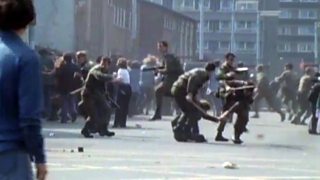
Northern Ireland in 1977, from Peter Taylor's film
What also came over most vividly from the 1977 film was what a different world we all inhabited then.
The other reason I think journalism has trouble with history is that there often isn't a single simple story to tell.
Journalists love simplicity. And with good reason: it’s an important part of the craft of journalism to distill and make clear complex events.
But history – especially the history of conflicts – is often about conflicting narratives. That’s part of the reason why covering the Middle East has been so problematic.
So with Northern Ireland there is the story of the Unionist majority terrorised by the bombers of the IRA versus the Republican story of nationalist aspirations crushed by the British occupation.
With Bomber Command, there’s the story of justifiable total warfare by the heavy bombing of German cities to speed the path to victory versus the opposite version that portrays it as a misguided and barbaric campaign culminating in the firestorm of Dresden.
Two different eras of history, but both with competing stories of what happened in the past.
And for the working correspondent comes the massive journalistic challenge of how to capture all of that in a two-and-a-half-minute package for BBC1's Ten O'Clock News.
In such circumstances context becomes absolutely crucial – and that means allowing enough time for the context to be explored and explained. Hence the wise decision to run a second package on the Ten on the McGuinness visit.
Both stories also raise difficult questions of tone - perhaps most acutely in the case of Bomber Command. To convey the courage of the flight crews without ducking the controversy is a difficult balancing act. And that balance becomes ever more difficult when in interviews so many of the heroic survivors vigorously defend the wartime strategy.
The best of the reporting in the past few days has managed to draw a clear distinction between the individual heroism of the airmen and the wider debate about tactics.
Reporting today can be tough enough. But, as editors have been reminded this week, reporting yesterday can be even harder.
