Public broadcaster battles legal threat against using Twitter and Facebook

Axel Maireder
is a researcher at the University of Vienna's Department of Communication, studying structures and dynamics of public communication on the internet.
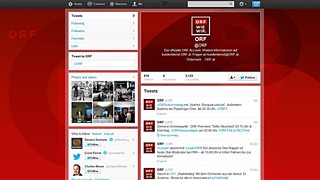
ORF on Twitter
Based on a revision of Austrian media law in 2010, the prohibition has now been the subject of political debate and lawsuits for almost two years.
According to the law, ORF is not allowed to operate, link to or cooperate with online social networks except when they are the subject of a news report. In spite of this prohibition, ORF continued to operate Facebook pages.
Last year the federal media regulator, the Austrian Communications Authority (KommAustria), decided that 39 of ORF’s Facebook pages were illegal and requested the public broadcaster to shut them down. The ORF filed a complaint against the decision before the Federal Communications Board (Bundeskommunikationssenat or BKS), but in April 2012 the appeal was rejected, forcing ORF to take its Facebook pages offline.
Private media companies applauded the BKS’s ruling, which claimed the law was intended to protect private media companies from having to compete with the public broadcaster in yet another field.
Given that ORF has a 36% share in the television market, compared to the combined 6.5% of the two largest private Austrian broadcasters, as well as 74% in the radio market, this claim seems comprehensible and explains why private media has consistently lobbied for stricter regulation of ORF.
In this context, the Facebook ban was seen as simply another episode in private media’s struggle to prevent ORF from monopolising market share and, consequently, advertising revenues. In contrast to some other publicly funded broadcasters, ORF makes about a third of its money from advertising.
Whatever the legitimacy of the private media’s concern with ORF’s dominance, ORF’s social media activities have hardly any effect on its advertising revenue. ORF’s Facebook pages and Twitter accounts create neither direct revenue nor advertising money for the public broadcaster.
BKS did not explain why it was worried about ORF’s social media activities, besides the juridical argumentation. ORF’s management, journalists, media experts, and parts of its audience, protested at the BKS’s decision mostly on the grounds that the law violates the right to free expression and prevents ORF, as a public service provider, from adapting to a changing media environment.
After ORF failed to file a complaint with the Supreme Administrative Court, the Constitutional Court (Verfassungsgerichtshof or VfGH) announced it would investigate the case. Arguing that the social media ban contradicts the universal right to free expression, the court ruled in favour of ORF in July this year, allowing the public broadcaster to resume its Facebook activities.
Yet last month the regulators at the BKS issued another verdict that acknowledged the VfGH’s decision by permitting ORF to distribute content via Facebook but not to operate “permanent discussion forums”. Given that Facebook is essentially a permanent discussion forum, this move has been met largely with incomprehension, and raised questions as to why the regulatory body would oppose the ruling of the constitutional court.
While this question remains unanswered, the VfGH decision has postponed the effect of the BKS’s verdict, allowing ORF and its audience to once again meet on Facebook. But for how long?
Axel Maireder blogs about his work, in English and German.
