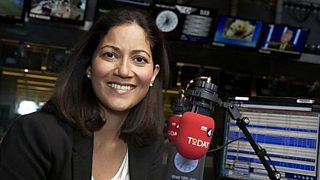
The alarm goes off at 3:10 AM. It’s not a clock, but a buzzer on a wristband, to avoid waking her husband. As she gets dressed she watches last night’s 10 o’clock TV news. She’s in the cab by 3:35, reading the papers on the way to the BBC. By 4:10, she’s often pre-recording an interview.
Mishal Husain’s professional life is a mix of the carefully planned and the spontaneous – much like the formula for the Today programme, which she joined two and a half years ago. Since starting on the programme, she’s streamlined her routine: she now has 10 more minutes in bed.
Talking to former Today programme editor Phil Harding for a Media Society event in London, Husain was reluctant to admit that she’d “settled in” to the programme. After all, as she said, two and half years means that “in the life of a Today programme presenter, I’ve hardly been born”. Besides, it was important to keep “an element of apprehension about it” rather than getting too settled.
Overall impressions? It’s “definitely the hardest job I’ve done so far – but it’s great”. And of course “the working hours are atrocious”.
It’s also a very long programme, at three hours. On her first day, Husain said, she couldn’t sleep the night before. After the show had been on-air for a while, she thought they’d been cracking through it pretty well: she looked at the clock and found it was still only 6:12 AM.
Husain’s previous job had been presenting a daily BBC television news programme for international audiences. Knowing she had got the Today programme job, she felt she needed to mug up on the British agenda: “When I’m faced with something new, I’ve always bought a book on it”. In this case a book wasn’t enough. Instead she took herself off to a hotel for three days with a large collection of cuttings to fill in the gaps.
Any background knowledge is put to good use, not only during interviews, but in scriptwriting too. The programme presenters are given briefs for each of their items, but they write their own intros. Since they may be covering a big story two or three times during one programme, they have to come up with different ways of approaching the subject, not only to avoid repetition, but to write something appropriate for the different slots (longer and more considered for the main interviews, for instance).
Husain said she tries to make her first question a natural continuation of the cue, but from then on will play it by ear as it “has to feel like a natural conversation”. Phil Harding put it to her that she was “searching but not confrontational” in her interview style: “I would say I’m confrontational when I feel I need to be”, was her response.
There was a small demonstration of this when she chided Harding for the lack of female presenters on the programme under his tenure – only Sue MacGregor. It was a point that cropped up more than once, until she won an admission from Harding: “I should have done more about it”.
Husain said she’d been delighted to receive a supportive call from MacGregor when it was announced that she’d got the job. As to how much things have changed now, she said that improving female representation on the programme among both contributors and presenters was “an ongoing battle” – but then that was true more widely too, and not just in the media.
Alongside the self-discipline, including the five-year career plans which she’d revealed in an interview with the Financial Times (although she told Harding they “weren’t written down – it wasn’t a spreadsheet”), the ability to be spontaneous is an important part of the job.
One of the charms of the Today programme is the unplanned reactions of the presenters to the items and their ability to chat to each other just enough to be personal without any suggestion of self-indulgence. Husain said that part of the programme was never discussed between them, but it was one of the reasons she liked working with other presenters.
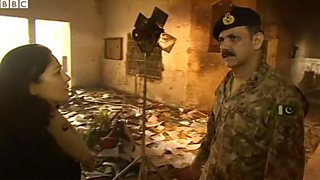
In a completely different vein, spontaneity was called for in what she described as “the hardest bit of broadcasting I’ve done”. It was from a Pakistani school where children had been killed by the Taliban. She had only a local cameraman with her, and just one chance to walk through the blood-stained school with a general from the Pakistan army (above), recording for both television and radio at the same time. That was hard in itself, she said, because you need to describe things for radio that the camera is showing TV viewers. Harding complemented her on the powerful piece, and Husain admitted: “I haven’t dared listen or watch back anything we recorded on that day.”
It was 8:30 in the evening, and Husain was still looking wide awake. She admitted she takes a nap in the middle of the day – otherwise “I’m quite grisly when I pick up the children from school”.
But she’d only talked about half of her upside-down schedule: she also often presents the BBC News at Ten. And after that “I’m wide awake at two in the morning”. The audience drifted out of London’s Groucho Club, never more grateful for the prospect of a normal night’s sleep.
