Investigative journalism with bite: How The Ferret was set running

Rachel Hamada
Co-founder of investigative website The Ferret @rachelhamada
The Ferret is Scotland’s first online investigative journalism platform. It’s taken some time to emerge from its burrow and get to work. So what prompted it?
We saw a clear gap in the Scottish media scene for a site that would support in-depth journalism, that would encourage innovative and imaginative presentation of stories, and that would ask hard questions - because it was beholden to nobody.
Things began slowly with a small grant from Co-operatives UK, and then came a series of meetings in pubs with a revolving cast of Scottish and Scotland-based journalists, debating what form this new project could take.
A core (and, importantly for productivity, non-pub-based) steering group emerged, made up of five established journalists from across Scotland’s central belt: original founder Peter Geoghegan, Billy Briggs, Rob Edwards, Alistair Tibbitt and myself. With specialisms including politics, human rights, social justice and the environment, the group established a website and an initial working title, the Scottish Inquirer. It also established some key principles about how it would operate so that it would stand out.
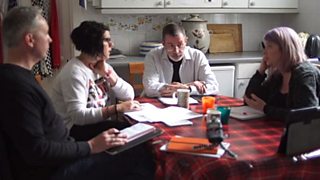
The Ferret team in an early, non-pub editorial meeting
Editorial independence
Post the Scottish independence referendum, many in Scotland felt that the mainstream media had been pro-union and pro-status quo. This resulted in the flowering of many new media offerings - including the likes of Bella Caledonia and Common Space – who were ‘out’ as being pro-independence. It also heralded in a brand new pro-Indy newspaper, The National.
We decided that we would offer something else, a non-partisan team that would investigate wrongdoing regardless of who was involved. As a journalist-owned operation, we would also remain mercifully free from pressure applied by owners and editors (and therefore unlikely to pull any reverse ferrets!).
Democratic journalism
We have just formally confirmed our status as a co-operative. Our set-up means we will have journalists on our board, alongside reader members who will come from our pool of regular subscribers and help to hold us to account. And we’re transparent: our finances will be published in their entirety.
For our first investigation, we asked the public to vote on three potential topics, and so we are investigating fracking in Scotland, the top choice. We’re logging public suggestions for stories and investigations – we can’t investigate everything, but we are listening and open to ideas. We’re also looking to commission journalists, photographers, audio and video makers, animators and illustrators from diverse backgrounds so we capture an exciting range of stories and go beyond the obvious.
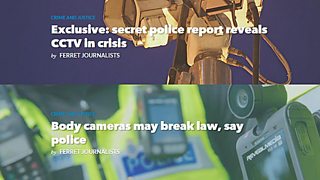
Investigations into surveillance cameras are among stories already published
Evolution of multimedia
Our initial focus was on the practical; how could we tell good-looking stories on the internet? We ended up going with WordPress and using Aesop Story Engine, which has been developed with imaginative, multimedia storytelling in mind. We’re still testing its limits, but even at this early stage we’re publishing stories with visuals, interactive maps and data that rival (and, I’d say, sometimes surpass) those being offered by national media groups. We hope to get better and better at using different techniques to enhance our features, although at the heart of each must still be a cracking story.
Funding model
We successfully crowdfunded our first major investigation package – into fracking – on Indiegogo. We made well over 200% of our original target and this will allow us to look into the treatment of people seeking asylum in the UK, the public’s second choice topic. Both packages will come online in 2015. In the meantime, we are gathering subscribers and looking at ways to make sure we offer added value to them. Until we publish our major investigations, we have been publishing one-off articles, which have already gained us a good profile in Scotland.
Like most media organisations, the burning question of sustainable funding has no one right answer and we will aim to fund our work through a combination of income streams. It won’t be easy, but the appetite for public interest journalism in Scotland looks to be pretty ferocious, and that is in our favour.
After lengthy discussions – and of course some consulting with the public – we decided to brand ourselves The Ferret. It’s a memorable name. Much like us, ferrets are pleasant but tenacious. We now have a great graphic designer, Jo Skinner, on board, whose ferret logo has captured the public imagination and made Ferret badges cult accessories… honest!
Public goodwill and support has helped get us to where we are now – funded to run two major investigations shortly that we hope can make a real difference to the political landscape. We are planning a conference in the next few months with major speakers and workshops, aimed at supporting the journalist community in Scotland. As many of Scotland’s newspapers struggle to survive, it’s more essential than ever to keep nourishing journalism in Scotland. Who else will nose up the trousers of power?
The BBC does not endorse any of the online products mentioned in this article.
Rachel Hamada is a freelance journalist with a special interest in social justice and human rights. Top image courtesy of David King.