
Is there an African property boom?
While the property market in some parts of the world is slowly showing signs of recovery from the global financial crisis, Africa's is said to be thriving.
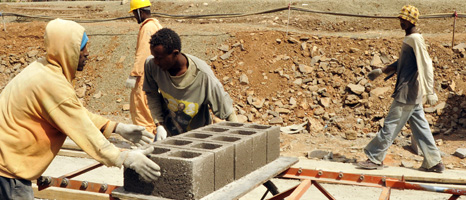
Egypt, South Africa, Kenya and Sudan are just a few of the countries on the continent where real estate is booming.
Many local and foreign companies from the United Arab Emirates, Qatar and Malaysia are investing in Sudan's real estate, attracted by a boom fuelled by rising oil production. Small buildings are disappearing and new high-rises are being built in their place.
Investment analysts say there is renewed interest in the South African market following its successful hosting of the football World Cup.
But how is this demand for property affecting ordinary people?
How is the property market faring in your country? How easy is it to get on the property ladder ? Has the rise in property prices affected you? If so, how? Is Africa's property boom sustainable?
If you would like to debate this topic LIVE on air on Wednesday 27 October at 1600 GMT, please include a telephone number. It will not be published.


Comment number 1.
At 14:52 27th Oct 2010, blossomnigeria wrote:Is real estate booming in my country Nigeria, i think not, rather buildings are collapsing as a result of poor supervision. This is due largely to unskilled persons handling construction work to the high cost charged by skilled personnel's coupled with the high cost of building materials. Truth is, i wish it were in my country that there is property boom.
Complain about this comment (Comment number 1)
Comment number 2.
At 21:39 27th Oct 2010, caesarbbc wrote:The Kenyan Real estate is in the verge of taking off. This will be fueled by improving infrastructure, rising incomes as a middle class emerge, and untapped potential of the home mortgage lending. As the stock exchange develop the infrustructure nessesary for corporate bonds will emerge the introduction of REITS and other form of real Estate bonds. This will allow new investors take on big projects. As the units increase prices both rental and house prices will stablize. People will move to better newer, more modern, units raising standards of living for all. In this process the poor are benefiting by the jobs in the construction industry
Complain about this comment (Comment number 2)
Comment number 3.
At 04:36 28th Oct 2010, yinks wrote:One is indeed struck by the resilience of the Nigerian real estate market.My unprofessional analysis identified several possible contributory factors.I am intrigued and continue to study the market especially in Lagos and Abuja.
1.Paradoxically, the absence of a mature banking industry with poor access to mortgages has been a positive for real estate. I have been informed by a lot of property owners that they paid for their properties in full and as such are not subject to whims and caprices of banks.The limited access to mortgage financing limits the number of potential investors thus allowing those with the funds to prosper.Owners dont rely on refinancing or "cashing out equity" as we do in the west--(they dont need to--a lot of properties in even middle class areas generate impressive cash flow to fund additional ddevelopment.
2. huge demand for even marginal properties across all "product lines"--residential homes,apartment buildings,retail,office properties and hotels.
Practically all segments of the real estate industry are under-developed for a country with 150 million citizens.This translates into low vacancy rates and higher margins for property owners.
3.Landlords command fairly hefty rents and in some cases, "cash on cash" returns( a real estate investment term) are 50% or more annually such that a property can be paid off in as little as 5--10 yrs vis-a vis a 30 yr mortgage or 10--15 yr commercial loans in the Western countries.
4. Influx of foreign money--from 'NIDs' (Nigerians in diaspora) and foreign investors alike helps keep prices up.
5.Expat tenants---oil companies and oil service companies in Lagos and P/H,businessmen in Abuja,etc provide a steady stream of clients willing to pay top naira for the right property thus justifying the high rents in high brow areas like Lekki, etc and fuelling construction boom to meet "demand".
Just my 2 cents...
5.
Will It crash? Hard to tell --I expected a steep decline in prices or even a hard landing after the twin whammies of the "world financial crisis" and Nigeria's own stock market implosion/banking crisis, but it didnt happen(i told you im not a professional!). One is left with the impression that the market is so undersupplied that prices will remain high for quite some time due to the simply amazing demand for real estate from the local population and expatriates which trumps any and all negative factors including high local unemployment,poor transport networks,poor infrastructure
Complain about this comment (Comment number 3)
Comment number 4.
At 08:17 28th Oct 2010, akmuhumuza wrote:Definately, there is a heavy property boom in Africa at the moment! Leave alone Agriculture which used to be the number one major economic producer! Alot of Arable and productive land has already been allocated to real estate dealers and property masters for development into satelite cities, towns and industrial parks! Property investiment remains the leading investment ground for both local and foreign investors attracting huge somes of money for the African governments in form of revennue collection and employment opportunities!
Complain about this comment (Comment number 4)
Comment number 5.
At 08:57 3rd Nov 2010, David wrote:Construction booms mean that financiers see a problem with the local economy so the safe hedge is bricks and mortar!! Standard banking proceedure.
But building is also a way to clean up dirty funds ie Large percentage of legitimate funds mixed with dirty money and then you can say you built economically but in real terms the costs are the costs.
A forensic audit of the real costs to build will show the variance!!!
Complain about this comment (Comment number 5)