
Are African nurseries too academic?
Do you have children in an African nursery or creche? Are you worried about the type of education they are getting?
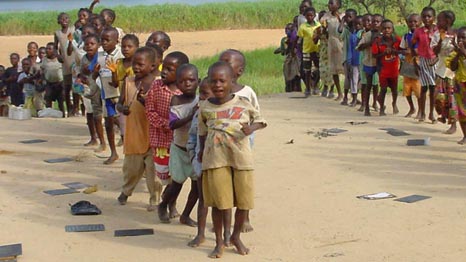 BBC Africa HYS listener Anne Mayanja from Uganda contacted us to suggest we discuss early childhood education in Africa.
Anne says the learning that toddlers receive between ages 1-5 is too focused on pushing academic achievement, while ignoring the child's personal, social and emotional development in those formative years.
In her opinion, this could harm the continent developing knowledgeable but well rounded future leaders. Do you agree with her?
In Norway for example children only begin to learn how to read from the age of 7. Would you like to see African nursery schools adopt a similar practice?
Is there too much focus on academic work and not enough social interaction for Africa's toddlers?
If you would like to debate this topic LIVE on air on Wednesday 25 August at 1600 GMT, please include a telephone number. It will not be published.


Comment number 1.
At 21:41 24th Aug 2010, George Oyeho wrote:Ann has a point. Early childhood development (ECD) is intended to help kids socialize and build interpersonal and group skills. It is true many ECD instutions may be challenged and African countries Education Ministries should take over the portfolio of ECD from social services and bring it into the main stream of education. Under the education docket the curriculum will be monitored and made uniform accross the board and the governments will take responsibility for the child development.
Focusing the little kids on academics end in route learning. However, the Montessori system seem to be working and may provide a good starting point.
Complain about this comment (Comment number 1)
Comment number 2.
At 21:59 24th Aug 2010, BOLA wrote:There probably is an element of truth to what the writer has stated, however, i would still beg to differ. The emphasis on academic knowledge/ achievement is what makes us who we are, if the continent was stable and conducive to development then i believe that the benefits of such a programme would/ could be seen, unfortunately, because of the mess that most of Africa is in our best brains have to flee and go to the west. Professors, Chike Obi, Chinua Achebe, Wole Soyinka & Ayodele Awojobi, to name a few of Africa's academic greats did not go through the " touchy feely" development that we all to often foist upon society, they have left their mark on the academic world and are/ were extremely well rounded.
Our toddlers have ample social interaction compared to most of their Western peers who are more often than not to be found sitting in front of their PC's and games consoles, devoid of any social skills and getting fat
I am often amazed when conversing with students and graduates who allegedly have been to school and have gone to university in this country, they may have had a " touchy feely" upbringing, but their knowledge and grasp of the English Language is shocking, comments such as " was you there" as opposed to were you there? or he "come on the pitch" instead of he came on the pitch, a new one one i heard recently was " I was conversating" i assume that was meant to imply i was conversing, seems to be the norm.
African kids might not have a " touchy feely" education/ upbringing, but a least they can speak read and write English better than most that have this " touchy feely" upbringing.
Great strides have been made in the West with regards to equality and raace issues, however, the adage that we as people of colour have to work twice as hard as those of a lighter hue still rings true, therefore the emphasis on academic excellence.
Complain about this comment (Comment number 2)
Comment number 3.
At 22:19 24th Aug 2010, Massawa wrote:[Personal details removed by Moderator]The learning most African toddlers receive between the ages of 1-5 is definitely not focuses on pushing academic achievement. In fact, due to lack of resources most African mothers carry their infants with them while fetching water from surrounding areas, searching for fuel fodder or simply preparing food or cleaning the house. They do not have the luxury, and in some cases the education, to press their kids for academic achievement.
African culture unlike Europe's is a communal culture that inherently satisfies the social needs of the community through different outlets allowing the personal and emotional development at different stages. Therefore, in my view to suggest African children's personal, social and emotional needs are ignored is ludicrous. On the contrary, what is needed is more resource to organize communities to be able to educate their children using visual objects like books or PCs and also assist them with nutritional necessities to permit them to focus on academic achievement that in turn would allow the continent to progress.
Complain about this comment (Comment number 3)
Comment number 4.
At 00:17 25th Aug 2010, Audu wrote:Education is the all round development of the individual. Therefore if any part of the individual is left out that person is half-baked. Anne's observation of the danger inherent in childhood education in Africa is correct. Children in Africa deserve the type of education that is a balanced one for a better future of the continent. However, the problem with us (Africans) is that we want to see how fast our children are learning since they are going to school. No school proprietor may like to buy the idea of developing the child's personal, social and emotional life because most parents are likely to refuse sending their children to such a school. The Norwegian approach is a better option to me.
Complain about this comment (Comment number 4)
Comment number 5.
At 00:54 25th Aug 2010, Elizabeth Kuranchie-Mensah wrote:[Personal details removed by Moderator]I would like to know whether Anne conducted a research and that was the findings she came up with. If it is something she has observed from some nursery schools around her country, I think it doesn't cut across the whole of the African Sub-region.
I believe that the social,personal and emotional development that Anne was referring to are all embedded in the academic terrain.In my country(Ghana),a K.G(kindergarten) will be taught how recitation of rhymes and learning of alphabets and figures.Their teachers mostly allow them to sing with such things they are being taught. Is it not a social activity?Let us consider the sort of activities or things that take place during that period-as they sing,they will be clapping their hands, tapping their feet and sometimes dancing!They are performing academic activity.
I suggest Anne should take the whole of Africa and undertake a research so that when she comes up with her findings, I will be able to weigh it and see how true the findings relate to what she is referring to because I have a niece who is about one and half years old and she can really sing some hymes that I can't sing.She has never been to any creche or nursery or kindergarten before,this means that she didn't learn anything she sing or say from school but from the home!
Complain about this comment (Comment number 5)
Comment number 6.
At 00:56 25th Aug 2010, Elizabeth Kuranchie-Mensah wrote:This comment was removed because the moderators found it broke the house rules. Explain.
Complain about this comment (Comment number 6)
Comment number 7.
At 01:54 25th Aug 2010, Kilz wrote:Africa is aimed at raising our tomorrows' leaders the best that they can by applying these necessary majors in impacting knowledge to this toddlers from the early age. English like we Africans say is a borrowed language, not everybody get to blend with communication status generally as English is widely used in our everyday interaction rather than our mother-tongue.
In African schools, students caught speaking 'venakula' (Pegin English or Native Language) paid heavy fines to the disciplinary committee and sign undertaking that next time if caught, they'll be suspended or dismissed.
In summary I'd say people should adapt this mode of education for their young lads as we know, people are different and not every child get to catchup even after this day care n creche system.
on the other hand most parents are too busy with their occupation and can leave their babys alone at home so the creche and day care in school happens to be a very big solution in resolving that problem.
Complain about this comment (Comment number 7)
Comment number 8.
At 03:18 25th Aug 2010, adah john wrote:yea! that is true. toddlers are given more than their
brain really can retained. my brother kids are kept in
in school after the normal school hour for lessons by their
teachers who want to make extra pay, thereby denying the
children the essential of their life. keeping children for
too long does not guarantee wisdom, knowledge or inteligence.
playing is part of their development that can help them to
dicover so many things. hence children study more than adult
in Africa. this must stop!!!!!!!!!!!!!!!!!!!!!!.
Complain about this comment (Comment number 8)
Comment number 9.
At 05:08 25th Aug 2010, JanErde wrote:My daughter, who just turned 4, has spent one year trying to learn basic figures and letters. Why such a waste of her time when she'd learn this at high speed when she's a bit older?
My daughter came home one day, saying she did not like the teacher, and she did not like number 2. "Always number 2, number 2..." Now she's daunted because she's going to start reception class in September. More numbers and letters!
Sometimes my heart is bleeding because she's such a social person, such a creative spirit, but in school they think she is quiet and lacks confidence.
Early learning should be about honesty, integrity, tolerance, curiosity and all those life skills that she will need a lot.
Christine K, Nigeria
Complain about this comment (Comment number 9)
Comment number 10.
At 13:08 25th Aug 2010, omeje wrote:[Personal details removed by Moderator]CAN I SAY THAT OUR PROBLEM IN AFRICA IS COPYING WHAT WE SEE WORKING IN DEVELOPED WORLD WITHOUT KNOWING HOW SUCH POLICY WAS PUT IN PLACE FOR THAT. A CHILD WHO DOES NOT FOLLOW HIS CLASS MATE IN THE CLASS WHILE THE TEACHER IS GIVING OUT IS BOUND TO MAKE MISTAKES WHILE TRYING TO COPY THE SAME FROM COLLEAGUES AND HIS LITTLE SENSE MAY TRY TO ARGUE WHO IS PUTTING HIM RIGHT. WHEN CHECK THE TIME THESE CHILDREN SPENT IN THE SCHOOL THEN YOU ALSO ASK YOURSELF WHAT INPUT HAVE THEIR TEACHERS INJECT IN THE LIFE OF THESE CHILDREN . NOT DUMPING THESE CHILDREN FOR HOURS IN THE SCHOOL OR A CHILD OF THREE YEARS BEEN FORCE TO GO TO SCHOOL THAT MATTERS BUT DOING THE RIGHT THING. MANY OF THEM HAVE GOOD PLACE LEARNING,NO MATERIAL FOR TEACHERS .SO WE SHOULD KNOW THE RIGHT TO DO NOT COPYING WHAT WE FELL THAT IS WORKING ELSE WHERE
SYLVESTER DARFUR SUDAN
Complain about this comment (Comment number 10)
Comment number 11.
At 14:38 25th Aug 2010, LIFTer24 wrote:First of all, Anne does have a valid point in saying that during our early childhood development we ought to be focused more on our social and emotional growth than on our educational growth. But I also want to take a stand for the opposing side and say that, having grown up in Uganda, I have noticed on multiple occasions that the educational system in the country is not as strong as it could be. Therefore, perhaps we should be more concerned about the quality of the education rather than the quantity. Personally, I see a large need for stronger, better teachers in the country--teachers who are more concerned about their pupils' education than they are about their own paychecks. That has definitely been a problem in Uganda.
Complain about this comment (Comment number 11)
Comment number 12.
At 15:41 25th Aug 2010, Tat2 wrote:My first question is what is African nurseries? Are we making an assumption here that Africa with nearly 53 countries (if you include the islands of Madagascar, Cape Verde etc)is a homogeneous continent. I have a problem of lumping Africa into having the same experiences and then compare the vast different experiences to one Western Country e.g UK or Sweden. This makes the whole assumption being made here of African nursery experiences flawed.
When you look at the history of education in most African countries, it depends on the influence from whether its a former Portuguese, French or British Colony and the time each country has been independent. So when you look at nurseries one has to consider a lot of factors. A very small percentage of children in most African countries attend nursery and the emphasis of learning/activities varies even in one individual country for those children who attend nursery.
This issue is a debate for all countries not just 'African Nurseries' In the UK for example you have Early Years Foundation stage which not only put emphasis on physical development, communication/language but on numeracy and literacy. How this is delivered varies from individual nurseries as long as they meet the OFSTED inspection criteria which tends to be the focus these days. Some nurseries from my experience tend to just let children do their own thing while some nurseries are more structured and let children learn to read & write especially at 4+ .
When you move further to children who are 5+ there are still given pressure to perform well in maths, english, science and league tables are now the key in measuring children's attainment of English, Maths, and Science and measuring the quality of a school.Again this method does not either tell you much about education as I don't believe education is only about reading and writing or neither does it tell you much about a school. Yes its important to read and write but a child need to be rounded in all aspects of life and a school should also be able to offer variety e.g values, discipline, general knowledge regardless of whether its in Africa or Europe.
Complain about this comment (Comment number 12)
Comment number 13.
At 17:46 25th Aug 2010, Diane wrote:I work in Northern Malawi where early childhood education is in the early stages of development itself. We have community based childcare centres in villages where the academic level of the caregivers is low - the only learning they themselves undertook was rote learning at primary school and so this is what they believe children need. Added to that is the pressure from parents who want their children to read and write before going to formal primary school at 6 years. However, as an early childhood educator, it is important that children play, and have fun before early learning begins. Children learn through their senses, they experiment, they explore and they learn all by themselves. They need guidance of course but not formal learning before primary school. Social and emotional development is part of the learning process at nursery school as children play with each other. Parents need to be sensitised on the way children learn and how they can assist them at home. Children need outdoor as well as indoor play. It must be emphasized that children learn at different stages - one three year old will learn at a different pace from another three year old, and that is normal!! We make many learning materials from natural resources, we don't need a lot of money to have resources - the whole idea is to have lots of materials available to allow the child to teach himself! Training for caregivers is what is necessary in Malawi so that they understand the meaning of early childhood development!
Complain about this comment (Comment number 13)
Comment number 14.
At 23:17 25th Aug 2010, lee wrote:well this is stupid , just because our continent still acknowledges that education is very important doesnt mean they are taking it too far, i went to a primary school in zimbabwe and never found anything too challenging and then to my surprise i came to england and they were still learning the things i had learned a year ago.
And as for the norway comment its ridiculous that a child should reach the age of before knowing how too spell they're own name.
in conclusion i find this atticle highly offensive because if anything it should questioning the education in europe
xx:D xx
Complain about this comment (Comment number 14)
Comment number 15.
At 23:23 25th Aug 2010, lee wrote:when you were writing this i hope you knew that africa is a continent and can not be judged bu just looking at one country if you even looked at one,
and i would also hope that you have evidence to prove your conclusion, and im also wondering if you took it uppon yourself to ask some of the children how they felt about it ?
i think you should learn to get your facts right first .
Complain about this comment (Comment number 15)
Comment number 16.
At 23:32 25th Aug 2010, lee wrote:This comment was removed because the moderators found it broke the house rules. Explain.
Complain about this comment (Comment number 16)
Comment number 17.
At 09:33 26th Aug 2010, lsk2010 wrote:I am from the UK but currently living in Zambia and my 3 year old son goes to a local nursery here. I am confident that he is getting a lot of skills in terms of socialising with other children (there is a real family feel about the nursery) but I am concerned that there is an over-emphasis on formal education. There is nothing wrong about introducing numbers or letters at an early age (we all do this instinctively from a very early age with our children – counting the stairs as we climb them, spelling out words etc) but the problem with the approach used to teach new skills and information. My experience has been that a very old-fashioned and strict approach is used (learning by rote, endless colouring in instead of free drawing, etc) rather than the more creative techniques that teach children how to learn, how to think critically, how to find out the answers for themselves through playing, experimenting and generally acting like toddlers and young children. I’m not suggesting that Northern Europe has all the answers but I think we need to be careful that we do not crush creativity, a desire to learn and critical thinking in our impatient desire to educate our children.
Complain about this comment (Comment number 17)
Comment number 18.
At 11:07 26th Aug 2010, Dreamss wrote:Anne has not painted the true picture of early childhood education in Uganda. The early schooling involves games, singing as well as some academic tasks such as learning the alphabet and numbers.. The games allow for interaction and development of social skills among toddlers. The children are also able to learn social skills at home, since they do not spend the whole day at school (children can also learn social skills later in life, there is no restriction in the time period for learning social skills; another possibility is that relevant social skills may be viewed differently in different culture as each culture has its own acceptable mode of communication). Probably, the focus on academic achievement in Africa is due to the fact that education is not free for all and is thus taken as a privilege, rather than a right. Different countries around the world also focus on academic achievement, as is shown by the constant discussion in their media about the grades attained by students in different schools, as well as the quality of the output of graduands from different universities in the work environment they eventually enter into.
Complain about this comment (Comment number 18)
Comment number 19.
At 16:24 26th Aug 2010, Echai Uchiba wrote:I think children at early age are just oriented to have an idea of pieces of issues not that there is a strict evaluation on what they are told.In Etwii-Ngie, we believe that "its good to a tree while at tender age" and you know age this age,children are quite flexible in pronounciing and imitating things or langauges.After all,at home they spend time playing in bushes and I think while in school, theya are introduced to better learning, hygiene and good behavior.Infact, in developed countries, they speak GOOD Engkish at homes while in most parts of Africa,only their dialects of "pidgin" while they even speeak everywhere and therefore must be introduced to good learning as a prerqquisite for success. After all the children do not complain by themselves instead most are proud when they can count and speak English to reount on daily activites.
Complain about this comment (Comment number 19)
Comment number 20.
At 16:41 26th Aug 2010, Franck wrote:I think Ann has a point. There is a lot of emphasis on an African child education but i cannot agree with her claim that child's personal, social and emotional development are ignored. As a child that went through the African education system, I still had a lot of chances to socialize and I was fine in my later years. I think the reason why African child's are pushed so much during their earlier years is because of the influence and the success that developed countries have on us. We want our kids to succeed and make our countries better when they grow; too bad we do not have the necessary resources to get to that point. Therefore we push our kids at a really young age to start learning in hope to have a head start in being successfull. We cannot afford to have our kids to learn how to read at the age of 7 because by this age most africans kids are a few years away to be considered adults.
Complain about this comment (Comment number 20)
Comment number 21.
At 18:54 26th Aug 2010, pauloa wrote:I attended Nursery school in Kenya which has a similar system as Uganda. I have to disagree about this. I have been lucky enough to travel the world and I see no fault in the way African pupils are taught in highly educated populations where a minimum of 70,000 graduates leave universities every four months it is important to instill these values at a young age. Children have time to socialize long after school in done for the day and this usually at 12.45pm for Nursery pupils. A strong educational base actually does lead to a stable and consistent school career. The children being children will adjust to the education and will also still find time to develop socially and indeed also develop their personalities based on their school performance, peers,and home structure. In why fix a working system
Complain about this comment (Comment number 21)
Comment number 22.
At 22:08 26th Aug 2010, Emmanuel wrote:The general purpose of schooling is to allow parents the time to work with the knowledge that their kids are in a safe environment, and a way to make sure that their time is well spent is to educate them.
In the west, you see mothers and parents struggling to place their children in day care. Regardless of the pros and cons, it answers the questions of how that parent is going to continue to work and provide for the family, especially in countries not known for having flexible work environments.
As someone who went through that standard and somehow turned out fine, I don't see the harm, I was still able to tell the difference between violent video games and reality, unlike some of my more afluent western contemporaries.
The point is, africa is a 3rd world country for a reason, therefore not privy to the luxury of a later, more relaxed educational regime. Give us 1st world status and then the comparison will be valid.
Complain about this comment (Comment number 22)
Comment number 23.
At 00:43 27th Aug 2010, Fula Elanga wrote:I agree some african countries (in my case Cameroon) lay more emphasis on academics in early childhood education. Why? I think now in Africa a good academic education is one of the best, and mostly the only way to survive in Africa. Meaning your chances of getting a scholarship (and subsequently leaving the continent)are great. So Parents tend to put their kids under this pressure from the 1st day of Kindergarten. If the child does well (i.e if he can master the alphabet and multiplication tables at an early age) the next step will be making him skip a class in order to take his G.C.E Exams as fast and early as possible. The Aim: Getting a degree as fast as possible and start working to support the family. I had this experience.I remember back in those my early school days(age 5-7yrs old by then) the first question i'm asked during holidays is which position did i finish in school etc. Thaw was all that mattered. No Ratings for social, emotional development. Just the arithmetic, Spellings etc
Having a good academic, social or emotional foundation i thinks relies on how skilled the teachers are. And this varies from school to school and country to country.
Complain about this comment (Comment number 23)
Comment number 24.
At 10:38 27th Aug 2010, derele wrote:Mere seeing the picture above, I am convinced this writer already had a biased opinion. There is no point seeking people's view when your point of view is already clouded with preconceived negative ideas. I did my nursery, primary and secondary studies in Africa. I participated in many sports like Volley ball, handball,tennis, basket ball, ping-pong, badminton,soccer(of course),athletics and gymnastics. I cannot remember numerous sports we were introduced to with adequate facilities and yet these schools were in rural South West of Nigeria. There were many moral values inculcated in us apart from rigorous academics. I enjoyed it and they make me who I am today! It is high time BBC stopped this dirty tricks of painting Africans as primitive humans.
Complain about this comment (Comment number 24)
Comment number 25.
At 22:15 27th Aug 2010, Fred Otieno wrote:In a continent where academic achievement is glorified and a good grasp of the queen's tongue is enough qualification for a parliamentary seat,Anne's observations could not be entirely wrong.However,if she did some research then my country Kenya was not one of her samples.Here the caregivers have done a good job so far.They know how to balance academic and the childs social and emotional development.This success story has seen many people struggle to register their children with ECD centres and today ECD is one booming business.This has however led to exaggerated costs which in turn drives away children from poor families.I know of a particular ECD that charges ksh.12000 for a three month term.This is the state of things in kenya.The tragedy with this trend is that in the end all round education remains a preserve of children from rich families.I therefore support the thinking that ECD's should be brought under Education ministries and if possible Early childhood development should be included in the free basic education package.This would not only check the quality of learning but also nip in the bud the further widening of the gap between the rich and the poor.
Complain about this comment (Comment number 25)
Comment number 26.
At 19:43 29th Aug 2010, Kolawole Ajao wrote:Not just too academic, but too unnecessary and uncalled for! I see a lot of parents getting enmeshed in that mania every day. The hype has grown beyond control. Except government places a barrier across it I don't see it dying. If Africans had their way, I opine they would want their 10-year old wards in Harvard and Cambridge studying medicine or law. The craze actually erupted like volcano in Nigeria around the late 1980's, when private school owners harped upon bad government policy on education. I can bet it with anybody that pupils are no longer getting the right education at the elementary level. The case gets worsened by the new rush by parents to enrol their children at school as early as 3.
Complain about this comment (Comment number 26)
Comment number 27.
At 20:14 5th Sep 2010, mossy wrote:This comment was removed because the moderators found it broke the house rules. Explain.
Complain about this comment (Comment number 27)
Comment number 28.
At 11:56 15th Sep 2010, Vernon wrote:I agree with Anne. I was raised in Zambia and Zimbabwe and I got my childhood education from both of these countries. At the age of 3 I entered pre-school and by the time I was 5 years old I could read and write. I was privileged to complete my elementary and high school as valedictorian but my social life had proved to be a mess. I would say my life is imbalanced. My parents, who happen to be lecturers, always emphasized the need for education and its importance in life. They always explained to me that education is the only key to success in life. I may be a genius in the classroom but I am a failure outside the classroom because education is the only thing I've known. I never found free time to play around and develop the other aspects of my life.
Too much of anything is bad. Though the current education system helps children get educated, it is a little too strong. I analyzed the education system in the Philippines where I'm currently studying. Everything here is different. I was looking at the materials that the children here study during Elementary School years and during their high-school and I noticed that we put too much pressure on children in Africa at an early stage.
Though we love education, we might end up producing children who are too focused educationally and socially dull. I think the education system should change.
Complain about this comment (Comment number 28)